Berkshire Hathaway Hits an All-Time High: Here’s What $10,000 Invested a Year Ago Is Worth Now

This post may contain links from our sponsors and affiliates, and Flywheel Publishing may receive compensation for actions taken through them.
Berkshire Hathaway (NYSE: BRK-B | BRK-B Price Prediction) Class B shares hit an intraday all-time high of $596.92 on November 12, 2026. At $595.48, the stock is trading near that record. A $10,000 investment made a year ago is now worth $11,605. Berkshire paid no dividend over that year, so the price gain is your entire return. Over the past 52 weeks, shares ranged from a $464.01 low on April 16, 2026, to a peak on November 12.

Berkshire Erased Its Post-Buffett Slump
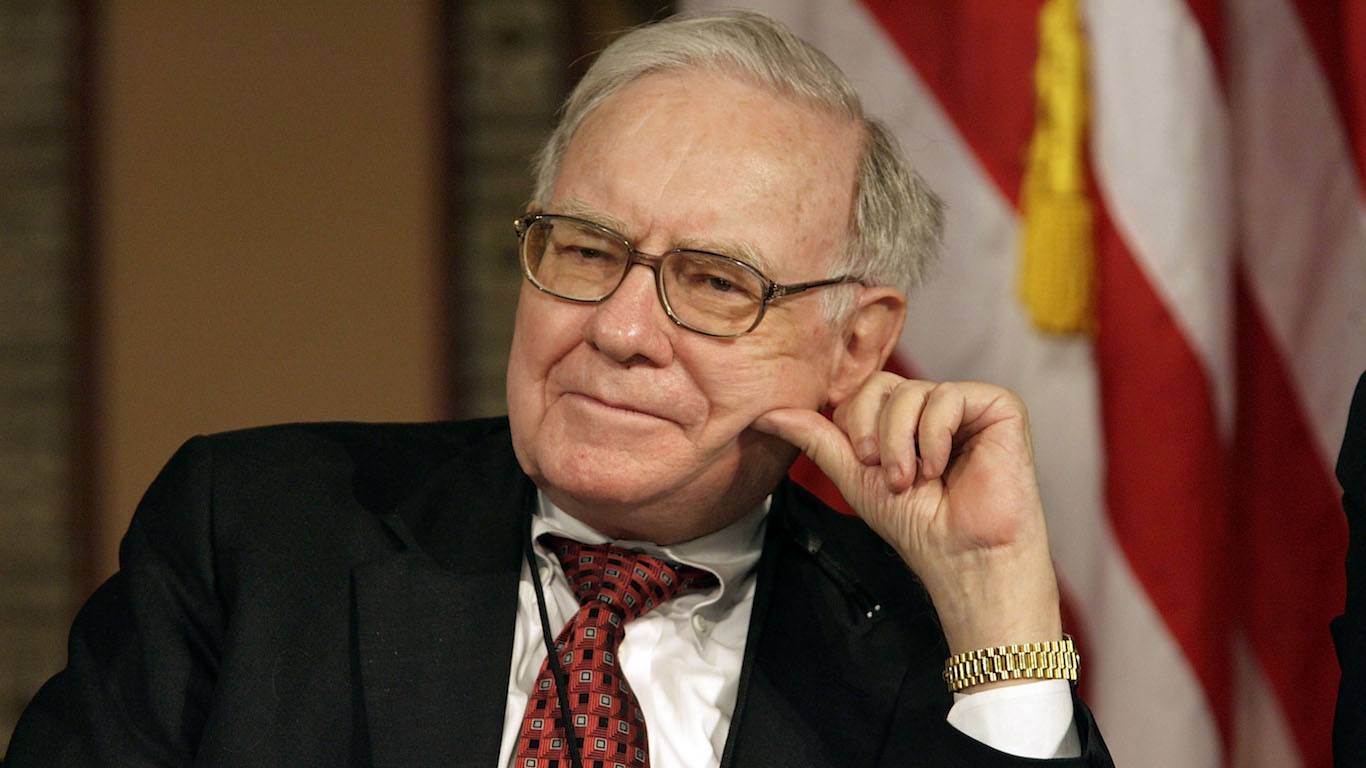
Warren Buffett’s May 2025 announcement that he would step down as CEO hit the stock hard. At the August 2025 low, B shares were down almost 15%, CNBC reported. Greg Abel took over as CEO, and 2026 is his first full year[1] in the role.
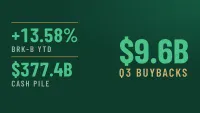
Under Abel, Berkshire has started putting its cash to work. In Q3 2025, it held a record $381.6 billion[2] in cash and bought back no stock. In results reported August 11, 2026[3], Berkshire was a net buyer of stocks for the first time in more than three years, investing about $23.5 billion and repurchasing roughly $4.5 billion of its own shares. Abel also bought $15 million[4] of stock personally.
Late-October coverage tied the new highs to that shift. On October 24, CNBC reported the shares had fully recovered their post-announcement losses, while investors rotated out of AI-heavy tech and into Berkshire’s defensive mix of GEICO, BNSF and Berkshire Hathaway Energy.
If you want to copy Buffett’s homework while Abel acts on it, we pulled the seven cheapest dividend payers still inside Berkshire’s own portfolio into a free report you can grab here.
Berkshire Beat the S&P 500 Over All Three Periods
1-Year Return
- Initial Investment: $1,000
- Current Value: $1,160.50
- Total Return: 16.05%
- S&P 500 (same period): $1,118.50 (11.85%)
5-Year Return
- Initial Investment: $1,000
- Current Value: $2,082.20
- Total Return: 108.22%
- Annualized Return: 15.80%
- S&P 500 (same period): $1,608.60 (60.86%)
10-Year Return
- Initial Investment: $1,000
- Current Value: $3,781.80
- Total Return: 278.18%
- Annualized Return: 14.23%
- S&P 500 (same period): $3,443.50 (244.35%)
The five-year gap is the largest of the three periods. The S&P 500 figures come from the SPDR S&P 500 ETF Trust (NYSEARCA: SPY) price, so they exclude index dividends and slightly overstate Berkshire’s lead.
Timing counted: anyone who sold during the 2025 decline missed the recovery. The bulk of the past year’s gain also came late: the stock rose 13.13% in the last month alone.
Valuation and Near-Term Risks at a Record High
The long-term case rests on whether new spending keeps earnings growing. Operating earnings rose to $12.98 billion[3] from $11.16 billion a year earlier. With the stock at about 12 times earnings and 1.16 times book value, it looks reasonably priced.
Near-term risks remain. That 13.13% monthly jump came while the S&P 500 fell 2.33%, so the stock looks stretched in the near term. Abel’s record as CEO is still short, and the latest quarter’s EPS of $5.9381 missed expectations of $6.1353.
The long-term outlook depends on Abel keeping that earnings growth. I laid out the fuller case for why Berkshire Hathaway is my #1 stock pick.
Contact [email protected] for any questions or corrections.
Lee Jackson has covered Wall Street analysts' equity and debt research and equity strategy daily for 24/7 Wall St. since 2012. His broad, diverse career, including a stint as creative services director at an NBC affiliate in Austin, Texas, gives him unique insight into the financial industry.
Lee Jackson's journey in the financial industry spans more than 30 years, including nearly two decades as an institutional equity salesperson at Bear Stearns, Lehman Brothers, and Morgan Stanley. His career spanned pivotal sell-side Wall Street events, from the dot-com rise and bubble to the Long-Term Capital Management debacle, 9/11, and the Great Recession of 2008. This reflects his resilience and adaptability amid market volatility.
Lee Jackson’s practical financial industry experience, gained through a career at some of the biggest banks and brokerage firms, is complemented by a lifetime of writing across various platforms. This unique combination allows him to shed light on the intricacies of Wall Street in a way only someone with deep insider experience and knowledge can. Moreover, his extensive network across Wall Street continues to provide direct access for him and 24/7 Wall St., a privilege few firms enjoy.
Since 2012, Jackson’s work for 24/7 Wall St. has been featured in Barron’s, Yahoo Finance, MarketWatch, Business Insider, TradingView, Real Money, The Street, Seeking Alpha, Benzinga, and other media outlets. He attended the prestigious Cranbrook Schools in Bloomfield Hills, Michigan, and has a degree in broadcasting from the Specs Howard School of Media Arts.