“The Biggest Competition For Capital I Have Seen in 50 years in Finance,” Larry Fink Sounds The Alarm As Public Worldwide Debt Hits $110 Trillion, While $13 Trillion Of Corporate Debt Must Be Refinanced In The Next 5 Years

This post may contain links from our sponsors and affiliates, and Flywheel Publishing may receive compensation for actions taken through them.
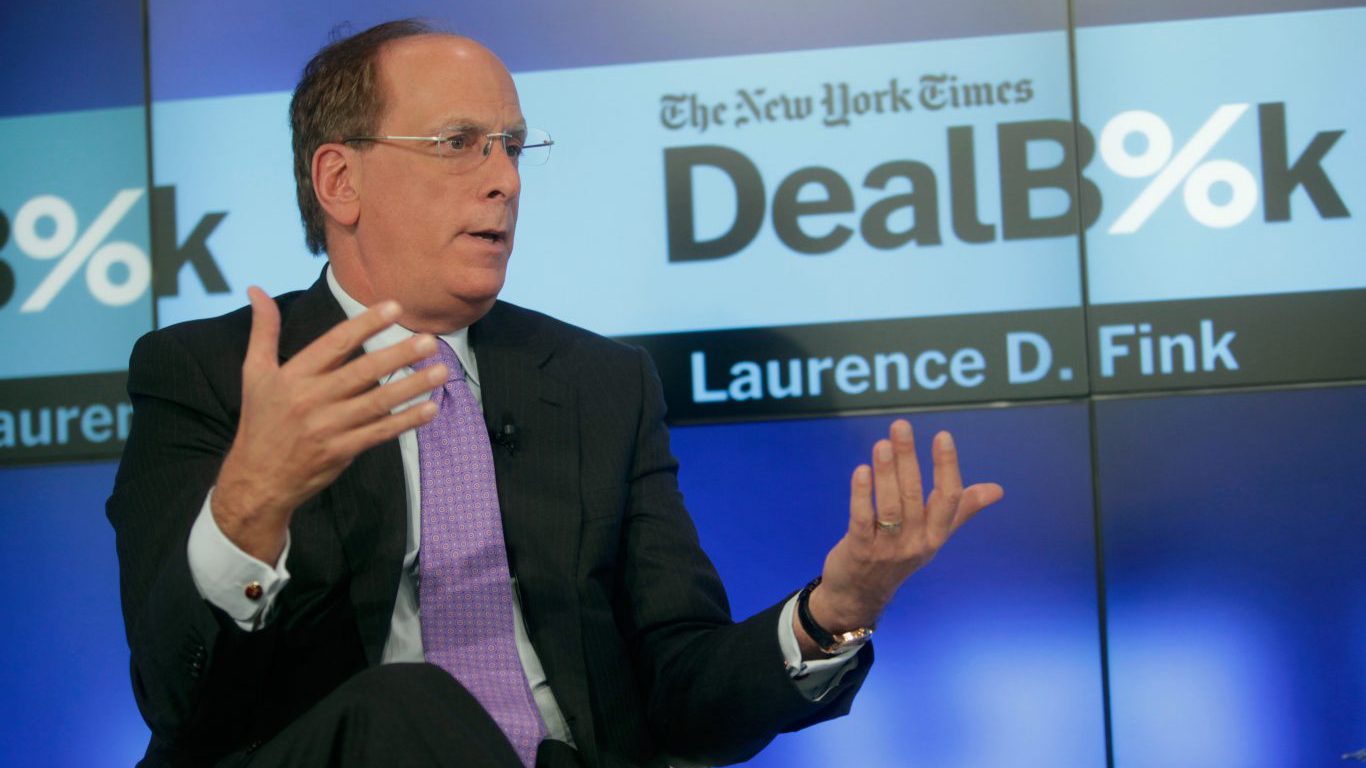
BlackRock (NYSE:BLK | BLK Price Prediction) chief Larry Fink calls the current moment “the biggest competition for capital I have seen in 50 years in finance.” He wrote the line in a mid-October Wall Street Journal opinion piece. That was weeks before The Telegraph’s Szu Ping Chan gathered the debt figures below for a Nov. 15 article arguing that the world faces a new credit crunch.
The Telegraph quoted Fink’s diagnosis: “Governments across the developed world are running huge deficits. That borrowing is now colliding with tremendous demand from the private sector, much of it from technology companies.” Households feel that hit in the price of money. The 10-year Treasury yield, the benchmark for mortgage rates, reached 5.10% on Nov. 12[1]. A year earlier it was at 4.13%[1].
Governments Have Added $40 Trillion in Debt Since the Pandemic
Institute of International Finance data cited by The Telegraph show that global public debt has rose by $40tn since the pandemic to $110tn. On BlackRock’s Oct. 14[2] earnings call, Fink said the result will be “structurally higher interest rates for longer, especially out the curve.”[2]
Companies Face a $13 Trillion Refinancing Wall
S&P Global Ratings, as reported by The Telegraph, places corporate debt worldwide at $26.4tn, with $13tn needing to be refinanced in the next five years. Szu Ping Chan reports that companies at greater risk of default must roll over $61.2bn of debt in 2027, a figure that rises to $222bn in 2028.
Those riskier borrowers carry speculative-grade ratings, meaning they are lower-rated companies often called junk. S&P Global Ratings data reported by ANI on Oct. 29 show annual speculative-grade nonfinancial maturities more than doubling to USD 588 billion[3] between 2027 and 2028, then peaking at USD 902 billion in 2031.
Companies have been getting ahead of the wall. The same report found borrowers “substantially reduced” speculative-grade debt coming due in the next two years. S&P Global Ratings says 2027 maturities fell 18%[3] between July 1 and Oct. 1, 2026. A large amount still comes due later in the decade.
Cracks Are Showing in Credit Markets
JPMorgan Chase (NYSE:JPM) CEO Jamie Dimon is described by The Telegraph as the longest-serving bank chief executive in America. He warned that government borrowing costs and AI spending risk spilling into corporate debt markets: “There will be a point where the market will ask for more and more and more, and at one point that’ll feed into corporate debt, corporate credit spreads and things like that.”
Szu Ping Chan reports that Brookfield (NYSE:BN) walked away from the Beaudry, a $600m residential tower in downtown Los Angeles, rather than refinance its $360m loan, citing “entrenched market challenges.” Bloomberg, as reported by The Telegraph, says more than $5bn of debt deals were shelved across the US and Europe in October. Goldman Sachs (NYSE:GS), also as reported by The Telegraph, says a quarter of US investment-grade debt issued in 2026 came from companies involved in AI.
Who Pays When Money Gets More Expensive
Higher refinancing costs can widen credit spreads and push up borrowing costs well beyond Wall Street. That matters for anyone carrying variable-rate debt or a large mortgage, and for anyone who owns a corporate bond fund. The average credit card rate was already 21.19%[4] in August, according to Federal Reserve data. Households between the median and the 90th wealth percentile hold 48.9%[5] of US home mortgages. The bottom half of households carries 51.6%[5] of consumer credit.
Arif Husain, chief investment officer and head of global fixed income at T. Rowe Price (NASDAQ:TROW), told The Telegraph who is most exposed: “Clearly, the people that will suffer most will be the ones that need to borrow the most. The bigger mortgages, [more] higher leveraged consumers, will be most at risk here.”
Contact [email protected] for any questions or corrections.
AJ spent 10 years writing about financial markets at The Motley Fool. His coverage centers on technology stocks and the broader macroeconomic trends, from interest rates to geopolitics, that shape where markets are headed next. AJ is drawn to the stories where big-picture economics and individual companies collide.