Wall Street’s 5 Safest Dividend Stocks Built for Any Market

This post may contain links from our sponsors and affiliates, and Flywheel Publishing may receive compensation for actions taken through them.
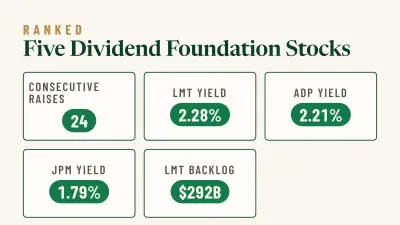
An income base is the core of a retirement portfolio: the small group of holdings you expect to pay you every quarter for decades, through recessions, rate cycles, and bear markets. That job places quality ahead of yield. It calls for durable free cash flow, conservative balance sheets, and a long record of raising payouts, because a dividend cut does more damage to a retirement plan than a modest yield ever will. Lockheed Martin (NYSE: LMT | LMT Price Prediction) sets the tone for this group after raising its dividend for the 24th consecutive year[1]. The other four picks cover payroll processing, money-center banking, and technology, so the foundation gets income from several parts of the economy.
Lockheed Martin: 24 Straight Raises Backed by a Record Backlog
Lockheed yields 2.28% at a recent price of $596.81, the richest payout in this bundle. The board just raised the quarterly dividend by $0.15 to $3.60 per share[2]. The quarterly rate has risen from $2.00 in 2018 to $3.45 before this latest increase.
Dividend safety: Trailing dividends of $13.80 per share sit well below trailing earnings of $28.16 per share. Cash flow backs that up. Lockheed generated $2.999 billion[1] of free cash flow in the third quarter alone and now guides to full-year free cash flow of $7.8 billion to $8.0 billion, after raising its outlook twice. On the third-quarter call, CFO Evan Scott said, “Our robust free cash flow supports investment and growth while simultaneously returning value to shareholders, reflected in a 24th consecutive annual dividend increase.”[2]
Why it belongs in the foundation: Backlog reached a record $292 billion[1] after a $52.5 billion PAC-3 MSE multi-year award, and Missiles and Fire Control sales rose 24% as PAC-3 and THAAD ramped up. Management described demand as “driven by the threat”[2] with bipartisan support. That much contracted work gives the dividend years of visibility, and the stock trades at about 18 times forward earnings.
Risk to watch: F-35 Lot 20 costs are running above current contractual authorization, which could pressure future results without added US Government funding.
Automatic Data Processing: A Fresh Raise From a Payroll Franchise
Automatic Data Processing (NASDAQ: ADP) yields 2.21% at $311.71. Last week, the board declared a quarterly dividend of $1.90, up from $1.70. That continues a rise from $1.04 a quarter in 2022, and ADP’s quarterly payment record runs back to 1999 in the available history.
Dividend safety: ADP paid $2,626.3 million[3] in dividends in fiscal 2026. In the same year, it generated $5.44 billion in operating cash flow and spent only $196.6 million on capital expenditures, leaving room for $2,083.3 million in buybacks in addition to the payout. Trailing earnings of $11.28 per share cover the $6.80 per share trailing dividend. Because the business needs so little capital, most of its cash can go to shareholders.
Why it belongs in the foundation: Payroll revenue repeats every pay period. ADP serves 1.1 million clients[4] and over 42 million workers. First-quarter fiscal 2027 revenue rose 6.1%[5] to $5.49 billion, adjusted diluted EPS came in at $2.82, and management now expects full-year adjusted EPS growth of 10% to 12%. Interest on client funds, forecast to be $1.59 billion to $1.61 billion[4], adds a high-margin income stream. CFO Peter Hadley said the plan is to “drop some to the bottom and to retain some to continue to invest in future growth opportunities.”[4]
Risk to watch: Management expects client revenue retention to slip by 10 to 30 basis points, slowing the recurring revenue base that funds the dividend.
JPMorgan Chase: Fortress Capital Behind a Growing Bank Dividend
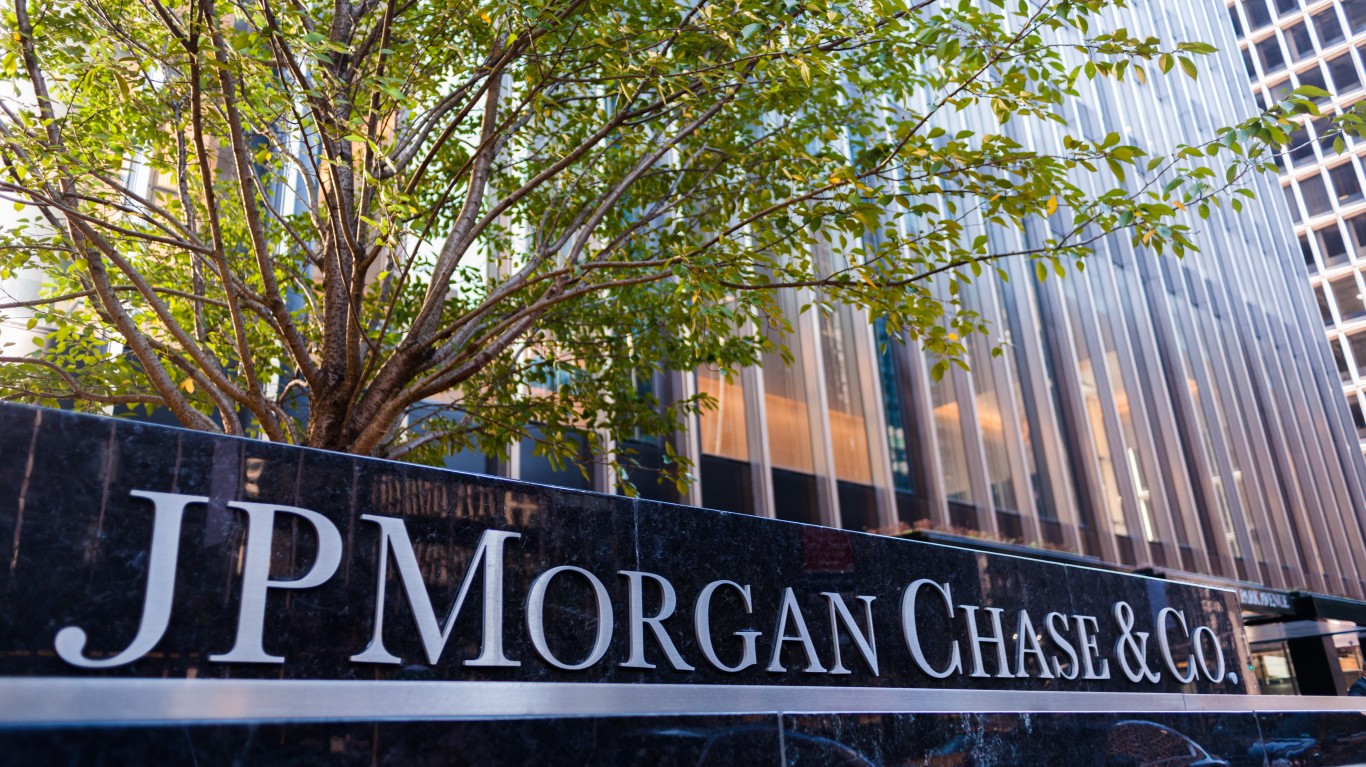
JPMorgan Chase (NYSE: JPM) yields 1.79% at $346.93. The quarterly dividend rose to $1.65 from $1.50 with the most recent payment. The payment history shows a steady series of raises from $1.00 a quarter in 2023.
Dividend safety: Trailing earnings of $23.84 per share far exceed the $6.15 per share trailing dividend. In the first quarter, JPMorgan paid $4.1 billion[6] in dividends against net income of $16.49 billion. For a bank, capital is the main safety net. JPMorgan reported a CET1 ratio of 14.3%, $572 billion[6] of total loss-absorbing capacity and $1.5 trillion in cash and marketable securities.
Why it belongs in the foundation: The largest US bank earned a return on tangible common equity of 23% in the second quarter, excluding the Visa and equity investment gains. It also authorized a new $50 billion buyback program, which reduces the share count and gives each remaining share more room to grow dividends. At about 14 times forward earnings, JPMorgan carries the lowest forward multiple in this group.
Risk to watch: Bank earnings move with the economy. Credit card net charge-offs ran at 3.33%, and nonperforming exposures stood at $11 billion, so a recession would push loan losses higher.
Microsoft: Cloud Cash Flow Funds a Rising Payout
Microsoft (NASDAQ: MSFT) yields 0.68% at $528.22. The low starting yield hides how quickly the income grows. The quarterly dividend steps up to $0.98 from $0.91 with this Thursday’s ex-dividend date. The regular quarterly rate has climbed from $0.08 in 2005.
Dividend safety: Trailing dividends of $3.71 per share are a small piece of trailing earnings of $19.16 per share. Fiscal 2026 free cash flow came in at $66.99 billion[7] on operating cash flow of $182.94 billion. The balance sheet is a fortress, with debt-to-equity of 0.29, net debt-to-EBITDA of 0.56, and interest coverage of 50.88x.
Why it belongs in the foundation: First-quarter fiscal 2027 revenue rose 18.8%[8] to $92.28 billion. Azure grew 48%,[8] and Microsoft Cloud grew 30%. Commercial remaining performance obligations reached $677 billion[8], revenue already under contract that supports future dividends. Microsoft returned $10.2 billion[8] to shareholders in the quarter and trades at about 26 times forward earnings.
Risk to watch: AI infrastructure spending is heavy. Capex reached $115.95 billion[7] in fiscal 2026 and $39.37 billion[8] in the latest quarter alone, and fiscal 2026 free cash flow fell 6.46%. Slower free cash flow growth could limit future raises.
Apple: A Payout Landing Today, Backed by Massive Cash Generation
Apple (NASDAQ: AAPL) yields 0.30% at $358.53, the lowest yield in this bundle. Its $0.27[9] quarterly dividend pays out today. The regular quarterly rate has risen every year in the recent record, from $0.22 in 2022 to the current $0.27.
Dividend safety: Trailing dividends of $1.06 per share compare with fiscal 2026 earnings of $8.98 per share[9]. Operating cash flow reached $145.10 billion[9] for the year against capex of $9.04 billion. Leverage is light, with net debt to EBITDA of 0.26. Apple pairs the dividend with heavy buybacks, buying back $62.094 billion of stock in the first nine months of fiscal 2026.
Why it belongs in the foundation: Fiscal 2026 revenue grew 15.06%[9] to $478.83 billion, and Services set an all-time high of $31.57 billion in the fourth quarter. In an income base, Apple is the dividend-growth anchor. The payout is small today, but enormous cash generation supports it, and share reductions make each future raise easier to fund.
Risk to watch: Tariff refunds boosted recent results, adding $0.05 per share[9] to fourth-quarter EPS and about 1 point to gross margin. Those gains will not repeat.
Lockheed Martin and ADP supply the yield. JPMorgan Chase adds a well-capitalized financial leg, and Microsoft and Apple contribute fast-growing payouts supported by enormous cash flow. Four of the five raised their quarterly dividends within the past few months, and all five fund those payments from earnings and free cash flow while keeping their balance sheets strong. Coverage, capital strength, and rising payments are what an income base for the decades ahead needs (the whole point of a dividend ladder built this way is never having to sell a share, and we laid out how to construct one in a free guide here).
Contact [email protected] for any questions or corrections.
Lee Jackson has covered Wall Street analysts' equity and debt research and equity strategy daily for 24/7 Wall St. since 2012. His broad, diverse career, including a stint as creative services director at an NBC affiliate in Austin, Texas, gives him unique insight into the financial industry.
Lee Jackson's journey in the financial industry spans more than 30 years, including nearly two decades as an institutional equity salesperson at Bear Stearns, Lehman Brothers, and Morgan Stanley. His career spanned pivotal sell-side Wall Street events, from the dot-com rise and bubble to the Long-Term Capital Management debacle, 9/11, and the Great Recession of 2008. This reflects his resilience and adaptability amid market volatility.
Lee Jackson’s practical financial industry experience, gained through a career at some of the biggest banks and brokerage firms, is complemented by a lifetime of writing across various platforms. This unique combination allows him to shed light on the intricacies of Wall Street in a way only someone with deep insider experience and knowledge can. Moreover, his extensive network across Wall Street continues to provide direct access for him and 24/7 Wall St., a privilege few firms enjoy.
Since 2012, Jackson’s work for 24/7 Wall St. has been featured in Barron’s, Yahoo Finance, MarketWatch, Business Insider, TradingView, Real Money, The Street, Seeking Alpha, Benzinga, and other media outlets. He attended the prestigious Cranbrook Schools in Bloomfield Hills, Michigan, and has a degree in broadcasting from the Specs Howard School of Media Arts.