Chip Stocks Are Having Their Worst Two Months Since 2008

This post may contain links from our sponsors and affiliates, and Flywheel Publishing may receive compensation for actions taken through them.
The PHLX Semiconductor Index (SOX) fell 5.28% on Monday, November 16, 2026, closing at 9,610.65. All 30 members finished lower. It was the index’s third straight loss and left the SOX at its lowest close since Friday, November 6.
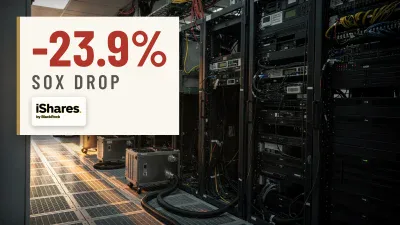
From the September 30 close of 12,628.62, the SOX is down 23.9%. October fell 15.36%, and November so far has fallen another 10.09%, putting the two months on track for the worst stretch since 2008.
iShares Semiconductor ETF (NASDAQ:SOXX) fell 5.41% to $141.22, and VanEck Semiconductor ETF (NASDAQ:SMH) lost 5.11% to $461.90.
AI-focused stocks drove the selling. NVIDIA (NASDAQ:NVDA | NVDA Price Prediction) dropped 4.12% to $156.14, leaving it worth about $3.77 trillion, ahead of its November 17 earnings report.
How This Slide Ranks Against 2000 and 2008
Since May 1994, only 11 two-calendar-month stretches have been worse, and none came after 2008. The worst was August through September 2001, at -38.3%. October through November 2000 (-36.9%) and October through November 2008 (-35.4%) also ranked among the worst.
The current drop is already larger than the 22.3% decline in August through September 2022, the worst stretch since 2008. November so far also ranks as the fifth-worst November in the data.
The 2008 comparison holds only if the SOX ends November below about 9,817. That level is roughly 2.2% above Monday’s close, and nine trading sessions remain.
Memory and Equipment Stocks Fell Hardest
SanDisk lost 8.58% to $809.11, and Micron Technology (NASDAQ:MU) fell 7.62% to $719.02. Intel dropped 7.02% to $55.47. Among equipment makers, Lam Research fell 6.68%, ASML 5.91% and Applied Materials 5.47%, while Broadcom’s loss was smaller at 3.92%.
Research firm SemiAnalysis cut its global forecasts for AI accelerator capex (spending on chips, equipment and facilities) by 28% for 2028 and 40% for 2030. It cited slower AI revenue growth, tighter financing, and data center delays. Equipment and memory makers sell directly into that expansion, so it makes sense that they fell the most, although no single stock’s drop can be tied to the forecast. The capex still has to land somewhere, and a lot of it flows to the power, cooling and networking suppliers we rounded up in a free report on seven AI infrastructure stocks that aren’t chipmakers.
Export Controls Now Reach Rented Computing Power
The Commerce Department’s Bureau of Industry and Security issued an interim final rule restricting remote access to advanced U.S. chips and servers. The rule is meant to stop companies from getting around export controls by leasing computing power at data centers in third countries. Until now, the controls applied to where a chip was shipped, and the rule extends them to who can use it.
Nvidia’s report will be the next test.
On November 12, NVIDIA announced that Jensen Huang had resigned as president, CEO and director, effective immediately, and that CFO Colette Kress is serving as interim CEO. NVIDIA has lost about $735 billion in market value since the controversy that led to his resignation began.
NVIDIA reports third-quarter fiscal 2027 results on Tuesday, November 17, at about 4:20 p.m. ET. Its revenue guidance is $108.0 billion, plus or minus 2%[1]. A strong reaction could lift the SOX back above 9,817, and a weak one would likely lock in the 2008 comparison.

Where Chip Stocks Stand After the Selloff
The SOX is 34.3% below its record close of 14,634.72 on June 22, but it is still up 35.7% for 2026. That leaves the index in a deep correction after a very strong year.
The bull case rests on earnings. Micron guided fiscal first-quarter revenue to $61.5 billion[2]. AMD (NASDAQ:AMD), which fell 5.58% to $504.28, guided fourth-quarter revenue to about $17 billion[3].
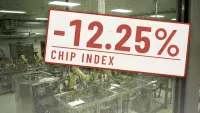
The bear case is that both expectations came before the capex cuts and the new rule. The moves have also been wild. The SOX fell 12.25% on November 5, then gained 6.85% and 5.66% on two later days, which suggests forced selling may not be over.
A broad fund such as SOXX or SMH spreads exposure across many chipmakers, so one company’s leadership problems carry less weight in the fund’s overall performance. Check the SOX close on November 30: a finish above 9,817 would suggest the worst of this decline has passed.
Contact [email protected] for any questions or corrections.
Omor Ibne Ehsan is a writer at 24/7 Wall St. He is a self-taught investor with a focus on growth, cyclical, and dividend equities that have strong fundamentals, value, and long-term potential. He also has an interest in high-risk, high-reward investments such as penny stocks.