Fed Chair Kevin Warsh Outlined 3 Possible Futures for AI Yesterday. One Could Be Devastating for Stocks

This post may contain links from our sponsors and affiliates, and Flywheel Publishing may receive compensation for actions taken through them.
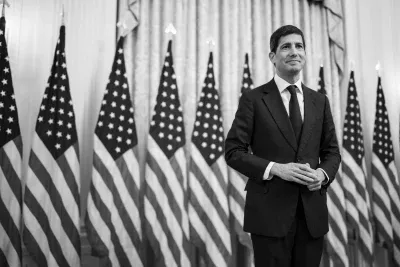
Wall Street has invested trillions of dollars in the belief that artificial intelligence will transform the global economy. Technology companies are building enormous data centers, semiconductor manufacturers are expanding production, and investors are paying premium valuations for businesses expected to benefit.
Yet the market’s enthusiasm rests on an assumption that deserves closer examination: AI’s economic benefits will justify the money being spent. Federal Reserve Chair Kevin Warsh raised that very issue yesterday.
In a November 16 speech, he described three possible futures for artificial intelligence. Two envision stronger productivity. The third could leave investors facing falling stock prices and a weakening economy.
Three Futures, Three Very Different Outcomes
Speaking at the San Francisco Fed’s Productivity and Jobs Task Force Conference, Warsh outlined scenarios showing how AI could reshape economic growth, employment, and financial markets.
| Scenario | Economic Outcome | Stock Market Implications |
| AI delivers | Productivity rises, GDP accelerates, and employment remains healthy | Stronger earnings could support valuations |
| AI displaces workers | Productivity improves, but unemployment rises | Corporate gains could come at consumers’ expense |
| AI disappoints | Investment returns fall short, growth slows, and unemployment increases | Expensive technology stocks face valuation pressure |
Warsh’s third scenario deserves particular attention. After years of capital investment and stock market gains, disappointing AI returns could trigger declining equity valuations, slower economic growth, and rising unemployment.
That’s a different problem from AI simply failing to revolutionize business. It suggests the investment boom itself could become a source of economic weakness.
The Trillion-Dollar Problem Behind AI Expectations
The stakes are enormous because AI spending has spread far beyond semiconductor manufacturers.
Microsoft (NASDAQ:MSFT | MSFT Price Prediction), Alphabet (NASDAQ:GOOGL), Amazon (NASDAQ:AMZN), and Meta Platforms (NASDAQ:META) are committing billions to computing infrastructure. Their investments support demand for Nvidia (NASDAQ:NVDA) processors, networking equipment, electrical systems, and data-center construction.
But spending isn’t the same as earning. An AI data center can operate successfully while generating returns below what investors anticipated. And when billions of dollars are invested upfront, even modest disappointments can become expensive.
Consider Nvidia, whose stock has faced growing scrutiny following Jensen Huang’s departure. Its shares have lost approximately $1 trillion worth of value in less than a week, illustrating how quickly expectations can change even before the industry’s long-term prospects become clear.
Surprisingly, Warsh’s warning also echoes concerns raised by OpenAI CEO Sam Altman, who recently suggested that multiple chipmakers may be assuming they’ll capture the same future customer demand.
If suppliers collectively plan for more purchases than customers can make, excess capacity becomes a genuine risk. That could put additional pressure on AI investments whose economics already depend on years of future growth.
The Productivity Paradox Investors Should Watch
Warsh wasn’t predicting an AI collapse. He also highlighted the technology’s potential to reverse a troubling economic trend.
Research efforts have increased more than 20-fold since the 1930s, yet research productivity has declined. AI could change that by helping scientists and businesses discover new ideas faster. That offers a powerful argument for continued investment.
However, higher productivity doesn’t guarantee every AI company will prosper. The internet transformed commerce without making every internet stock purchased in 1999 a winning investment.
The same distinction applies today. Investors concerned about market concentration should recognize that broad index funds carry exposure to the same technology companies funding the AI expansion.
Key Takeaway
Warsh’s three scenarios aren’t forecasts. They’re reminders that economic progress and investment returns aren’t necessarily the same thing. AI could transform productivity while disappointing shareholders who paid too much for anticipated growth.
For investors, the sensible response isn’t abandoning technology stocks. It’s examining free cash flow, capital spending, and valuations rather than assuming every dollar invested in AI will produce an attractive return.
The greatest risk may not be that AI fails. It’s that AI succeeds, but not enough to justify what Wall Street has already priced in.
Contact [email protected] for any questions or corrections.
After two decades of patrolling the dark corners of suburbia as a police officer, Rich Duprey hung up his badge and gun to begin writing full time about stocks and investing. For the past 20 years, he’s been cruising the markets looking for companies to lock up as long-term holdings in a portfolio while writing extensively on the broad sectors of consumer goods, technology, and industrials. Because his experience isn’t from the typical financial analyst track, Rich is able to break down complex topics into understandable and useful action points for the average investor. His writings have appeared on The Motley Fool, InvestorPlace, Yahoo! Finance, Money Morning, and, of course, 24/7 Wall St. He has been featured in both U.S. and international publications, including MarketWatch, Financial Times, Forbes, Fast Company, and USA Today.