Broadcom Has a $27 Billion Advantage Over Taiwan Semiconductor as Your Portfolio’s AI Anchor

This post may contain links from our sponsors and affiliates, and Flywheel Publishing may receive compensation for actions taken through them.
Broadcom (NASDAQ:AVGO | AVGO Price Prediction) and Taiwan Semiconductor Manufacturing (NYSE:TSM) both just reported quarters driven by AI. TSMC makes the chips. Broadcom designs them and leaves the factory bill to others. That split is how Broadcom turned out $26.9 billion in fiscal 2025 free cash flow while spending only $623 million on capex.
Custom Chips Power Broadcom as the 2nm Ramp Squeezes TSMC
Broadcom’s AI semiconductor revenue reached $16.70B, up 221% YoY[1]. That is a design business growing at foundry scale. Custom XPUs made up 73% of AI revenue[2], spread across Google TPUs, Anthropic, OpenAI’s Jalapeno and Meta’s MTIA. Putting it plainly, Hock Tan said: “Q3 demand was simply hot, and we’re just getting started.”[2]
TSMC’s revenue came in at $46.72B[3], and HPC grew to 68% of revenue[4]. Gross margin, however, slipped 1.3pp sequentially[3] to 66.4% because of 2nm dilution. That is the price of leading the node race. Chairman and CEO C.C. Wei sounded confident: “Demand is extremely robust.”[4]
| Business Driver | Broadcom | TSMC |
|---|---|---|
| Growth Engine | Custom XPUs, Ethernet networking | 2nm and 3nm wafers |
| Q3 Capex | $532 million[2] | $13.8 billion[4] |
| Margin Pressure | XPU memory content | 2nm ramp, overseas fabs |
Broadcom Outsources the Fabs While TSMC Pours the Concrete
That $27 billion cash engine has kept growing. Broadcom produced $13.66B[1] of free cash flow in Q3 alone, or 46% of revenue, which brings the last four reported quarters to $39.4 billion. TSMC repeated a 2026 capital budget of $60 billion to $64 billion[4] and expects 2026 through 2028 spending to run “significantly higher than the past three years.” Those fabs support the whole industry, but they consume cash long before they pay it back.
Broadcom’s model comes with its own responsibilities. It carries $59.6 billion[2] in fixed-rate debt and depends on a $63 billion bank-led financing structure to fund compute for its customers.
| Lens | Broadcom | TSMC |
|---|---|---|
| Core Edge | Workload-specific design | Process and packaging lead |
| Key Vulnerability | Six-customer concentration | Capex intensity, FX |
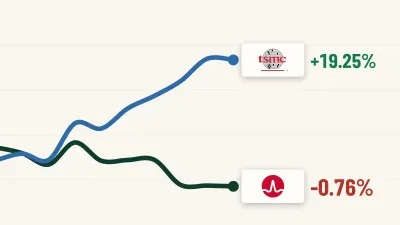
| Stock YTD | -0.76% | 19.25% |
December Margins Could Expose the Weaker Ramp
Broadcom reports on December 9, 2026 and has forecast AI revenue to $21.7B[1]. The question is whether gross margin holds near the guided 73%[2] as memory-heavy XPUs take a larger share of the mix. For TSMC, watch whether overseas dilution broadens toward 3%–4%[4]. October revenue rose 59.7% YoY, which is an encouraging early sign for the quarter.
Why I Lean Toward Broadcom as My AI Anchor
I want an anchor that pays for its own growth and still returns cash to shareholders. In Q3, Broadcom paid $3.1 billion[2] in dividends and repaid $5.6 billion of debt. The stock has moved just 0.43% over the past year and trades near 18x forward earnings, which looks cheap to me against a fiscal 2027 AI outlook of about $115 billion[2]. TSMC fits investors who want the toll road that every AI chip goes, Broadcom’s included. My view would change if Anthropic or OpenAI stumbled, because that would show how concentrated this cash engine really is.
Contact [email protected] for any questions or corrections.
Alex Sirois is a financial writer with experience spanning both retail and institutional investing. He has written for InvestorPlace and held roles at BNY Mellon and Bernstein, giving him a perspective that bridges Main Street portfolios and Wall Street analysis.
Alex holds an MBA from George Washington University and has built his career across multiple industries, including e-commerce, education, and translation — a breadth of experience that informs how he breaks down complex financial topics for everyday investors. His writing is conversational, actionable, and grounded in long-term, buy-and-hold investing principles.
At 247 Wall St., Alex focuses on delivering analysis that is both accessible and useful, with a clear emphasis on helping readers make more informed decisions with their money.