4 High-Yield Mortgage REITs Facing a Growing Dividend Cut Risk

This post may contain links from our sponsors and affiliates, and Flywheel Publishing may receive compensation for actions taken through them.

The 10-year Treasury yield stood at 5.15%[1] in the latest reading, up from 4.65% on August 19. Few income stocks have taken that rate jump worse than mortgage REITs. Their headline yields now look huge, but a high yield is worth little unless the company can keep paying it.
Why Mortgage REIT Dividends Break Faster
A mortgage REIT owns mortgage bonds instead of buildings, and it borrows heavily to buy them, mostly through short-term repurchase agreements. It makes the gap between what the bonds yield and what the borrowing costs. When rates spike, three things hit at once: bond prices fall and shrink book value, funding costs rise, and hedging gets more expensive. A property REIT collects rent from tenants, and nobody marks its buildings to market every day. A mortgage REIT gets revalued every day.
The quick test: compare earnings available for distribution (EAD, or the company’s equivalent) with the dividend, then check for a shrinking book value and rising leverage. GAAP EPS moves with mark-to-market losses, so it’s the wrong measure for coverage. These are the same red flags we walked through in a free guide to the seven warning signs that a big yield is about to be cut.
AGNC Investment (AGNC): A Payout Covered by the Thinnest of Margins
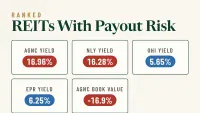
AGNC Investment (NASDAQ:AGNC) pays $0.12 a month, or $1.44 a year. With the stock at $7.90, that works out to a yield of about 18.2%. Part of that yield comes from a falling share price. The stock is down 17.28% year to date and 9.61% in the past week alone.
Third-quarter non-GAAP EPS came in at $0.37[2], just above the $0.36 paid out for the quarter. That figure also included a $0.05 per share[2] catch-up premium amortization benefit. Tangible book value fell 16.9%[2] to $7.13, leverage reached 7.9x, and the net interest spread narrowed to 1.86% from 2.00%. AGNC also sold 97.6 million shares through its at-the-market program during the quarter. The dividend has a history of cuts: it fell from $0.16 to $0.12 in 2020, following cuts in 2019, 2016, 2015 and 2014.
For the bull case, hedge coverage rose to 90%[2] of funding liabilities from 73%, and CEO Peter Federico said he was constructive on Agency MBS once Treasury volatility settles down. The stock still trades about 10.8% above third-quarter tangible book, so a further drop in book value leaves little room for error.
Orchid Island Capital (ORC): Already Cut Once This Year
Orchid Island Capital (NYSE:ORC) pays $0.10 monthly, or $1.20 annualized. At $4.51, that’s a yield of about 26.6%. The stock has fallen 26.46% this year and 51.5% over five years.
Orchid does not report an EAD-style figure, so GAAP results are the closest coverage measure available. They look bad. The third-quarter loss was $0.90 per share[3], against $0.30 in dividends paid. Book value fell $1.20[3] to $6.02, a drop of about 16.6%. The firm’s leverage rose to 8.8x from 7.4x. The payout was already cut from $0.12 to $0.10 starting with the April 2026 ex-date, after an earlier cut from $0.16 to $0.12 in 2023.
Management says its goal is “to sustain the dividend,”[3] and it points to discount accretion and slow prepayments as support. The stock trades about 25% below book, which makes its buybacks (about 1.67 million shares[3] in October at $5.05) accretive. Book value still has to stabilize for that to matter.
ARMOUR Residential REIT (ARR): Distributable Earnings Fall Short of the Payout
ARMOUR Residential REIT (NYSE:ARR) pays $0.24 monthly, or $2.88 a year. At $10.97, the yield is about 26.3%. The stock has dropped 15.15% in a month and 60.12% over ten years.
Third-quarter distributable earnings were $0.71[4] per share, short of the $0.72 quarterly dividend. Book value fell to $14.55[4] from $17.53, total economic return fell 12.9%, and leverage rose to 8.24:1 from 7.54:1[5]. ARMOUR also raised $205.7 million through its ATM while the stock was falling. It paid $13.0 million in external management fees. Past cuts include $0.17 to $0.09 in 2020 and $0.10 to $0.08 in 2023.
On the positive side, net interest income rose to $83.7 million[4] from $38.5 million a year earlier, and the $0.24 monthly payout was maintained for October and November. The shares trade about 24.6% below book.
Two Harbors Investment (TWO): Two Cuts Before the Buyout
Two Harbors Investment (NYSE:TWO) no longer trades. CrossCountry Mortgage acquired it for $12.00 per share in cash, so shareholders received the buyout price and never faced another dividend decision. Its record shows how these payouts usually wear down. The quarterly dividend was $0.45 through April 2025, then fell to $0.39, then to $0.34.
Before the deal closed, second-quarter EAD of $0.28[6] fell short of the $0.34 dividend, and the portfolio shrank to $7.48 billion from $8.95 billion. The final payout was a stub dividend of $0.12196.
What Retirees Should Check Before Trusting These Yields
Each quarter, compare EAD (or the closest equivalent) with the dividend, and check for a book value per share and leverage moving the wrong way. Watch the 10-year Treasury yield and new share issuance, which dilutes existing holders when it happens at low prices. When a dividend gets cut, the share price tends to drop alongside it, so a stock yielding over 20% can wipe out years of income in a single day. Yield alone is not enough of a reason to buy.
Contact [email protected] for any questions or corrections.
Chris Lange is a financial and geopolitical writer with more than a decade of experience covering a myriad of topics. He has published thousands of articles for 24/7 Wall St., with past coverage focused heavily on stocks, IPOs, healthcare, defense, global affairs, and technology.
His work has been quoted, or referenced by a number of outlets including Business Insider, USA Today, Yahoo Finance, MSN, The Motley Fool, and many other publications. A graduate of Southwestern University, he studied business with a focus on investments and has previous experience in banking and startups.
When not reading or writing the news, he is following his passion for Lacrosse, playing chess, or building solar projects with his dad.