Broadcom Stock Has Another Growth Driver. Here’s Where I See It Going in 2027

This post may contain links from our sponsors and affiliates, and Flywheel Publishing may receive compensation for actions taken through them.

Chip designer Broadcom (NASDAQ:AVGO | AVGO Price Prediction) makes the custom silicon behind TPUs for Alphabet (NASDAQ:GOOGL), OpenAI’s first-generation Jalapeno accelerator and MTIA chips for Meta Platforms (NASDAQ:META).
Now it has a second engine: VMware Private AI Cloud[1], which lets enterprises build and run AI agents inside their own data centers.
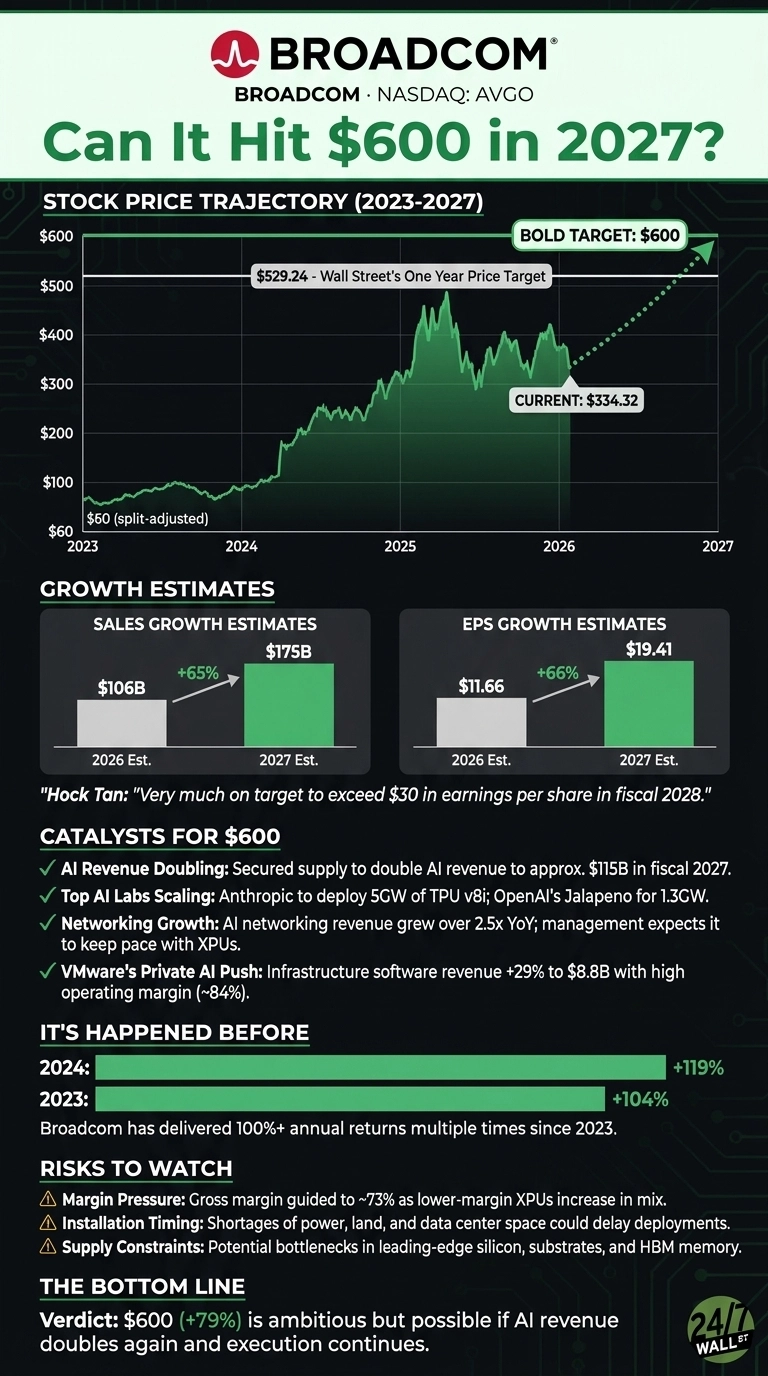
The stock hasn’t kept up with the business. Shares are down 2.87% year-to-date at $334.32, even though Q3 revenue rose 85.5%[2]. Over five years, shares have gained 541.14%. Here’s how Broadcom could reach $600 in 2027.

Wall Street Sees Nearly 60% Upside Already
Analysts’ consensus price target is $529.24, suggesting roughly 58% upside. Analysts carry 8 Strong Buy ratings plus 41 Buy ratings against just 2 Holds and zero Sells.

Wall Street analysts expect fiscal 2027 EPS of $19.4140, up about 66% from $11.6644, on revenue growth near 65%. Over the past 30 days, fiscal 2027 estimates were raised two times, with no down revisions. The company has also beaten EPS estimates 10 straight quarters, so actual results could land above those forecasts.
Here’s What It Takes for Broadcom to Reach $600
Broadcom currently trades at about 17x fiscal 2027 earnings. At $600, that multiple rises to roughly 31x. It trades at a premium to the S&P 500’s forward multiple of around 21x to 23x, but reasonable for earnings growing more than 60%.
Looking further out, CEO Hock Tan said Broadcom is “very much on target to exceed $30 in earnings per share in fiscal 2028.”[1] Against that figure, $600 equals just 20x.

What could push Broadcom to $600?
- AI revenue doubling again: Tan said Broadcom has “secured the supply to again double AI revenue to approximately $115 billion”[1] in fiscal 2027. He added that demand exceeds that outlook.
- Top AI labs are scaling: Anthropic is expected to deploy 5 gigawatts[1] of TPU version 8i in 2027. OpenAI’s Jalapeno is scheduled for 1.3 gigawatts[1].
- Networking: AI networking revenue grew over 2.5x[1] year-over-year in Q3. Management expects it to keep pace with XPUs, helped by Tomahawk 6 and the 200-terabit-per-second[1] Tomahawk 7.
- VMware’s private AI push: Infrastructure software revenue rose 29%[1] to $8.8 billion at an operating margin near 84%. That gives Broadcom a high-margin way to sell AI to enterprises.
All of that AI expansion has to be powered, cooled, and networked by somebody, and Broadcom is one of several names profiting. We rounded up seven suppliers behind the data-center boom in a free report you can grab here.
Hurdles remain: Q4 gross margin is guided to about 73%[1], compared with 78% a year ago, as lower-margin XPUs make up more of the mix. Shortages of power, land and data center space could also delay installations.
Broadcom Has Delivered Gains This Large Before
Reaching $600 requires a gain of about 79%. Broadcom has exceeded that recently. Based on split-adjusted closes, shares rose roughly 104% in 2023 and about 119% in 2024.
The stock hit $493.32 within the past 52 weeks, so most of the climb would only return it to recent levels. At a $1.59 trillion market cap, triple-digit years are harder to repeat, but a rebound toward recent highs is within reach.

$600 Is a Stretch, but the Earnings Support It
The case for $600 depends on AI revenue doubling to roughly $115 billion[1], a beat streak that keeps going and VMware adding enterprise AI demand.
Margin pressure and installations timing are the key risks to track. Such returns are rare, which makes execution on these drivers the key variable for Broadcom in 2027.
Contact [email protected] for any questions or corrections.
Vandita Jadeja is a financial publisher with over a decade of experience writing about financial topics, including investment, savings, retirement, insurance and banking. Vandita is a Chartered Accountant who loves to debunk financial concepts for readers.
Her work has appeared on sites that include The Motley Fool, InvestorPlace, and Benzinga. She covers investing and focuses on stock picks and price prediction for 24/7 Wall St.
When not looking for the next stock investment opportunity, she can be found traveling, reading, chasing sunsets and enjoying her iced latte.