NVIDIA Rises 3% After Record Quarter as Wells Fargo Sees $250 and Barclays Backs Board on Huang; Taiwan Semiconductor Climbs 3%, Broadcom Gains 2%

This post may contain links from our sponsors and affiliates, and Flywheel Publishing may receive compensation for actions taken through them.
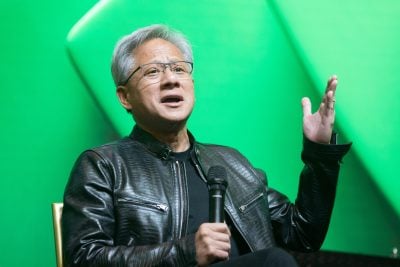
Analysts are lining up behind NVIDIA (NASDAQ:NVDA | NVDA Price Prediction) after its first earnings report since Jensen Huang resigned as CEO[1]. NVIDIA stock is at $160.15, up 3% in morning trading. The gain follows record Q3 FY2027[2] results, a revenue forecast that topped consensus and a raised long-range growth outlook.
Even with the bounce, NVIDIA stock is down 14% year to date (YTD). Interim CEO Colette Kress raised NVIDIA’s fiscal 2028 revenue growth outlook to 75%[3] from 70%. Board chair Harvey Jones said on the call that the board “does not intend to reinstate Jensen as CEO.”[1]

Record Quarter and Bigger Forecast Lift NVIDIA
On November 17[2], NVIDIA reported that its Q3 revenue reached a record $115.8 billion, up 103% year over year (YoY), against analyst estimates of $108.73 billion. The company’s adjusted earnings per share (EPS) of $2.68 exceeded the $2.47 consensus.
For Q4 FY2027, NVIDIA guided its revenue to $130 billion[3], plus or minus 3%, above the $125.3 billion Wall Street average. That forecast doesn’t include any data center compute revenue from China. Kress noted Vera Rubin generated $20 billion[3] in its first quarter of production shipments, calling it the fastest product ramp in NVIDIA’s history.
One soft spot showed up in the core business. NVIDIA’s data center revenue rose 110% YoY to $107.6 billion, a slower pace than the 116.6% growth posted in the prior quarter.

Wells Fargo and Barclays Stand Behind NVIDIA
Wells Fargo cut its NVIDIA price target to $250[4] from $300 but kept its Overweight rating, citing results, a higher growth outlook, supply chain execution and buybacks. The company returned a record $28 billion[1] to shareholders in Q3.
Barclays analyst Tom O’Malley kept an Overweight rating and a $210[4] target, saying NVIDIA’s board “did the right thing” by ending consideration of Huang’s return. O’Malley added that the raised outlook showed “this wasn’t a shell game with China soaking up excess demand,” though he said the longer-term leadership situation “remains in limbo.”
Citi kept its Buy rating and $225[4] target on NVIDIA, saying demand “remains very strong.” The bank warned that NVIDIA’s more selective approach to financing AI infrastructure could slow growth for some neocloud operators, the specialized AI cloud providers.

What the Peer Group Says About NVIDIA
Suppliers and rivals are rising on NVIDIA’s report. Shares of NVIDIA foundry Taiwan Semiconductor Manufacturing (NYSE:TSM) are at $369.50, up 3%. Broadcom (NASDAQ:AVGO) stock is at $349.25, up 2%. Meanwhile, Advanced Micro Devices (NASDAQ:AMD) stock is at $513.31, up 2%.
As the foundry that produces NVIDIA’s wafers, Taiwan Semiconductor is tracking the chipmaker most closely. Both Broadcom and AMD are posting smaller gains. Each competes with NVIDIA for AI data center budgets, so a stronger demand signal raises sentiment across the group.
How NVIDIA’s Business Model Differs From Its Chip Peers
NVIDIA sells full accelerated computing platforms that combine graphics processing units (GPUs), central processing units (CPUs), networking, systems and software, while outsourcing manufacturing. Taiwan Semiconductor sits upstream as a contract foundry, building chips for designers such as NVIDIA that sell under their own brands.
Broadcom pairs custom AI accelerators and networking chips for hyperscale cloud customers with an infrastructure software segment that includes VMware products. AMD competes most directly, selling Instinct GPUs and EPYC server CPUs alongside PC, gaming and embedded chips.
NVIDIA’s CEO Search Hangs Over the Rally
NVIDIA’s next test is whether the board finds a permanent CEO without slowing the Vera Rubin ramp. The bulls can point to a cloud-industry backlog of $2.5 trillion[1], up from $2 trillion three months earlier, cited by Kress.
The bears have their own list, starting with concentration: three direct customers made up 14%, 11%, and 11%[2] of NVIDIA’s Q3 revenue, and the company has guarantee exposure of up to $118 billion. Rates add another layer: Federal Reserve Bank of New York President John Williams stated on November 17 that surging AI investment could argue for more rate hikes next year, while pushing back on calls for a supersized December hike.
Stockholders are considering a bigger forecast against an open leadership question at NVIDIA. How NVIDIA’s CEO search resolves could shape sentiment toward the stock in the months ahead.
Contact [email protected] for any questions or corrections.
David Moadel is financial writer specializing in stocks, ETFs, options, precious metals, and Bitcoin. David has written well over 1,000 articles for leading online publications, helping investors understand markets, income strategies, and risk. His work has appeared in 24/7 Wall St., The Motley Fool, InvestorPlace, U.S. News & World Report, TipRanks, ValueWalk, Benzinga, Market Realist, MarketScreener, TalkMarkets, Finmasters, and others. With a master’s degree in education, David has taught at the elementary, high school, and college levels. That teaching background shapes his writing style: clear, educational, and practical. David has also built a loyal social-media audience by providing trustworthy financial content on YouTube, X/Twitter, and StockTwits.