South Korea’s Stock Market and the Nikkei 225 Sink More Than 4% as the AI Selloff Spreads From Wall Street. Here’s How Much of a Target-Date Fund Is in Samsung, SK Hynix and TSMC

This post may contain links from our sponsors and affiliates, and Flywheel Publishing may receive compensation for actions taken through them.
South Korea’s stock market and Japan’s Nikkei 225 both sank more than 4% on Friday morning as Wall Street’s AI selloff spread to Asia. The three chipmakers at the center of it, Samsung Electronics, SK hynix and Taiwan Semiconductor Manufacturing (TSMC), make up about 1.7% of Vanguard’s Target Retirement 2030 Fund, the kind of fund many 401(k) plans use as their default.
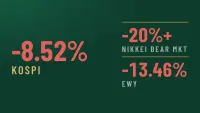
The KOSPI, South Korea’s main stock index, stood at 4,879.10 at 12:38 p.m. in Seoul, down 5.04%, after its first trip under 4,900 since February. The Korea Exchange triggered a sell-side sidecar, a five-minute pause on program selling. Samsung Electronics and SK hynix were each down about 6% late in the morning. In Tokyo, the Nikkei 225 was at 56,758.00 in the afternoon session, down 4.52%. Taiwan’s Taiex was down 5.46% at 36,326.90, a day after it lost 4.40%.
For a 61-year-old with $500,000 in that kind of fund, South Korea is $6,907 of the account, and the drop in Seoul so far comes to about $348. A selloff like this reads as a small event for a target-date saver, because South Korea is a little over 1% of the fund; the limit of that reading is that the same AI chip trade also runs through the fund’s Taiwan, Japan and US stocks, and those slices are far larger.
Why the KOSPI fell harder than Wall Street
The selling started in New York. (Our colleague Jeremy Phillips has the Seoul selloff stock by stock here, and the rest of Asia here.) On Thursday the S&P 500 lost 2.0% and the Nasdaq Composite lost 2.3%, after the Nasdaq had been up about 2% earlier in the session. The Dow fell 1,101 points and closed under 50,000. Anthropic ended its first day of trading 17% above its $83 offering price, and the largest IPO on record still did not steady AI stocks.
“Anthropic’s blockbuster IPO proved not enough to assuage the overall concern about the outlook for the AI trade,” Kyle Rodda, senior financial market analyst at Capital.com, told Reuters.
Seoul amplifies that mood because of two companies. Samsung Electronics and SK hynix make the memory chips that go into AI data centers, and together they were 46.5% of the KOSPI’s market value on Nov. 6, by Korea Exchange data. An index with nearly half its weight in two AI suppliers trades like a chip fund. When US investors doubt AI spending, the KOSPI takes the doubt at about twice the strength.
The damage is regional. Reuters put MSCI’s Asia-Pacific index on course for a 7% loss on the week, its worst week since March 2020.
How much of a 2030 target-date fund is South Korea, Japan and Taiwan
Put the whole $500,000 in that Vanguard fund, which held about $110 billion at the end of October. The fund’s filing with the SEC shows 23.9% of it in Vanguard’s Total International Stock Index Fund as of June 30. On this balance that is $119,500.
The international fund spreads that money over 8,874 stocks. Vanguard’s Oct. 31 country weights put Japan at 15.87%, Taiwan at 8.69% and South Korea at 5.78%. Here is what each is worth in the account and what Friday’s index move so far does to it.
| Market | Share of the international fund | Dollars in the account | Friday move so far | Dollar loss |
|---|---|---|---|---|
| Japan | 15.87% | $18,965 | Nikkei 225 down 4.52% | $857 |
| Taiwan | 8.69% | $10,385 | Taiex down 5.46% | $568 |
| South Korea | 5.78% | $6,907 | KOSPI down 5.04% | $348 |
| All three | 30.34% | $36,256 | $1,772 |
South Korea is 1.38% of the whole account. The three markets together are 7.25%, and their combined loss so far of $1,772 is about a third of 1% of the balance.
The three chipmakers in the headlines are in there by name. TSMC is the international fund’s largest holding at 4.00%. Samsung Electronics is 1.74% and SK hynix is 1.34%. Together they are 7.08% of the international fund, which works out to 1.69% of the whole target-date fund. In this account that is $4,774 of TSMC, $2,076 of Samsung and $1,605 of SK hynix, $8,456 in all.
Now compare Thursday at home. The same target-date fund holds 35.3% in US stocks, which is $176,500 here. A 2.0% fall on that slice is $3,530, more than ten times the Korean loss.
What the KOSPI’s 2026 run did for a 401(k)
This is also why most savers never felt South Korea’s boom. The KOSPI ended 2025 at 4,214.17 and reached a record close of 9,114.55 on June 22, a gain of 116% in under six months. It now sits 46% below that record and 16% above where it started the year.
If Korean stocks doubled, a fund with 1.38% in them would gain about 1.4%. The boom and the bust both reached a target-date saver in that diluted form.
You can see it in fund prices. The iShares MSCI South Korea ETF, the main US-listed Korea fund, was up 125% for the year at its June high and closed Thursday at $134.59, still up 38% for 2026. Vanguard’s Total International Stock ETF was up 17% at its September high and is up 3% now, by closing prices. The 2030 target-date fund has returned 4.13% this year through Nov. 18, according to Vanguard.
Where the Korea exposure is bigger
Two places in a 401(k) or IRA carry more.
The first is an emerging-markets fund, and funds with that label come in two kinds. MSCI classes South Korea as an emerging market. FTSE Russell classes it as developed. So the iShares Core MSCI Emerging Markets ETF held 17.51% in Korea and 26.54% in Taiwan as of Nov. 18, while Vanguard’s FTSE Emerging Markets ETF holds no Korean stocks and has 33.77% in Taiwan, with TSMC alone at 15.30%. If you have $10,000 in the MSCI fund, $1,751 of it is in Korea. In the FTSE fund, none is.
The second is the chip trade itself. A target-date fund’s US stocks are led by the same AI names that fell on Thursday, so a bad week for AI spending reaches the account from New York, Taipei, Tokyo and Seoul at once.
The math has three limits. The weights come from June 30 and Oct. 31 reports and have drifted since. The index moves are in won, yen and Taiwan dollars, and your fund is priced in US dollars. And Asia was still trading when these numbers were taken. Mutual funds price once a day, at 4 p.m. Eastern, so Friday’s balance will blend Asia’s close with whatever US stocks do on Friday. S&P 500 futures were down 0.4% in Asian hours, Reuters reported.
What to do with it
A day like this in Seoul is big news for anyone holding a single-country Korea fund. For a target-date saver it moves the account by less than a tenth of 1%. The number worth knowing is your fund’s total stock share, 59.2% in the 2030 fund, because the AI trade is spread across all of it. Your fund’s fact sheet lists the international share and its top countries. Three lines of multiplication turn any overseas headline into dollars.
Contact [email protected] for any questions or corrections.
I've spent more than 15 years inside enterprise software, working alongside the finance, sales operations, and HR leaders who run the revenue engines at some of the largest tech companies in the country.
My day job is helping enterprise executives make smarter decisions about retention, compensation, and growth. These are the same operational levers that show up in every earnings report investors actually read. That perspective shapes my writing for 24/7 Wall St.
The headline numbers are easy. The interesting stuff is underneath: how companies make money, what executives are worried about, and what any of it means for the person checking their 401(k) on a Sunday afternoon. I write about personal finance and business as someone who has spent her career inside the rooms where these decisions get made.