4 Consumer Staples Stocks Yielding Over 3% That Retirees Can Rely On in Any Market

This post may contain links from our sponsors and affiliates, and Flywheel Publishing may receive compensation for actions taken through them.
Retirees need a dividend that keeps coming when markets turn rough, and consumer staples are built for that. People keep buying diapers, cereal, snacks and coffee in a recession, so the cash behind these dividends tends to hold steady. The four names below all yield more than 3% at current prices, and the longest record of raises goes to Kimberly-Clark (NASDAQ:KMB | KMB Price Prediction), which has lifted its dividend for 54 consecutive years. Each section below opens with the dividend’s safety, because yield alone tells you very little about how dependable a payout is.
Kimberly-Clark: 54 Straight Raises Behind a 4.6% Yield
Kimberly-Clark pays $1.28 per quarter, an annualized forward rate of $5.12. At the current price of $110.92, that works out to a yield of about 4.6%. The next payment is scheduled for January 5, 2027.
Dividend safety: Over the trailing 12 months, Kimberly-Clark paid $5.10 per share. Over the last four quarters it reported adjusted EPS of $1.86, $1.97, $2.12 and $1.70, so the dividend took up about 67% of adjusted earnings. That leaves room for more raises. The company has paid a dividend for 92 consecutive years and raised it for 54 straight, which passes the 50-year bar for Dividend King status. The most recent raise lifted the quarterly payout to $1.28 from $1.26[1]. Cash was at $1.87 billion[1] at the end of the third quarter, and the stock trades at about 15 times forward earnings.
Why demand holds up: Huggies, Kleenex, Cottonelle and Depend are products families keep buying in any economy. On a 2025 earnings call, the chief executive put it simply: "There’s not a whole lot of substitutes for our products."[2] The Kenvue deal, which closed on November 2, 2026, adds Tylenol, Listerine and Neutrogena. The stock’s beta of 0.276 shows how little it has moved with the broader market.
Risk: The $49 billion Kenvue acquisition will substantially increase indebtedness[1]. That means more of Kimberly-Clark’s cash will go toward debt payments for the next several years.
PepsiCo: A 54th Consecutive Raise and Global Snack Demand
PepsiCo (NASDAQ:PEP) pays $1.48 per quarter, an annualized $5.92. At $146.43 a share, that is a yield of about 4.0%. The current rate reflects a 4% increase from $5.69, which management called its 54th consecutive annual increase.
Dividend safety: Coverage is the tightest in this group. In 2025, PepsiCo generated $12.087 billion of operating cash flow and spent $4.415 billion on capital projects. The free cash flow left over covered the $7.6 billion dividend bill about 1.01 times. Its free cash flow yield of 3.84% is almost identical to its trailing dividend yield of 3.83%. PepsiCo has more flexibility on its balance sheet: interest coverage is 10.26x and net debt is 2.60 times EBITDA. PepsiCo plans to return $8.9 billion[3] to shareholders this year, including $7.9 billion in dividends. The stock trades at 24 times earnings.
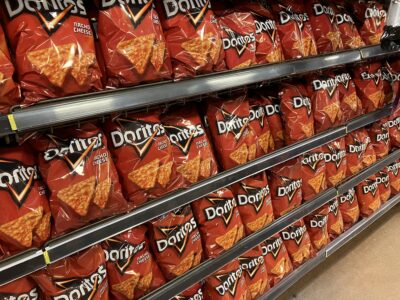
Why demand holds up: Lay’s, Doritos, Gatorade and Quaker are low-cost everyday purchases, and growth outside the U.S. is broadening the earnings base. Third-quarter organic revenue grew 3.1%[4]. The chief executive noted that "Year-to-date, international is already 45% of our profit."[4]
Risk: PepsiCo cut its 2026 core EPS growth outlook to 2.5% to 3.5%, down from 5% to 7%[3]. Core operating profit in North American snacks fell 12%[3] as input costs rose. Slower earnings growth would mean smaller dividend raises.
General Mills: An Ultra-High Yield Backed by 127 Years of Payments
General Mills (NYSE:GIS) pays $0.61 per quarter, or $2.44 a year. At $35.24, the yield is about 6.9%, which makes it the only ultra-high-yield stock in this group.
Dividend safety: General Mills has paid dividends without break for 127 consecutive years[5]. That record tracks payments. Raises have paused, and the quarterly rate has stayed at $0.61 since the 2025-07-10 ex-dividend date. In fiscal 2026, free cash flow of $1.63 billion covered $1.3153 billion of dividends, so the payout used about 81% of free cash flow. On a GAAP basis, however, the company lost $85.3 million after impairment charges. Leverage is a little above four times net debt, and the chief financial officer said it will take "at least a couple years"[6] to get back to the three times target. In the latest quarter, operating cash flow of $297.8 million fell short of the $330.5 million paid in dividends.
Why demand holds up: Cheerios, Pillsbury, Betty Crocker and Blue Buffalo pet food are lower-cost basics that families buy more of when they eat at home to save money. In the pet business, cat food grew by double digits. Management is targeting $3 billion[5] in cumulative savings by fiscal 2030 and expects free cash flow conversion of about 95%[7] of adjusted after-tax earnings. The stock trades at 11 times forward earnings, near the low end of its 52-week range of $30.60 to $47.04.
Risk: Barron’s reported that Piper Sandler warned the dividend could be on the chopping block. General Mills guides fiscal 2027 adjusted EPS to $3.00 to $3.20[7], so earnings are falling while debt remains high. Retirees relying on this income face the possibility of a cut.
J.M. Smucker: Coffee and Uncrustables Fund a 3.3% Yield
J.M. Smucker (NYSE:SJM) takes the spot that Coca-Cola (NYSE:KO) usually holds in basics income lists. Coca-Cola’s 2.05% yield falls short of this list’s 3% floor.
Smucker pays $1.12 per quarter, or $4.48 a year. At $135.54, the yield is about 3.3%.
Dividend safety: Smucker has the strongest coverage in this group. Fiscal 2026 free cash flow was $1.156 billion, against roughly $474 million a year in dividends at the trailing rate. That covers the payout about 2.4 times. Management raised its fiscal 2027 free cash flow outlook to about $1.1 billion. That raise took the quarterly dividend to $1.12 from $1.10. The payment record shows a higher quarterly rate in every year since 2002, when it was $0.20. Paying down debt cut net interest expense by 18%. The stock trades at 13 times forward earnings.
Why demand holds up: Folgers, Café Bustelo, Jif, Smucker’s, Milk-Bone and Meow Mix are pantry and pet basics that shoppers keep buying in a downturn. Net sales in U.S. retail coffee rose 13% to $807.8 million last quarter, and Uncrustables keeps driving growth in frozen handheld foods.
Risk: Hostess remains a weak spot. Smucker took $961.7 million in impairment charges tied to Sweet Baked Snacks, and that segment’s sales fell another 7% last quarter.
Building a Staples Income Core That Holds Up
Kimberly-Clark and PepsiCo have the longest records of raises, at 54 years each, and they pay 4.6% and 4.0% at current prices. Smucker has the most free cash flow behind its dividend. General Mills pays the most income, but its payout has the least margin for error. Together, the four give retirees essential-product demand that holds up in a downturn and dividend coverage at several levels of risk (if you want to see how a mid six-figure balance can be turned into a steady monthly check using names like these, we outlined the full plan in a free income guide).
Contact [email protected] for any questions or corrections.
Lee Jackson has covered Wall Street analysts' equity and debt research and equity strategy daily for 24/7 Wall St. since 2012. His broad, diverse career, including a stint as creative services director at an NBC affiliate in Austin, Texas, gives him unique insight into the financial industry.
Lee Jackson's journey in the financial industry spans more than 30 years, including nearly two decades as an institutional equity salesperson at Bear Stearns, Lehman Brothers, and Morgan Stanley. His career spanned pivotal sell-side Wall Street events, from the dot-com rise and bubble to the Long-Term Capital Management debacle, 9/11, and the Great Recession of 2008. This reflects his resilience and adaptability amid market volatility.
Lee Jackson’s practical financial industry experience, gained through a career at some of the biggest banks and brokerage firms, is complemented by a lifetime of writing across various platforms. This unique combination allows him to shed light on the intricacies of Wall Street in a way only someone with deep insider experience and knowledge can. Moreover, his extensive network across Wall Street continues to provide direct access for him and 24/7 Wall St., a privilege few firms enjoy.
Since 2012, Jackson’s work for 24/7 Wall St. has been featured in Barron’s, Yahoo Finance, MarketWatch, Business Insider, TradingView, Real Money, The Street, Seeking Alpha, Benzinga, and other media outlets. He attended the prestigious Cranbrook Schools in Bloomfield Hills, Michigan, and has a degree in broadcasting from the Specs Howard School of Media Arts.