Nebius Drops 7% as Michael Burry Takes a Victory Lap on Neocloud Rout; IREN Falls 5%, Oracle Slides 4%

This post may contain links from our sponsors and affiliates, and Flywheel Publishing may receive compensation for actions taken through them.

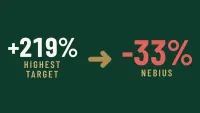
The selloff in AI cloud stocks is deepening, and the highest-profile neocloud is taking the heaviest hit. Nebius Group (NASDAQ:NBIS | NBIS Price Prediction) stock is at $90.30, down 7% in morning trading. The decline adds to a slide that leaves Nebius stock down 47% over the past month.

Concern about Big Tech cloud spending, the debt-fueled models of neocloud companies and a broader retreat from AI stocks is weighing on Nebius. Futures tied to the NASDAQ 100 are pointing lower. Anthropic (NASDAQ:ANT) is sliding in its second trading day after its November 19 Nasdaq debut failed to lift AI infrastructure names.
On November 12[1], Nebius reported Q3 2026 revenue of $980.8 million[2], up 571% year over year, but third-party colocation delays pushed its 2026 revenue outlook to the low end of its $3 billion to $3.4 billion range. Included in that revenue was $325 million[1] of nonrecurring asset-light partnership revenue, which the company’s finance chief cautioned doesn’t recur in the same form[3].
Michael Burry Claims Vindication on Neocloud Rout
Michael Burry is taking a victory lap as Nebius and its peers slide. In an X post, Burry wrote, “Coreweave, Nebius, NVIDIA, semis, I tried to warn you all. I didn’t say short. But I provided the information one would need to sell.” Burry argued in a follow-up exchange that the weakness traces back to fundamentals.
Hedge fund manager Eric Jackson sees merit in the bear case, but he argued that investors may be overlooking demand signals in Anthropic’s initial public offering filing. “I don’t think every neocloud survives. But the best-capitalized ones could become substantially bigger businesses than Wall Street currently imagines,” Jackson stated.
“The changes in our 2026 guidance are just about timing, not demand,”[3] Nebius CEO Arkady Volozh asserted on the company’s earnings call. Still, Nebius expects capital expenditures (capex) of $27 billion[1] in 2026 and $40 billion to $45 billion in 2027, which keeps financing at the heart of the Burry debate.
IREN and Oracle Slide Alongside Nebius
IREN (NASDAQ:IREN) stock is at $13.69, down 5%. Measured year to date (YTD), IREN stock is down 64%. Revenue at IREN reached $228 million[2] in Q1 FY2027, reported November 5[4], up 66% from the prior quarter.
Microsoft (NASDAQ:MSFT), which took over IREN’s Horizon 1 cluster, asked for a network reconfiguration and upgrade[5]. That request, along with supplier timing, pushed IREN’s target of more than $4 billion[4] in operating annualized run-rate revenue from year-end to January, and possibly the end of February. Net debt at IREN rose to $4.43 billion[4] from $216 million.
Oracle (NYSE:ORCL) stock is at $106.10, down 4%, the smallest decline of the three. On a YTD basis, Oracle stock is down 45%, a smaller loss than IREN’s. Capex at Oracle reached $28.5 billion[6] in Q1 FY2027, reported September 10, leaving free cash flow at negative $5.4 billion. An upcoming quarterly report gives Oracle its next chance to update the market on that spending.
How Nebius, IREN and Oracle Build Their AI Clouds
Nebius’s AI cloud mixes its own data centers with colocation capacity and asset-light partnerships, where partners fund the hardware and the company supplies the platform. That model can lift revenue quickly, but it leaves Nebius exposed to third-party builders. Management is steering most new capacity toward company-owned sites, where Nebius controls the land, power and operations.
IREN takes a vertically integrated approach, owning the land, power and data centers beneath its AI Cloud after pivoting away from digital-asset mining. Oracle sits at the other end of the spectrum, a legacy enterprise software giant funding its AI infrastructure push with software cash flows alongside debt and equity raises. All three still lean on the same backbone of power, cooling and networking suppliers feeding the AI buildout, something we covered in a free report on seven of those companies.
Nebius and the Burry Debate Over AI Build-Outs
The bulls argue that Nebius has the customer commitments to grow into its build-out. Volozh noted that prepayments on Nebius’s Q3 agreements covered more than 100%[1] of the associated capex. Since the start of Q3, Nebius has signed more than $12 billion[1] of contract value.
On the other side, the bears counter that Burry’s warning about debt and spending is already playing out. Nebius’s convertible notes and at-the-market share sales add dilution, while IREN still needs to line up $6 billion[4] of its remaining FY2027 capex. Slipping delivery schedules have already pushed revenue for both neoclouds into 2027.
Looking ahead, the next test for Nebius is whether its company-owned sites deliver new capacity on schedule in 2027 while customers keep paying upfront. The debate over neocloud financing may keep volatility elevated until it resolves.
Contact [email protected] for any questions or corrections.
David Moadel is financial writer specializing in stocks, ETFs, options, precious metals, and Bitcoin. David has written well over 1,000 articles for leading online publications, helping investors understand markets, income strategies, and risk. His work has appeared in 24/7 Wall St., The Motley Fool, InvestorPlace, U.S. News & World Report, TipRanks, ValueWalk, Benzinga, Market Realist, MarketScreener, TalkMarkets, Finmasters, and others. With a master’s degree in education, David has taught at the elementary, high school, and college levels. That teaching background shapes his writing style: clear, educational, and practical. David has also built a loyal social-media audience by providing trustworthy financial content on YouTube, X/Twitter, and StockTwits.