NVIDIA Is Down 37% in a Month. Can NVDA Stock Get Back to $200?

This post may contain links from our sponsors and affiliates, and Flywheel Publishing may receive compensation for actions taken through them.
A leadership shake-up has made NVIDIA (NASDAQ:NVDA | NVDA Price Prediction) one of the market’s biggest decliners, even though the artificial intelligence (AI) chip leader keeps beating forecasts. NVIDIA stock is at $135.47 in trading this afternoon, down 37% over the past month. That slip includes a 7% drop from where the stock closed previously.
On October 20, NVIDIA stock traded at $216.47, above the $200 level that now frames the recovery debate. The slide pushed NVIDIA’s market value below that of Google parent Alphabet (NASDAQ:GOOGL) on November 20. After a drop this steep, the valuation case has become the central question.

Leadership Turmoil and China Weigh on NVIDIA
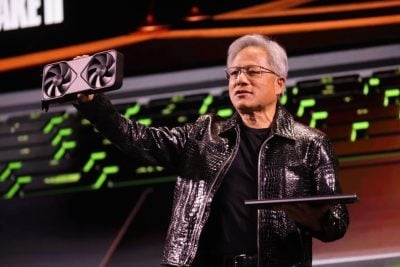
Jensen Huang resigned as NVIDIA’s CEO and left its board after the disclosure of personal behavior that the company called inconsistent with its code of conduct. On the November 17[1] earnings call, the board said it doesn’t intend to restore him, and finance chief Colette Kress is serving as interim CEO. Board chairman Harvey Jones stated: “The search will be thorough and we want to install the permanent CEO as quickly as possible, but we won’t expedite the CEO before finding exactly the right person.”[1]
China adds another layer of uncertainty for NVIDIA. It disclosed $2.4 billion[1] in Q3 FY2027 sales of licensed Hopper data center products to China, but it’s no longer shipping them, and its outlook assumes no China data center compute revenue. Management noted that it’s still studying current export controls.
Sector pressure has added to NVIDIA’s own problems as chip stocks weaken and a wider AI sell-off spreads. Riding a mania is one thing; knowing when to step aside is another, and we covered both halves in a free bubble survivor’s handbook. Even a strong quarterly report hasn’t stopped the selling in NVIDIA stock.
NVIDIA’s Valuation Shrinks as Results Keep Beating
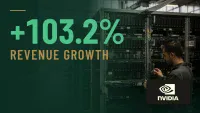
NVIDIA’s November 17[2] report gave the bulls plenty to work with. The company’s revenue of $115.84 billion[2] rose 103.2% year over year, beating the $108.73 billion consensus. NVIDIA’s adjusted earnings per share (EPS) came in at $2.68[2], ahead of the $2.4712 consensus. The company guided to Q4 FY2027 revenue of $130 billion, plus or minus 3%[2], and lifted its FY2028 revenue growth outlook to 75%[1] from 70%.
On valuation, NVIDIA’s trailing 12-month price-to-earnings (P/E) ratio stands at 15x. That multiple looks modest for a company growing revenue at triple-digit rates, yet NVIDIA stock has kept falling as results and guidance beat. Analysts’ consensus price target of $253.67 stands as the bull-case marker.

How Google and AMD Compare With NVIDIA
Google stock is down 20% over the past month to $273.45, a smaller decline than NVIDIA’s. Search advertising and cloud services anchor Google’s business, and the company designs its own tensor processing unit (TPU) chips that compete with NVIDIA. Vera Rubin systems are also deploying on Google Cloud, which makes Google both a rival and a customer.
Advanced Micro Devices (NASDAQ:AMD) stock is at $432.75. As NVIDIA’s most direct rival in graphics processing units (GPUs), the company is scaling up its Instinct MI450 chips and Helios racks while also selling server, PC and gaming processors. That broader mix leaves AMD less concentrated in AI accelerators than NVIDIA.
NVIDIA, by contrast, sells complete AI systems, from chips to networking, to hyperscalers, AI labs and governments, and large customers account for a big share of the company’s sales.
What It Would Take for NVIDIA to Get Back to $200

Bulls point to faster-than-expected growth, a low trailing P/E and the $227.3 billion[2] left on NVIDIA’s buyback authorization. A path back to $200 could require clarity on the CEO search, no further increase of China-related scrutiny and a steadier AI trade. “From a business perspective, it’s business as usual,”[1] Kress asserted on the call.
The bears counter that the leadership gap, the ongoing independent board committee investigation and NVIDIA’s $118 billion[2] in guarantee exposure could keep pressure on the stock. NVIDIA expects its Q4 gross margin of 71% to 72%[2] to mark the bottom as Vera Rubin ramps. Competition is growing, with Google’s TPU systems and AMD’s Helios racks giving buyers more choices.
NVIDIA’s Recovery Case Rests on Its Next CEO
NVIDIA’s next test is whether the board names a permanent CEO who can handle advanced chip technology and national-security pressure. Clarity on succession could refocus attention on Vera Rubin demand, while a drawn-out search could extend the valuation debate.
A return to $200 for NVIDIA depends on whether its earnings momentum can outweigh the leadership gap. Taking a conservative investment approach may be warranted until NVIDIA’s CEO search resolves.
Contact [email protected] for any questions or corrections.
David Moadel is financial writer specializing in stocks, ETFs, options, precious metals, and Bitcoin. David has written well over 1,000 articles for leading online publications, helping investors understand markets, income strategies, and risk. His work has appeared in 24/7 Wall St., The Motley Fool, InvestorPlace, U.S. News & World Report, TipRanks, ValueWalk, Benzinga, Market Realist, MarketScreener, TalkMarkets, Finmasters, and others. With a master’s degree in education, David has taught at the elementary, high school, and college levels. That teaching background shapes his writing style: clear, educational, and practical. David has also built a loyal social-media audience by providing trustworthy financial content on YouTube, X/Twitter, and StockTwits.