4 Dividend Stocks That Wall Street Gave Up On To Buy Now

This post may contain links from our sponsors and affiliates, and Flywheel Publishing may receive compensation for actions taken through them.
When the market gives up on a stock, the share price falls and the yield goes up, so new buyers lock in more income on every dollar they invest. That only works if the company keeps paying the dividend while the business recovers. Pfizer (NYSE:PFE | PFE Price Prediction) is a good example: its forward payout now yields 6.24% at today’s share price. Analysts are skeptical of all four names below, and each one passes three tests: cash flow or cash reserves that can fund the payout, a balance sheet the company can handle, and a specific reason the selloff went further than the business deserves. Those tests are essentially the opposite of the warning signs we track in a free dividend trap guide, which is worth a look before buying any ultra-high yielder.
Pfizer: Ultra-High Yield Backed by a Raised Outlook
Pfizer is a diversified drugmaker selling medicines and vaccines in oncology, cardiology, immunology and other areas. The market has soured on it. Shares are down 28.97% over five years and 6.88% over the past month, to $27.56. Analysts have 17 Hold ratings against 8 Buys and 1 Strong Buy, and the stock trades at about 9 times forward earnings.
We think that pessimism has gone too far, because results keep beating expectations. Third-quarter adjusted EPS came in at $0.87[1] against a $0.73 estimate, the seventh consecutive beat. Management raised full-year adjusted EPS guidance to $2.95 to $3.05[1]. Padcev grew 55%[1] and Eliquis grew 25%.
Dividend safety: The yield is ultra-high mostly because the share price has fallen. The $1.72 annual dividend equals about 57% of the midpoint of the EPS guidance. Cash coverage is tighter. The free cash flow yield of 5.81% is slightly below the dividend yield. Through nine months, operating cash flow of $8.8 billion[2] covered $7.3 billion in dividends, which means the dividend used about 83% of that cash. On the balance sheet, net debt to EBITDA is 2.76, interest coverage is 6.52x, and Pfizer paused share buybacks this year to pay down debt.
Track record: The quarterly payout grew from $0.18 in 2010 to $0.43, with no reduction since then. Pfizer did cut the dividend in 2009, from $0.32 to $0.16. The chief financial officer says the plan is to "maintain and, over time, grow our dividend."[2]
Why it is a recovery story: Newer launched and acquired products are growing fast enough to offset the shrinking COVID business. Those products grew 32%[2] operationally last quarter.
Risk: Patents are running out. Eliquis loses exclusivity internationally starting at the end of this year, and Ibrance and Xtandi are losing U.S. exclusivity, so if the new drugs grow more slowly than those sales fall, cash coverage gets thinner.
United Parcel Service: Ultra-High Yield With Rising Margins
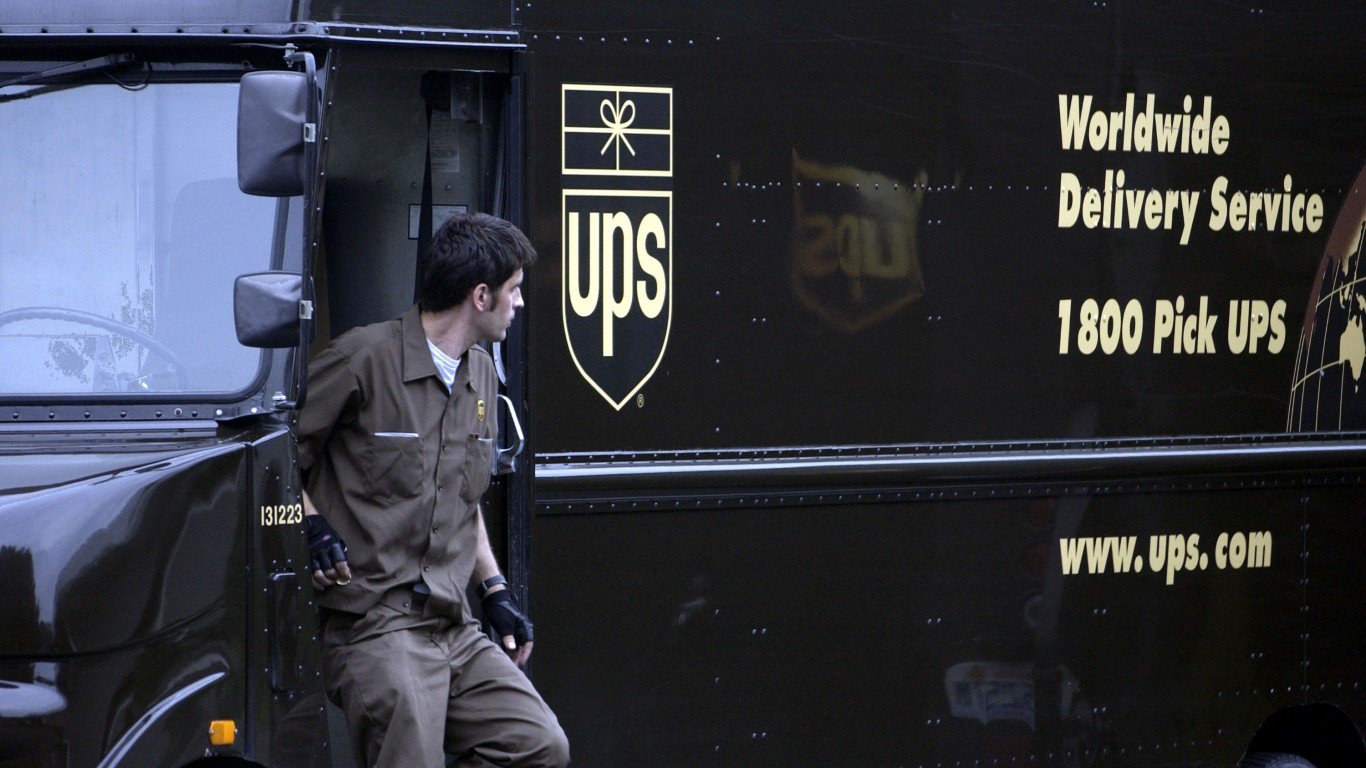
United Parcel Service (NYSE:UPS) delivers packages around the world and runs a supply chain business. Shares are down 33.52% over five years at $108.40. Analysts are split: 12 Holds, 1 Sell and 2 Strong Sells, against 14 Buys. A big reason is that UPS is deliberately reducing its volume from Amazon (NASDAQ:AMZN).
The selloff misses how much the pricing has improved. U.S. revenue per piece rose 6.1%[3], and the U.S. adjusted operating margin improved to 7.0%[4] from 6.4%. UPS raised full-year adjusted EPS guidance to about $7.28[4], and the stock trades at about 13 times forward earnings.
Dividend safety: At a 6.05% yield on the $6.56 annual payout, UPS is ultra-high-yield. Coverage is tight. Planned dividends of about $5.4 billion[4] use roughly 88.5% of the guided $6.1 billion in adjusted free cash flow. One cost is going away: the Driver Choice buyout program took $1.4 billion[3] in cash this year and is now finished. UPS ended the third quarter with $6.8 billion[3] in cash and no commercial paper outstanding. The chief executive put it directly: "Our dividend is safe and secure."[3]
Track record: UPS’s quarterly dividend records go back to 1999. The payout grew from $0.17 in 2000 to $1.64, with no reduction in the listed history. The most recent eight consecutive payments were held at that level.
Why it is a recovery story: Core volume, excluding Amazon, grew nearly 2%[3]. The finance chief expects free cash flow to "improve our dividend coverage."[3]
Risk: U.S. daily volume dropped to 15,621[4] thousand pieces from 16,150 thousand. If that decline keeps going faster than pricing increases can make up for it, there is little room left. It sits between free cash flow and the dividend.
Nike: A Net-Cash Balance Sheet Behind a Beaten-Down Brand
Nike (NYSE:NKE) is the world’s largest supplier of athletic shoes and apparel. Of these four stocks, it has fallen the hardest: down 45.42% year to date and 78.42% over five years, to $33.87. Analysts have 25 Holds, 5 Sells and 3 Strong Sells on the stock, and shares fell after Nike set a 2029 sales growth target meant to reassure investors (Reuters).
The pessimism ignores the parts of the business that are working. Performance products grew high single digits, North America grew 2%[5], and gross margin expanded to 42.8%. Nike’s new PACE operating model targets about $2.5 billion[5] in cumulative savings.
Dividend safety: The 4.84% yield is high because the share price fell. Earnings will not cover the dividend this fiscal year: the $1.64 annual dividend equals about 131.2% of the midpoint of fiscal 2027 adjusted EPS guidance ($1.15 to $1.35[5]). For now, the balance sheet pays the gap. Nike holds $8.4 billion[6] in cash and short-term investments and has more cash than debt, compared with about $610 million in dividends per quarter. It also has room to cut back on buybacks: it repurchased only $123 million[7] in stock last fiscal year under an $18 billion authorization. The finance chief said, "Under all scenarios, we have support for maintaining and ultimately growing the dividend over time."[6]
Track record: Nike has paid a quarterly dividend without a gap since 1999. The payout rose from $0.275 to $0.41 over the past six annual steps, and the next $0.41 payment has already been declared.
Why it is a recovery story: The cash cushion is large enough to keep the dividend going through a weak year. Meanwhile, the cost savings build.
Risk: Greater China revenue fell 22%[5], and that reset is expected by management to continue into fiscal 2028. If earnings stay below the dividend for several years, Nike would be paying it out of cash reserves.
Hershey: Raised Guidance and a Fresh Dividend Hike
Hershey (NYSE:HSY) is one of the world’s largest chocolate makers and has a growing salty snacks business. At $174.70, the stock is well below its 52-week high of $233.83 and its 200-day average of $187.14. Analysts have 15 Holds against 5 Buys and 2 Strong Buys, and the stock fell behind its competitors in the latest session (MarketWatch).
We think the market is too focused on cocoa costs. Third-quarter adjusted EPS of $2.64[8] beat the $2.11 estimate, the fifth straight beat, and full-year adjusted EPS guidance rose to $8.58 to $8.74. Salty snacks sales jumped 22.3%[8]. According to the CFO, "We don’t expect cocoa to remain at current levels long term."[9]
Dividend safety: The yield is 3.32%. The $5.808 annual payout equals about 67% of the midpoint of the EPS guidance, the most comfortable coverage in this group. Hershey’s strong free cash flow supports the dividend. Trailing EBITDA of about $3.14 billion and a 21.2% operating margin show earnings power that can comfortably handle its obligations.
Track record: Hershey raised the quarterly dividend to $1.452 from $1.37, after holding at $1.37 through the 2024 and 2025 payments. Before that, the record shows an increase in every year from $0.32 in 2009 onward.
Why it is a recovery story: Price increases are slowing from double digits to single digits. Management reported "the bend in the trend"[9] on sales volume.
Risk: Sales volume fell by about 10 points, offsetting about 11 points of pricing. If shoppers keep buying less after prices ease, earnings growth will stall.
Who These Four Names Suit
Pfizer and UPS offer the highest starting income, with yields above 6%, and both rely on cash coverage that management says will improve. Hershey has the safest earnings coverage and the most recent dividend increase. Nike gives up some yield, and its large net-cash balance sheet is what supports the payout during the turnaround. Each of the four depends on a recovery that could take several years, so quarterly free cash flow is the key figure to keep an eye on.
Contact [email protected] for any questions or corrections.
Lee Jackson has covered Wall Street analysts' equity and debt research and equity strategy daily for 24/7 Wall St. since 2012. His broad, diverse career, including a stint as creative services director at an NBC affiliate in Austin, Texas, gives him unique insight into the financial industry.
Lee Jackson's journey in the financial industry spans more than 30 years, including nearly two decades as an institutional equity salesperson at Bear Stearns, Lehman Brothers, and Morgan Stanley. His career spanned pivotal sell-side Wall Street events, from the dot-com rise and bubble to the Long-Term Capital Management debacle, 9/11, and the Great Recession of 2008. This reflects his resilience and adaptability amid market volatility.
Lee Jackson’s practical financial industry experience, gained through a career at some of the biggest banks and brokerage firms, is complemented by a lifetime of writing across various platforms. This unique combination allows him to shed light on the intricacies of Wall Street in a way only someone with deep insider experience and knowledge can. Moreover, his extensive network across Wall Street continues to provide direct access for him and 24/7 Wall St., a privilege few firms enjoy.
Since 2012, Jackson’s work for 24/7 Wall St. has been featured in Barron’s, Yahoo Finance, MarketWatch, Business Insider, TradingView, Real Money, The Street, Seeking Alpha, Benzinga, and other media outlets. He attended the prestigious Cranbrook Schools in Bloomfield Hills, Michigan, and has a degree in broadcasting from the Specs Howard School of Media Arts.