Chevron Cut Its Debt by $8.4 Billion. These 4 Dividend Stocks Have Fortress Balance Sheets

This post may contain links from our sponsors and affiliates, and Flywheel Publishing may receive compensation for actions taken through them.
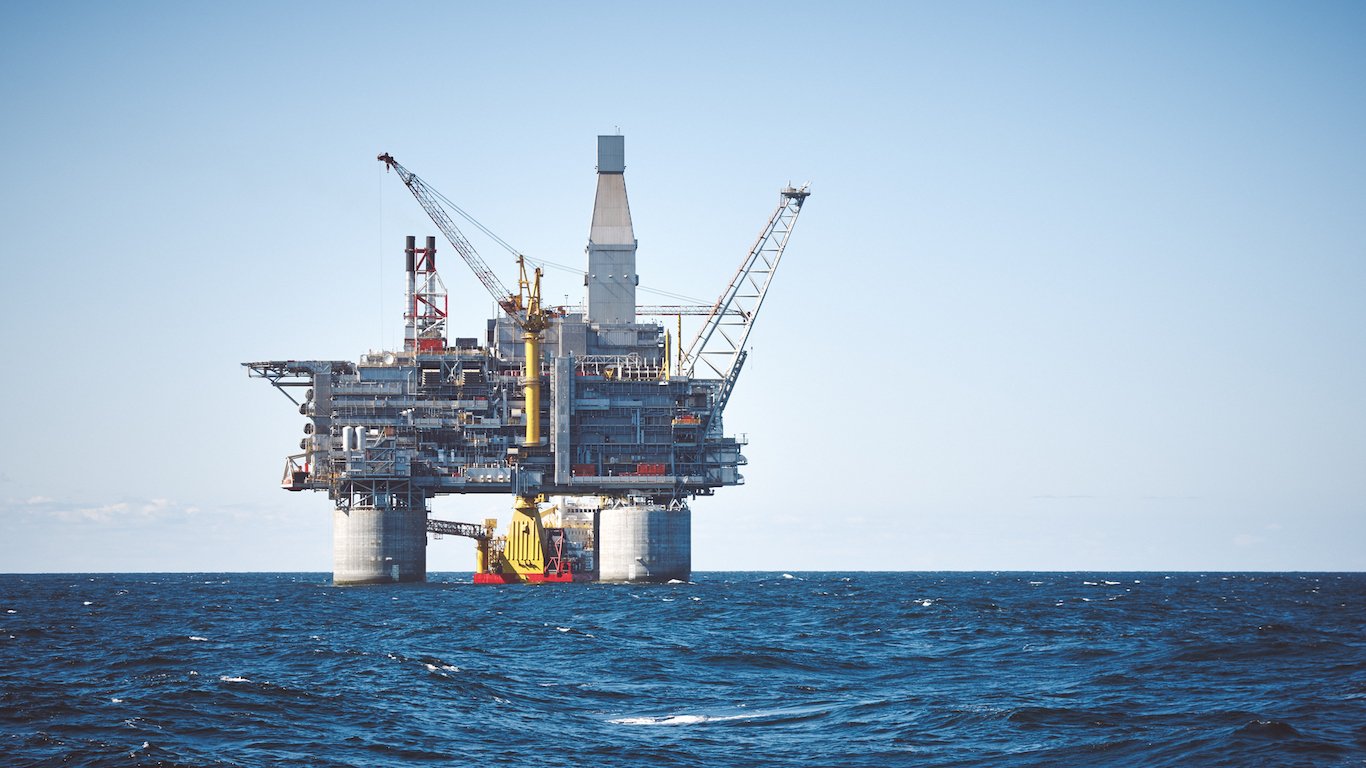
When a recession hits, the dividends that hold up are the ones backed by cash already in the bank, debt that’s easy to service, and free cash flow that covers the payout with room to spare. All four stocks below pass that test, each has a dividend-raise record checked against its actual payment history, and they come from four different sectors. Of the group, Chevron (NYSE:CVX | CVX Price Prediction) alone cut total debt by a record $8.4 billion[1] in the second quarter of 2026 and kept paying it down in the third. For readers at or near retirement, that kind of balance sheet protects the income stream when markets turn.
Chevron: A Debt Pile Shrinking Quarter After Quarter
Chevron yields 3.37% on a stock recently trading at $211.18. That’s based on a quarterly dividend of $1.78 per share[2], payable December 10, 2026.
Balance sheet evidence: Total debt fell to $33.5 billion at the end of September, down from $45.4 billion at the end of March. Net debt to EBITDA is 0.94. In plain terms, less than one year of cash earnings would pay off everything Chevron owes after taking off its cash. Operating profit covers interest costs 13.7x, and debt amounts to just 0.219 of shareholder equity. The company held $12.80 billion[2] in cash and equivalents. Management put net debt at 0.4 times[3] cash flow from operations at quarter-end.
Dividend safety: Third-quarter free cash flow reached $12.0 billion[2], while one quarter of dividends at the current rate and share count costs about $3.49 billion. The quarterly dividend equals about 34% of third-quarter adjusted EPS of $5.28[2], which beat the $4.83 consensus. CFO Eimear Bonner called dividend growth the company’s first priority: “We’ve done that for 39 consecutive years. We’ll continue to do that.”[3] The payment history supports her: the quarterly payout went from $1.63 in 2024 to $1.71 in 2025 and $1.78 in 2026.
Bull case: Chevron is producing more energy while spending less. Capex fell 12.1%[2] in the third quarter, and the company reached its $3 billion[1] structural cost-savings target six months early. In Venezuela, Chevron plans to double joint-venture output to roughly 600,000 bpd by 2031[3]. Management says the program will pay for itself, with total costs under $20 per barrel[3].
Risk: The results hinge on oil prices. During the third quarter alone, prices ran from $68[3] to $132 a barrel. The stock has dropped 8.66% over the past month and trades at about 33 times earnings. Chevron also expects a one-time, non-cash loss of $3 billion to $4 billion[3] when the Bakken midstream deal closes.
Johnson & Johnson: AAA Credit and 64 Straight Years of Raises
Johnson & Johnson (NYSE:JNJ) yields 1.95% at $274.55, based on a $1.34 quarterly dividend ($5.36 a year). The yield has come down because the stock is up 35.45% year to date. This pick is about income you can count on more than income size.
Balance sheet evidence: J&J carries S&P’s top AAA credit rating with a stable outlook. At the end of September, it held $16.91 billion in cash against $44.65 billion of total debt. That leaves net debt of about $27.7 billion for a company worth roughly $659.0 billion. Total debt was $54.99 billion at the end of March, so J&J has been paying it down all year.
Dividend safety: Second-quarter net income was $5.53 billion[4], while one quarter of dividends costs about $3.28 billion. The quarterly dividend equals about 46% of second-quarter adjusted EPS of $2.90[4]. In April, the board raised the dividend 3.1%[5], which the company said marked its 64th consecutive year of increases. That makes J&J a Dividend King. The payment history matches: $1.24 in early 2025, $1.30 after that year’s raise, and $1.34 today.
Bull case: New drugs are more than making up for lost sales of older ones. Oncology sales grew 17.3%[4] in the second quarter. DARZALEX reached $4.21 billion[4] (up 18.9%), and TREMFYA rose 72.5% to $2.05 billion. Total revenue grew 6.6%[4] to $25.31 billion.
Risk: STELARA sales fell 55.2%[4] to $740 million as cheaper biosimilar competitors took share. Litigation charges remain an ongoing cost, at $267 million in the second quarter, and the Orthopedics separation could be executed poorly.
Cisco Systems: More Cash Than It Needs to Fund the Dividend
Cisco Systems (NASDAQ:CSCO) yields 1.81% at $92.67, based on a $0.42[6] quarterly dividend. The next payment is due January 20, 2027,[6] to holders of record on January 4, 2027.
Balance sheet evidence: Cisco held $7.78 billion in cash and $8.07 billion in short-term investments against $29.8 billion of total debt. After taking off that cash, debt comes to about 0.7 times fiscal 2026 EBITDA of $20.0 billion. Fiscal 2026 operating income of $15.37 billion covered interest expense of $1.47 billion about 10 times.
Dividend safety: Operating cash flow in the first quarter of fiscal 2027 was $4.36 billion[6], while one quarter of dividends costs about $1.67 billion. The annual dividend equals only about 30% to 31% of fiscal 2027 non-GAAP EPS guidance of $5.47 to $5.53[6]. Cisco still had enough cash left to buy back $2.0 billion[6] of stock last quarter, with $6.1 billion left on its authorization. The payment history shows the quarterly dividend rising from $0.06 in 2011 to $0.42 today, with annual increases from 2014 through 2026.
Bull case: AI is driving Cisco’s fastest growth in years. Revenue rose 24.4%[6] to $18.52 billion, and non-GAAP EPS of $1.40 beat the $1.32 estimate. Networking jumped 43%[6], and management raised its fiscal 2027 AI infrastructure revenue outlook to $9 billion. CEO Chuck Robbins called it “the very early stages of a multi-year networking supercycle.”[6]
Risk: AI hardware sales carry lower margins, so gross margins could shrink, and a large share of those orders comes from a small group of hyperscalers. Tariffs add more pressure. The stock has fallen 12.99% over the past month, and it underperformed competitors on Tuesday.
Philip Morris International: Cash Flow Strong Enough to Shrink Its Debt
Philip Morris International (NYSE:PM) yields 3.47% at $184.65, after raising its quarterly dividend 8.8%[7] to $1.60 ($6.40 annualized).
Balance sheet evidence: Philip Morris carries the most debt of the four, but its debt load is falling fast. Net debt to adjusted EBITDA improved to 2.17x[7] from 2.53x at the end of 2025, and the company is targeting close to 2.0x by year-end. Total debt dropped from $51.95 billion at the end of March to $47.56 billion at the end of September. Cash rose 65.5%[7] to $6.68 billion. Operating income for 2025 covered interest expense about 9 times.
Dividend safety: Philip Morris expects a record of about $13.5 billion[8] in operating cash flow this year. A full year of dividends at the raised rate costs about $10.0 billion. The dividend equals about 76% to 77% of 2026 adjusted EPS guidance of $8.29 to $8.44[7], the highest payout ratio in this group. Management called September’s increase the 19th consecutive year[8] of raises. The payment history backs that up: the quarterly dividend rose from $0.46 in mid-2008 to $1.60 now, with a higher payout every year.
Bull case: Smoke-free products now make up more than 40% of net revenues across 110 markets. The adjusted operating margin expanded to 44.7%[7], and VEEV shipments rose 61.6%. The FDA granted reduced-risk (MRTP) authorization to 20 ZYN variants[9], which strengthens ZYN’s position in the U.S.
Risk: Shareholders’ equity was negative $7.94 billion at the end of September. That means liabilities on the books exceed recorded assets, and Philip Morris has reported negative equity in every annual report since 2012. Strong cash flow makes this more of an accounting quirk than a threat to the dividend, but it leaves less room for error than the other three have. Management also said full-year results will likely land at the midpoint, or the lower half of guidance, and the stock has slipped 5.01% over the past week.
Four Sectors, One Safety Test
Chevron and Philip Morris offer the higher current yields, while Johnson & Johnson and Cisco pay out a smaller share of earnings and have more room to raise their dividends. Each company covers its dividend with cash flow and has been paying down debt or holding it steady. Each also has a raise record confirmed by its actual payment history. Four names like these are the building blocks of a dividend ladder that pays the bills without ever touching the principal, the setup we walked through in a free guide here. Keep an eye on Chevron’s 2027 capital plan, which management said it would detail in December, and on Philip Morris’s progress toward its 2.0x leverage target.
Contact [email protected] for any questions or corrections.
Chris Lange is a financial and geopolitical writer with more than a decade of experience covering a myriad of topics. He has published thousands of articles for 24/7 Wall St., with past coverage focused heavily on stocks, IPOs, healthcare, defense, global affairs, and technology.
His work has been quoted, or referenced by a number of outlets including Business Insider, USA Today, Yahoo Finance, MSN, The Motley Fool, and many other publications. A graduate of Southwestern University, he studied business with a focus on investments and has previous experience in banking and startups.
When not reading or writing the news, he is following his passion for Lacrosse, playing chess, or building solar projects with his dad.