CoreWeave Can Now Borrow at 7% With Meta’s Name on the Loan

This post may contain links from our sponsors and affiliates, and Flywheel Publishing may receive compensation for actions taken through them.
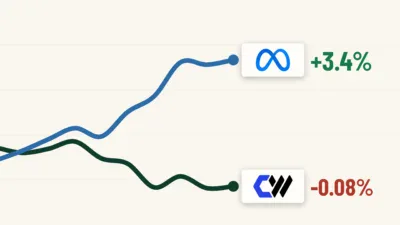
Banks are lining up a $4.5 billion loan for CoreWeave (NASDAQ:CRWV), with early price talk around 7% to 7.5%. On the same day, CoreWeave’s own 9% bond due 2031 hit a record low and yielded 18%.
Bloomberg reported the loan on Wednesday, November 25, 2026, citing people familiar with the deal. Morgan Stanley (NYSE:MS | MS Price Prediction) and Mitsubishi UFJ Financial Group (NYSE:MUFG) are preparing to sell it as soon as the week of November 30. The money would pay for graphics processors (GPUs) for Meta Platforms (NASDAQ:META) at a CoreWeave data center in Dalton, Georgia.
None of this is confirmed. CoreWeave and Morgan Stanley declined to comment; MUFG and Meta did not immediately respond, and the loan has not launched or been priced.
CoreWeave fell to a 52-week low of $37.40 before closing at $42.57, down 0.08%. It then rose 2.33% after hours, and that quote can change before markets reopen November 27.
What Banks Are Lining Up and What Is Unconfirmed
The loan is a delayed-draw term loan. CoreWeave takes cash from an escrow account as it buys hardware, then pays the debt down gradually. The GPUs that serve Meta are the collateral.
Meta is only the customer here, so the debt belongs to CoreWeave. CoreWeave itself is junk-rated, meaning its credit rating is below investment grade. The Meta contract is the reason the loan is still expected to earn investment-grade ratings, and that lets insurance companies limited to higher-quality debt buy it. Investors have already indicated demand that matches the full size, although the details and timing could change.
The reports did not say which Meta order supports the loan. The order already on record was signed September 25, 2025. Under it, Meta committed to pay up to approximately $14.2 billion through December 14, 2031.
What the Loan Changes for CoreWeave and Meta
CoreWeave spent $14.5 billion on capital projects in the third quarter, which brought its nine-month total to $30.65 billion. Spending at that rate only works if the debt costs less than the contracts earn.
Its average cost of debt across the business was 7.9%[1] at the end of the third quarter. So a loan priced near 7% would bring that average down.
For Meta, the loan is small next to its 2026 capital spending guidance of $135 billion to $145 billion. The report gives no reason for Meta’s 3.4% rise to $609.89.
Why 7% and 18% Can Both Be Right
The 7% figure is for a secured loan with an investment-grade rating that gets paid back in installments, while the 18% figure is the market yield on an unsecured bond. Both prices can be correct at the same time.
One bond due 2031 fell to 76.6 cents on the dollar on Tuesday, November 24, its lowest price since it was sold in July 2025. Five-year credit default swaps, which work like insurance against a default, put the chance of default over five years at more than 70%.
A separate measure put the spread at a record 13.14%. Figures from S&P Global Market Intelligence mean a 68% chance of default within five years.
Lenders will loan to CoreWeave cheaply only when Meta’s credit and the hardware stand behind the debt. Shareholders are paid after both kinds of lenders, and the collateral loses value if GPU prices fall.
What Investors Need to Know About CRWV Stock Now
CRWV stock carries more risk than the loan headline suggests. The loan pays for the Dalton expansion. But the cheap money is tied to Meta’s hardware, and CoreWeave’s own credit trades like distressed debt.
The stock is down 40.55% in 2026 and sits 76.8% below its record close of $183.58. Shareholders rank behind bondholders, who are asking for 18%, so the lower share price alone does not make the stock safer. Meta, by contrast, gets the computing capacity from this expansion without taking on CoreWeave’s debt.
The funding plan is holding if the loan prices at or below 7.5% with investment-grade ratings and the 2031 bond climbs back above 76.6 cents. If the launch shifts or the pricing goes higher, the 18% yield is the better guide.
Contact [email protected] for any questions or corrections.
Omor Ibne Ehsan is a writer at 24/7 Wall St. He is a self-taught investor with a focus on growth, cyclical, and dividend equities that have strong fundamentals, value, and long-term potential. He also has an interest in high-risk, high-reward investments such as penny stocks.