The Typical 401(k) Holds $44,115. The Average Is Nearly Four Times That

This post may contain links from our sponsors and affiliates, and Flywheel Publishing may receive compensation for actions taken through them.

If you have a 401(k), here’s the number to measure it against: $44,115. That’s the median balance in Vanguard’s 401(k) plans at the end of 2025, according to Vanguard’s How America Saves 2026. Half of savers have more and half have less.
The figure you’ll see quoted more often is the average, $167,970. It’s 3.8 times the median because a relatively small number of very large accounts pull it up. If your balance is under the average, you have plenty of company: most savers are.
Ray is 62, still working, and a few years from retiring. He rolled two old employer plans into his current 401(k), and the account now holds about $107,269, the median for Vanguard savers 55 to 64. Ray is a scenario we built for this story, so put your own balance in his place. Every time he reads about the average, he feels behind. He wants to know what his money will pay him.
The figures appear in 24/7 Wall St.’s new research report, “The State of the American Household.”
Why the median for your age is the fair test
Compare yourself with savers at your stage of life. Ray’s $107,269 is 2.4 times the median for all ages, because people in their late 50s and early 60s have had decades to contribute. Measured against the average, he’s short by $60,701. Measured against people his age, he’s right in the middle.
A quick check by age:
- Under 55: the all-ages median of $44,115 is the closest benchmark Vanguard publishes.
- 55 to 64: the median is $107,269.
If you have an old plan or an IRA somewhere else, add it in before you compare. Ray’s balance reached the median partly because he consolidated. Plenty of savers his age have money spread across two or three accounts, and each one looks small on its own.
A 401(k) usually isn’t a household’s only asset. In the Federal Reserve’s 2025 Survey of Consumer Finances, the median net worth for families headed by someone 55 to 64 is $411,300. Take out home equity and it’s $150,400, a 24/7 Wall St. calculation from the Fed’s public data. Next to those figures, Ray’s $107,269 would be most of a typical family’s money outside the house.
What Ray’s $107,269 pays each month
The 4% rule is a common starting point: withdraw 4% of the balance in the first year of retirement and raise it with inflation after that. On $107,269, that’s $4,291 a year, or $358 a month.
A 5% draw raises it to $447 a month, with more risk of running short if markets fall early in retirement. The average balance, for comparison, would pay $560 a month at 4%. The full gap between Ray and the average comes to $202 a month.
Every additional $10,000 Ray saves before he retires adds about $33 a month at 4%. That makes the next few years count. Catch-up contributions, an employer match he isn’t fully collecting, and a year or two more of work all move that monthly figure.
The other half of Ray’s retirement income is Social Security. He should pull his estimate from his account at ssa.gov and put it beside the $358. For most people near the median, Social Security will be the bigger of the two checks, which is why the age he claims it matters so much.
The withdrawal that costs the most
Vanguard also tracks hardship withdrawals, money taken out early to cover a bill such as medical costs or a looming eviction. In 2025, 6% of participants took one, three times the 2% share in 2021. That’s about 1 in 17 savers.
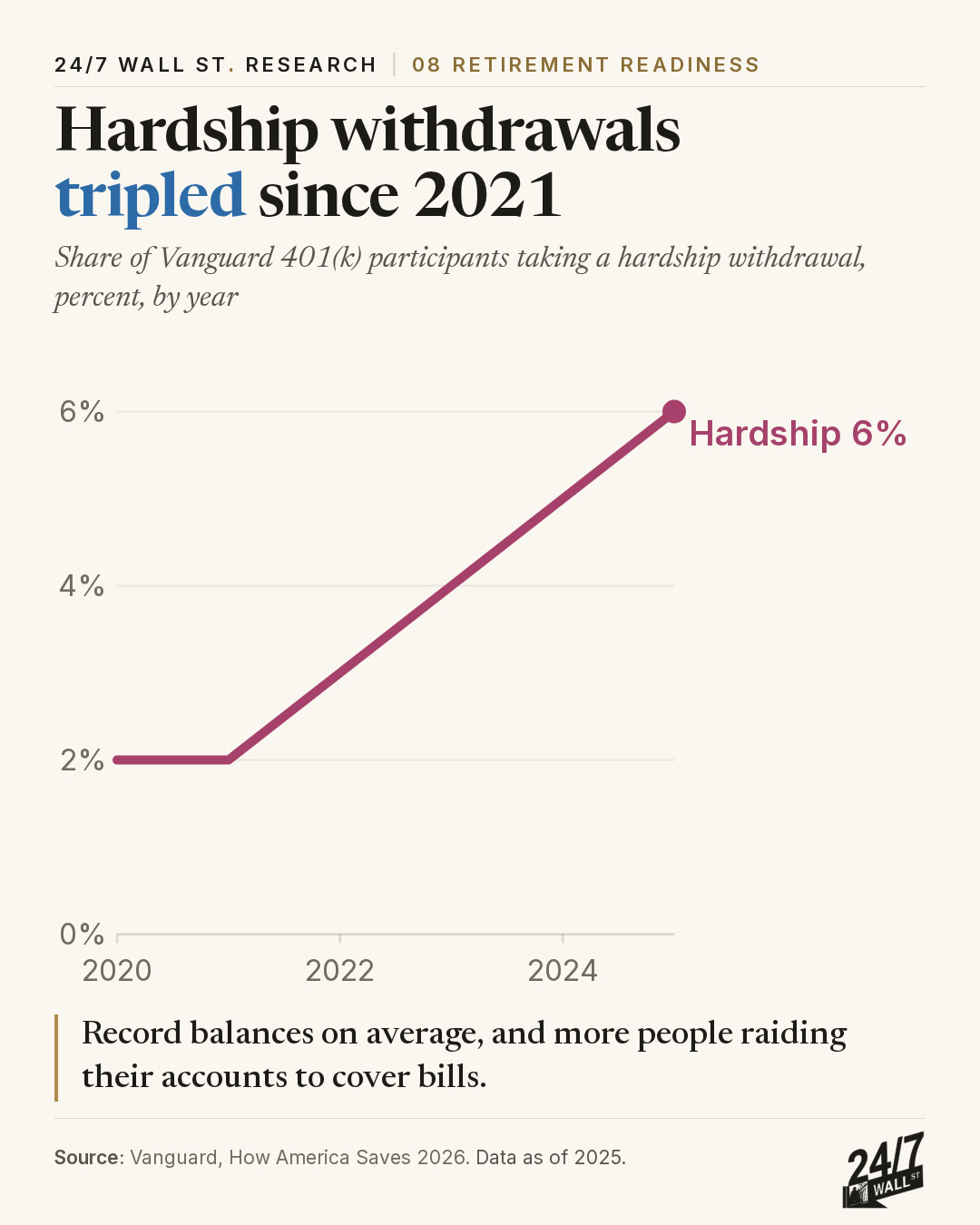
A hardship withdrawal trades a retirement dollar for a bill today. The money is taxed as income, and savers under the plan’s penalty-free age usually pay an extra early-withdrawal penalty on top. For someone in Ray’s position, every $10,000 pulled out now is $33 a month gone for life at the 4% rule, before counting the growth it would have earned.
If a large bill hits, check the alternatives first: a 401(k) loan, which you repay to yourself; a payment plan with the hospital or lender; or an emergency fund kept outside the plan.
Kevin O’Leary says you’ve made it at $5 million liquid, and as we reported in a recent story, almost no American household is anywhere near that. Ray doesn’t need to be. He needs to know his number, compare it with people his age, and turn the balance into a monthly figure he can plan around. Do the same math tonight: multiply your balance by 0.04, divide by 12, and set it next to your Social Security estimate.
On a $900,000 IRA, the IRS will make you withdraw $36,585 at 75. Here’s how to shrink it, free in The Daily Profit.
Contact [email protected] for any questions or corrections.
I've spent more than 15 years inside enterprise software, working alongside the finance, sales operations, and HR leaders who run the revenue engines at some of the largest tech companies in the country.
My day job is helping enterprise executives make smarter decisions about retention, compensation, and growth. These are the same operational levers that show up in every earnings report investors actually read. That perspective shapes my writing for 24/7 Wall St.
The headline numbers are easy. The interesting stuff is underneath: how companies make money, what executives are worried about, and what any of it means for the person checking their 401(k) on a Sunday afternoon. I write about personal finance and business as someone who has spent her career inside the rooms where these decisions get made.