The $110,000 Illusion: Why Vanguard’s “Average” Retirement Balance Misleads Most Workers
The headline number from Vanguard's 2025 How America Saves report looks reassuring at first glance: the average 401(k) account balance reached $148,153 in 2024. That figure suggests the typical American worker is sitting on a six-figure retirement nest egg. The…

This post may contain links from our sponsors and affiliates, and Flywheel Publishing may receive compensation for actions taken through them.

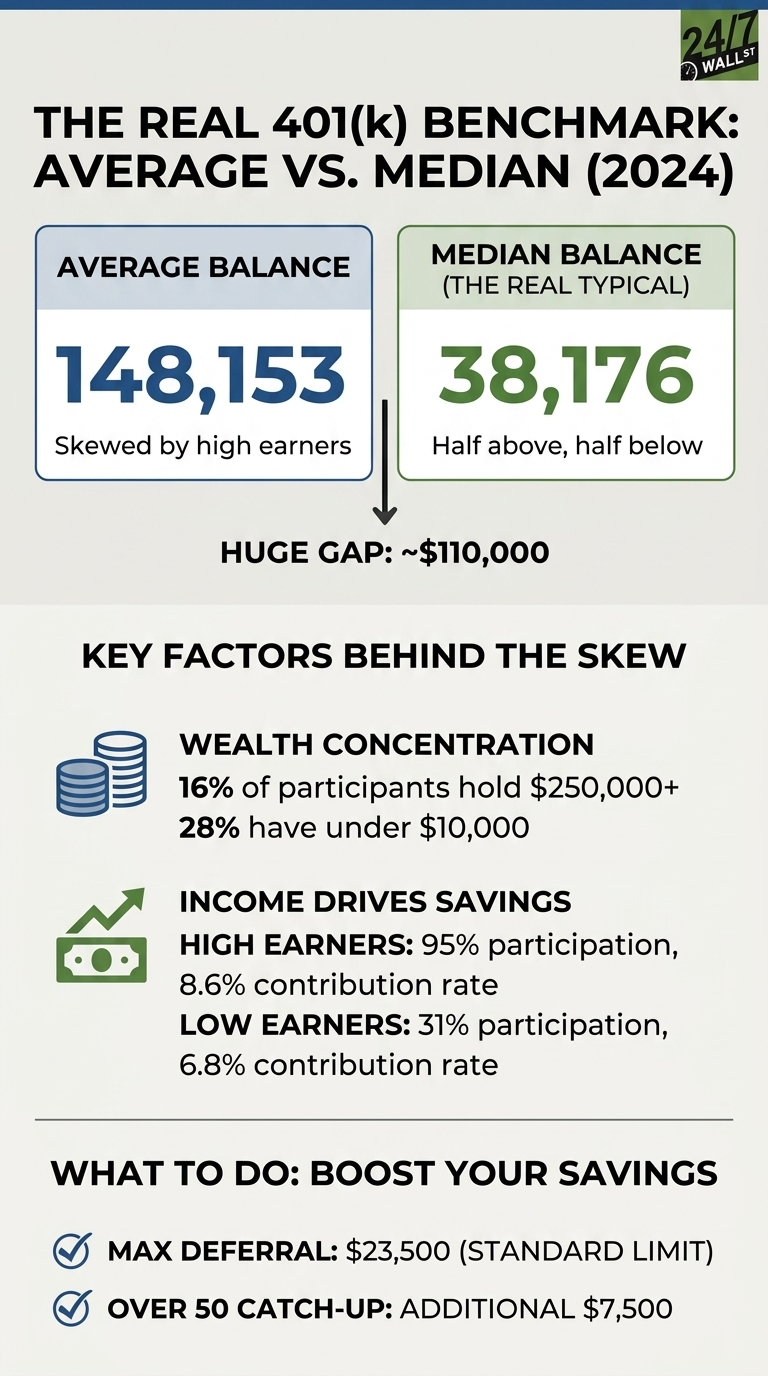
The headline number from Vanguard’s 2025 How America Saves report looks reassuring at first glance: the average 401(k) account balance reached $148,153 in 2024. That figure suggests the typical American worker is sitting on a six-figure retirement nest egg. The median tells a different story. At $38,176, the median balance describes the worker at the exact middle of the distribution, with half of all participants above and half below. That roughly $110,000 gap between those two numbers reflects how unevenly retirement wealth is distributed across the American workforce.
Why the Average Distorts
A simple illustration explains the problem. If 10 people each have $5,000 saved and one person walks in with $5 million, the median balance stays at $5,000. The average jumps to roughly $459,000. Nothing changed for the typical saver, yet the headline number now implies widespread wealth.
The same dynamic plays out in 401(k) data. Vanguard explicitly notes that the median “represents the typical participant: Half of all participants had balances above the median, and half had balances below.” The average, by contrast, is “indicative of participants at about the 75th percentile,” meaning roughly three in four workers have less than the figure dominating the headline.
Where the Skew Comes From
The concentration at the top is striking. According to Vanguard’s 2026 How America Saves report, which covers year-end 2025 data, 18% of participants held $250,000 or more, yet those balances carry most of the weight on the overall average. At the other end, one in four participants had less than $10,000 saved. The distribution resembles a steeply sloped, heavy-tailed curve rather than a tidy bell curve centered on the headline figure.
Income explains much of that tail. Participants earning $150,000 or more had a 95% participation rate in their employer plans, compared with 31% for those earning under $15,000. High earners also defer a larger share of their pay, contributing an average of 8.6% of income versus 6.8% for the lowest earners. Higher salaries, longer tenures, and a relatively small share of total accounts all combine to push the average well above what most workers actually hold.
The 6% Stress Test: Hardship on the Rise
While average balances look healthy on the surface, the underlying stability of retirement accounts is wavering. Vanguard’s 2026 report confirms that hardship withdrawals reached a record 6% of participants in 2025, up from 5% in 2024 and triple the pre-pandemic rate. That marks the sixth consecutive annual increase in Vanguard’s data. The leading reason participants tapped their funds early was to avoid home foreclosure or eviction; medical expenses ranked second, followed by home repair costs. The median hardship withdrawal amount was $1,900, and nearly half of those who made a withdrawal took more than one during the year.
The pattern suggests that for a growing segment of the workforce, the 401(k) is no longer a purely long-term vehicle. It increasingly doubles as a high-stakes emergency fund, with persistent inflation and elevated living costs pushing workers toward their retirement accounts when a crisis hits. Strong equity market performance, including a 16% return from the S&P 500 and a 7% rise in U.S. bonds in 2025, kept average balances climbing. But the hardship data reveals a fragility the headline numbers obscure. Vanguard’s 2026 report confirmed that the overall average balance climbed to $167,970 at year-end 2025, a 13% annual increase, while the median rose to $44,115, a 16% gain year over year.
Reading Your Real Number (Median vs. Average by Age)
To see where you actually stand, age-specific data is far more useful than the overall average. The gap between mean and median is most pronounced in older brackets, where a relatively small cohort of high-balance savers pulls the average far above what most workers actually hold. The table below shows figures from both the 2025 report (year-end 2024) and the more recent 2026 report (year-end 2025).
| Age Group | Median Balance (2024) | Average Balance (2024) | Median Balance (2025) | Average Balance (2025) |
|---|---|---|---|---|
| Under 25 | $1,948 | $6,899 | $2,234 | $7,259 |
| 35-44 | $39,958 | $103,552 | N/A | N/A |
| 55-64 | $95,642 | $271,320 | $107,269 | $305,006 |
| 65+ | $95,425 | $299,442 | $103,202 | $330,186 |
A Brighter Signal: Auto-Enrollment Gains
One area of genuine progress stands out. Plan participation climbed to a record 86% among eligible employees in 2025, driven largely by the spread of automatic enrollment. More than 61% of Vanguard plans with employee-elective deferrals had adopted auto-enrollment by year-end 2025, and nearly 79% of large plans (those with at least 1,000 participants) used the design. Nearly two-thirds of plans with auto-enrollment now default new participants at a deferral rate of 4% or higher. Auto-enrollment captures workers early, before inertia can delay the first contribution by months or years, which is why it has become one of the most consequential features in modern plan design.
New 2026 Rules for High Earners
The gap between high and low savers is also being reshaped by the SECURE 2.0 Act. Starting in the 2026 tax year, participants aged 50 and older who earned more than $150,000 in FICA wages in the prior year are required to make their catch-up contributions to Roth (after-tax) accounts. This removes the immediate tax-deferral benefit for the very group currently driving average balances higher, and it fundamentally alters long-term tax planning for top earners. Workers whose plans lack a Roth option lose access to catch-up contributions entirely if they clear the income threshold.
Key Numbers to Know
The IRS raised the 2026 annual deferral limit to $24,500, up from $23,500 for 2025. Workers aged 50 to 59 or 64 and older can add an $8,000 standard catch-up contribution, for a total of $32,500. Workers aged 60 to 63 qualify for the SECURE 2.0 “super catch-up” of $11,250, pushing their maximum annual contribution to $35,750. Those higher ceilings matter most to high earners: Vanguard’s 2026 data show that 52% of participants earning $150,000 or more used catch-up contributions in 2025, while fewer than 1% of those earning under $30,000 did the same.
Tenure, not age alone, may be the sharpest dividing line. Vanguard’s data show that participants with 10 or more years in their plan average $324,510, while those with under two years carry a median of just $6,140. Time in the plan compounds the advantage of every dollar contributed, which is why auto-enrollment has become such a consequential design feature: it captures workers early, before inertia can delay the first contribution by months or years.
Editor’s note: This article was updated to reflect Vanguard’s “How America Saves 2026” data, including a correction to the order of hardship withdrawal reasons (foreclosure and eviction avoidance ranked first, medical expenses second), the addition of the 2025 median hardship withdrawal amount of $1,900, equity market return context (S&P 500 up 16%, U.S. bonds up 7% in 2025), and auto-enrollment adoption figures showing 86% plan participation and 79% of large plans using automatic enrollment at year-end 2025.
Contact [email protected] for any questions or corrections.
David Beren has been a Flywheel Publishing contributor since 2022. Writing for 24/7 Wall St. since 2023, David loves to write about topics of all shapes and sizes. As a technology expert, David focuses heavily on consumer electronics brands, automobiles, and general technology. He has previously written for LifeWire, formerly About.com. As a part-time freelance writer, David’s “day job” has been working on and leading social media for multiple Fortune 100 brands. David loves the flexibility of this field and its ability to reach customers exactly where they like to spend their time. Additionally, David previously published his own blog, TmoNews.com, which reached 3 million readers in its first year. In addition to freelance and social media work, David loves to spend time with his family and children and relive the glory days of video game consoles by playing any retro game console he can get his hands on.