The 401(k) Paradox: Record Highs Mask a Growing Financial Crisis for Millions
Vanguard's 2025 How America Saves report describes a 401(k) landscape that appears healthy on the surface yet strained beneath. The average participant account balance climbed to a record level in 2024, but the share of workers tapping those same accounts…

This post may contain links from our sponsors and affiliates, and Flywheel Publishing may receive compensation for actions taken through them.

Vanguard’s 2025 How America Saves report describes a 401(k) landscape that looks healthy on the surface but shows real strain underneath. The average participant account balance climbed to a record in 2024, yet the share of workers tapping those same accounts under financial duress also hit a record. Both trends moved in the same direction at the same time, and the gap between them is the story of how the average American household experienced the past year.
Record Balances, Record Withdrawals
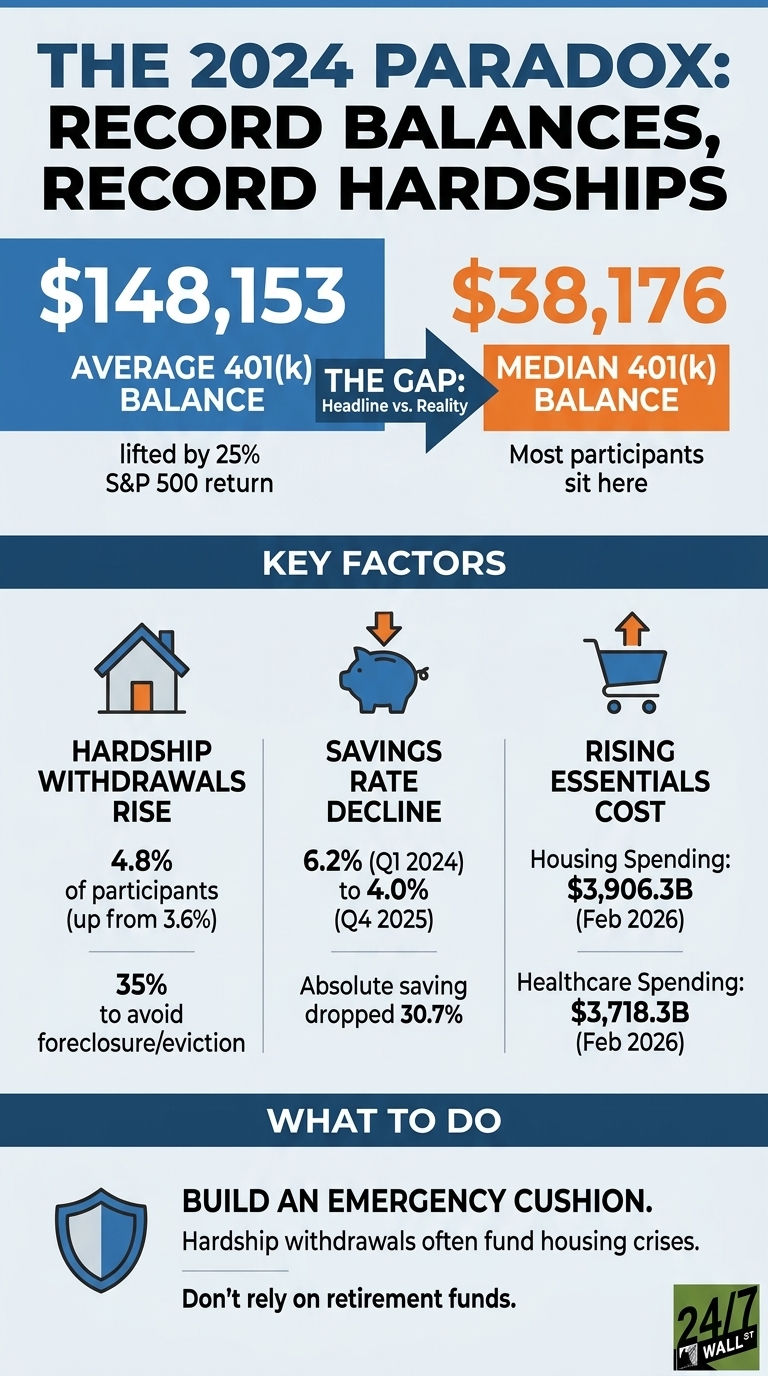
According to Vanguard, the average account balance rose 10% in 2024 to $148,153, lifted by an S&P 500 total return of 25% during the year. The median balance, which strips out the pull of very large accounts, was $38,176. The distinction matters. Vanguard notes that the average “is indicative of participants at about the 75th percentile,” meaning roughly three in four workers have balances below that headline figure, while the median “represents the typical participant.” A smaller group of large accounts is doing most of the lifting on the number most people see.
At the same time, hardship withdrawal usage rose to 4.8% of participants in 2024, up from 3.6% in 2023. Of those withdrawals, 35% went specifically toward avoiding home foreclosure or eviction, and another 30% covered medical expenses. Workers were not reaching into retirement accounts for discretionary spending. They were using them as last-resort emergency funds because other financial buffers had thinned out.
The K-Shaped Split
The Vanguard data breaks the participant base into income tiers, and the divide is wide. Among employees earning more than $150,000, 95% participate in their workplace plan. Among those earning under $15,000, only 31% do. Within the participant pool, workers with balances under $10,000 make up 28% of accounts and borrowed an average of 36% of their balance, the highest borrowing share of any balance group. Auto-enrollment plans posted 94% participation versus 64% for voluntary plans, but simply enrolling a low-income worker does not resolve the cash-flow pressure that can later force them to withdraw.
What the Macro Data Shows
The broader picture inside Vanguard plans aligns with the hardship trend rather than the balance trend. The average participant deferral rate reached 7.7% in 2024, an all-time high, but 22% of participants still deferred less than 4% of their pay. Meanwhile, 45% of participants saw their deferral rate increase during the year, through automatic escalation or their own decision, while 8% decreased it and 2% stopped contributing entirely.
Essentials absorbed most of the strain. Of the hardship withdrawals taken in 2024, 35% were directed at avoiding foreclosure or eviction and 30% at medical expenses. These were last-resort liquidity events. At the same time, 13% of participants had an outstanding loan, with the average loan amount running about $11,000. Workers were treating retirement accounts as emergency reserves because other buffers had thinned out first.
The Trend Has Not Reversed
The 2024 data already pointed to stress. The 2025 figures suggest that stress deepened. Vanguard’s preview of its How America Saves 2026 report, covering data through year-end 2025, shows the average account balance climbed further to $167,970, a 13% gain, while the median reached $44,115. The S&P 500 returned 16% in 2025, international equities returned 32%, and the U.S. bond market rose 7%, providing a strong tailwind.
Yet hardship withdrawals rose again. In 2025, 6% of Vanguard participants initiated at least one hardship withdrawal, up from 4.8% in 2024 and from roughly 2% before the pandemic. That marks six consecutive years of increases dating to 2018, when Congress eliminated the requirement to take a 401(k) loan before accessing a hardship distribution. Nearly half of those who took a hardship withdrawal in 2025 took more than one. The median withdrawal amount was $1,900. Avoiding foreclosure or eviction remained the top reason, followed by medical expenses. A separate Vanguard survey found that 45% of participants hold less than $2,000 in emergency savings outside their retirement accounts.
Practical Implications
A few observations follow from the combined data:
- Median versus average. The $38,176 median for 2024 (rising to $44,115 in 2025) is a more useful benchmark for most workers than the headline average, which reflects the pull of high-balance accounts near the top of the distribution.
- Emergency fund layering. The pattern of hardship withdrawals tied to foreclosure, eviction, and medical costs points to households that lacked a non-retirement cushion when expenses spiked. A Vanguard survey confirms this: nearly half of participants have less than $2,000 set aside outside their plan.
- Automatic enrollment and auto-escalation. Vanguard’s 94% participation rate in auto-enrolled plans is meaningful primarily when the default contribution rate continues to rise over time. In 2024, 61% of plans automatically enrolled workers at 4% or higher, up from 39% in 2014, and 69% of those plans paired enrollment with automatic annual increases.
The 2024 paradox is that the same year produced both record account values and record emergency drawdowns. The averages went up. The capacity to absorb a financial shock did not. The 2025 data published by Vanguard shows the same dynamic continuing, with balances rising again while the share of workers raiding their retirement savings also rose to a new record.
Editor’s note: This article has been updated to correct the S&P 500 return figure for 2024 from 23% to 25% (total return including dividends), consistent with the article’s own infographic, and to add context from Vanguard’s newly released How America Saves 2026 report, which shows average balances rising to $167,970 and hardship withdrawals climbing to 6% of participants in 2025.
Contact [email protected] for any questions or corrections.
David Beren has been a Flywheel Publishing contributor since 2022. Writing for 24/7 Wall St. since 2023, David loves to write about topics of all shapes and sizes. As a technology expert, David focuses heavily on consumer electronics brands, automobiles, and general technology. He has previously written for LifeWire, formerly About.com. As a part-time freelance writer, David’s “day job” has been working on and leading social media for multiple Fortune 100 brands. David loves the flexibility of this field and its ability to reach customers exactly where they like to spend their time. Additionally, David previously published his own blog, TmoNews.com, which reached 3 million readers in its first year. In addition to freelance and social media work, David loves to spend time with his family and children and relive the glory days of video game consoles by playing any retro game console he can get his hands on.