Broadcom Makes More AI Money Than AMD—So Why Is AMD’s Stock Crushing It?

This post may contain links from our sponsors and affiliates, and Flywheel Publishing may receive compensation for actions taken through them.
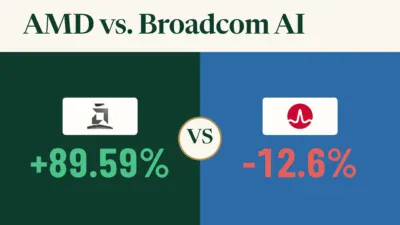
Last quarter, Broadcom (NASDAQ:AVGO | AVGO Price Prediction) earned $16.7 billion[1] in AI semiconductor revenue. That is more than the entire $8.5 billion[2] Data Center segment at AMD (NASDAQ:AMD). Even so, AMD shares are up 89.59% year to date, while Broadcom is down 12.6%. That gap shows what investors are paying for right now.
Custom Silicon Pays Broadcom While Helios Racks Fuel AMD
Six frontier-model customers drive Broadcom’s AI engine. XPUs made up 73% of AI revenue[3], across Google’s TPUs, OpenAI’s Jalapeno and Meta’s MTIA. AI revenue grew 221% year over year[1], so Broadcom still leads on scale. CEO Hock Tan said “Demand for our custom AI accelerators and networking continues to be very strong.”[1]
AMD sells merchant hardware that any buyer can order. Q3 brought its first revenue shipments of MI455X GPUs and Helios racks. Anthropic, Meta, Microsoft, OpenAI and Oracle were among the lead customers. Data center reached 64% of total revenue[2], up from 47% a year earlier. That is a fast shift toward AI infrastructure. Gaming fell 40%[4] as the console cycle aged, and investors appear to be looking past that drag.
| Business Driver | AMD | Broadcom |
|---|---|---|
| AI Product | Instinct GPUs, Helios racks, EPYC Venice | Custom XPUs, Tomahawk Ethernet |
| Weak Spot | Gaming, cash conversion | Customer concentration |
Investors Are Paying Up for AMD’s Growth Curve
AMD now expects 2027 revenue to grow more than 80%[2]. It also expects data center to top 80% of total revenue[2] and server sales to double. That path supports a 26x forward multiple, compared with Broadcom’s 16x. The ramp is eating cash, though. Free cash flow fell 70.9%[4] to $554 million, and inventory rose to $11.46 billion. AMD is building ahead of demand that still has to show up in shipments.
Broadcom is heading to about $115 billion[3] in fiscal 2027 AI revenue. Its reliance on a few of customers holds back enthusiasm. Broadcom built financing vehicles with Apollo and Blackstone for Anthropic and OpenAI, and it may provide residual-value guarantees. Memory-heavy XPUs are also driving gross margin down to 73%[3] from 78% a year ago. That is still well above AMD’s 55%[4] outlook.
Broadcom’s December 9 Report Comes First
Broadcom reports on December 9[3] and is heading to $21.7 billion[1] in Q4 AI revenue. It will be worth watching for more detail on its financing exposure. For AMD, you should keep an eye on whether data center grows about 50% sequentially[2] toward the company’s $17 billion[4] revenue guide. Last week AMD fell 23.41% and Broadcom fell 15.02%, a sign that view is still thin.
Why I Prefer Broadcom’s Cash Engine Over AMD’s Momentum
To me, Broadcom looks like the sturdier business at today’s valuation. Its $13.66 billion[1] in quarterly free cash flow pays for dividends and debt reduction, and the stock trades at a lower forward multiple despite larger AI sales. AMD suits growth investors who can handle a beta of 2.542. I would warm to AMD if Helios shipments turn that inventory into cash during 2027. I would second thought Broadcom if its frontier-lab customers delay deployments.
Contact [email protected] for any questions or corrections.
Alex Sirois is a financial writer with experience spanning both retail and institutional investing. He has written for InvestorPlace and held roles at BNY Mellon and Bernstein, giving him a perspective that bridges Main Street portfolios and Wall Street analysis.
Alex holds an MBA from George Washington University and has built his career across multiple industries, including e-commerce, education, and translation — a breadth of experience that informs how he breaks down complex financial topics for everyday investors. His writing is conversational, actionable, and grounded in long-term, buy-and-hold investing principles.
At 247 Wall St., Alex focuses on delivering analysis that is both accessible and useful, with a clear emphasis on helping readers make more informed decisions with their money.