Forget Yield Chasing. These 5 Dividend Stocks Have Raised Payouts Through Every Recession Since the 1970s

This post may contain links from our sponsors and affiliates, and Flywheel Publishing may receive compensation for actions taken through them.

Chasing yield is how income portfolios get cut during recessions. A steadier approach is to own payouts that keep growing while the economy contracts, and five blue chips have done exactly that. Each one has raised its dividend for at least 50 consecutive years, which puts all five in Dividend King territory and carries their runs through every U.S. recession since the 1970s. Every name below backs that record with real free cash flow, manageable payout ratios and brands that hold their pricing power in a downturn. For income investors, the yield is only the starting point. What matters most is the next raise.
Procter & Gamble Owns the Longest Raise Streak in the Group
Procter & Gamble (NYSE:PG | PG Price Prediction) sets the bar for dividend strength. In its fiscal Q4 filing, the company described its current payout as 70th consecutive year of dividend increases and 136th consecutive year of dividend payments[1]. The shares yield 2.56% at a recent price of $169.60, and the quarterly dividend is $1.0885.
The dividend is well covered. Trailing dividends of $4.291 per share take up about 65% of trailing earnings of $6.64 per share. Cash flow is stronger still. P&G generated $15.835 billion[1] of free cash flow in fiscal 2026 and plans to pay more than $10 billion[2] in dividends this fiscal year. Cash reached $15.365 billion after Q1, and management guides free cash flow productivity of 85% to 90%[3].
The bull case: Volume is doing the work. Q1 organic sales rose 4%[3], all 10 product categories grew, and core EPS of $2 came in ahead of the $1.89 estimate. The Thorne acquisition adds a health and wellness business on top of that.
The warning: Commodity inflation. Guidance absorbs an estimated $1.4 billion after-tax[3] cost drag, and core gross margin fell 150 basis points. If productivity savings fall short, future raises get smaller, but the payout itself stays well covered.
Coca-Cola Backs Its Growing Dividend With Its Strongest Balance Sheet in Years
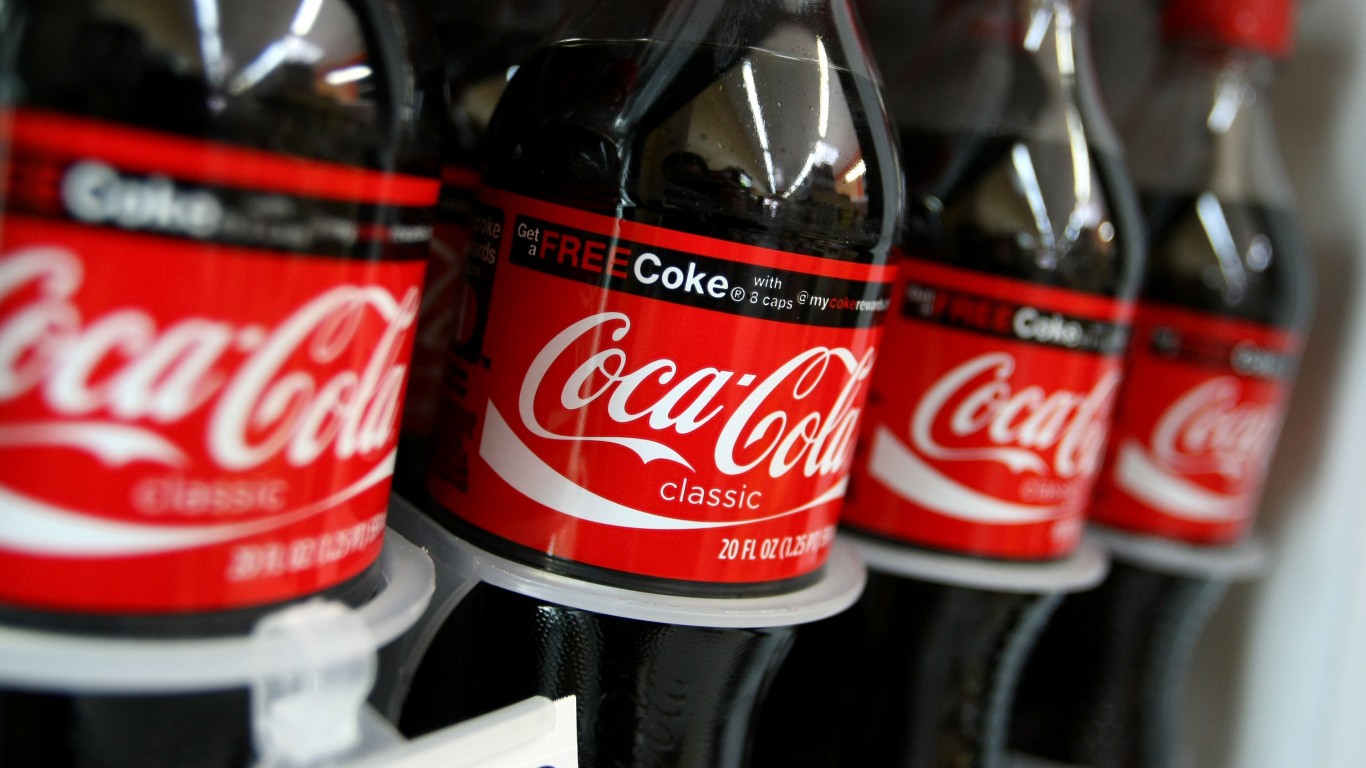
Coca-Cola (NYSE:KO) yields 2.13% at $95.88. The quarterly dividend rose to 53 cents from 51 cents. Dividend records show the quarterly rate climbing from 16 cents in 1999 to today’s level.
Coverage is solid. The trailing dividend of $2.10 uses about 62% of trailing EPS of $3.39. Management lifted its outlook for full-year free cash flow to at least $13 billion[4], well above the roughly $9.12 billion annual cost of the current dividend. On the third-quarter earnings call, CFO John Murphy put net debt leverage at 1.3 times EBITDA[5], below the company’s target range, and said capital returns run “primarily through our dividend.”
The bull case: Momentum is broad. Third-quarter organic revenue grew 7%[5], unit cases rose 5%, and comparable operating margin expanded to 32.9%[4] from 31.9%.
The warning: Pending IRS tax case. Murphy said the company is preparing for “a best- and worst-case scenario.”[5] An adverse ruling would use up cash that could otherwise fund bigger raises.
Johnson & Johnson Adds Healthcare Ballast to the Income Mix
Johnson & Johnson (NYSE:JNJ) yields 1.95% at $270.05. Its most recent raise lifted the quarterly dividend 3.1% to $1.34[6], which the company said marked its 64th consecutive year of dividend increases.
The annualized dividend of $5.36 equals about 50% of 2025 adjusted EPS of $10.79. The GAAP payout ratio looks higher, at about 80%, because reported earnings carry litigation, restructuring and separation charges. J&J produced $19.7 billion of free cash flow in 2025, well more than the roughly $12.9 billion the current dividend costs each year.
The bull case: Growth in oncology and immunology. Second-quarter adjusted EPS of $2.90[7] beat the $2.85 estimate on revenue of $25.31 billion. TREMFYA grew 72.5%, and J&J recently asked the FDA to approve CAPLYTA for bipolar mania, which would be the drug’s fifth potential indication.
The warning: Biosimilar erosion. STELARA sales fell 55.2%, and new products have to keep outrunning that decline to fund raises of the same size.
PepsiCo Pays the Highest Yield in the Group
PepsiCo (NASDAQ:PEP) yields 4% at $140.21, the highest yield of the five. The quarterly dividend now stands at $1.48, up from 13 cents in 1999 records.
Trailing dividends of $5.80 use about 73% of trailing EPS of $7.95. Interest coverage of 10.26x leaves room on the debt side. Management plans $7.9 billion[8] in dividends against just $1.0 billion in buybacks this year, which shows how strongly it puts the dividend first.
The bull case: Value plus international growth. The stock trades at 23x earnings and is up only 0.66% year to date, so the yield has stayed high. Latin America Foods grew 14% and Asia Pacific Foods grew 10%.
The warning: Free cash flow coverage. Trailing free cash flow of roughly $7.67 billion is below the dividend budget. Meanwhile, North America foods core operating profit fell 12% and core EPS growth guidance was cut to 2.5% to 3.5%[8]. Barron’s recently downgraded the stock to Sell over those North American problems (Barron’s). If that business doesn’t recover, expect smaller raises.
McDonald’s Turns Franchise Rent Into Rising Dividends
McDonald’s (NYSE:MCD) yields 2.62% at $276.38 after raising its quarterly dividend 4% to $1.93. Dividend records show a higher payout rate every year from 2001 through 2026.
Trailing dividends of $7.44 use about 59% of trailing EPS of $12.64. Trailing free cash flow of roughly $7.18 billion covers the $5.45 billion annual cost of the dividend. An operating margin of 46.10% and interest coverage of 7.83x offset net debt of 3.70 times EBITDA. Shareholder equity is negative because of years of buybacks.
The bull case: A business that collects royalties. CFO Ian Borden said the company is on a path to “98% by the end of 2028” restaurants. Third-quarter adjusted EPS of $3.57 beat the $3.38 estimate, and global comparable sales rose 1.5%.
The warning: Milder traffic. U.S. comparable sales slipped 0.2%, and revenue of $7.157 billion missed the $7.285 billion estimate. A planned national value menu has to bring traffic back.
5 Payouts That Have Kept Rising Through 6 Recessions
These runs crossed the 1980, 1981–82, 1990–91, 2001, 2008–09 and 2020 recessions, and the cash flow behind them still covers every payout except PepsiCo’s, where coverage is tight. Procter & Gamble and Johnson & Johnson offer the richest coverage, Coca-Cola and McDonald’s pair dividend growth with strong margins, and PepsiCo delivers the most current income, provided North America steadies. Together, they give income investors a dividend stream built to rise through the next downturn, too.
Contact [email protected] for any questions or corrections.
Joel South covers large-cap stocks, dividend investing, and major market trends, with a focus on earnings analysis, valuation, and turning complex data into actionable insights for investors.
He brings more than 15 years of experience as an investor and financial journalist, including 12 years at The Motley Fool, where he served as an investment analyst, Bureau Chief, and later led the Fool.com investing news desk. He has also co-hosted an investing podcast and appeared across TV and radio discussing market trends.