3 Dividend Kings Retirees Can Own for the Rest of Their Lives

This post may contain links from our sponsors and affiliates, and Flywheel Publishing may receive compensation for actions taken through them.

Retirement income works best when the check arrives on schedule and grows every year. Three companies that have done that through recessions, inflation spikes and rate cycles are Procter & Gamble (NYSE:PG | PG Price Prediction), Johnson & Johnson (NYSE:JNJ) and Coca-Cola (NYSE:KO). Together they have 198 years of consecutive dividend increases. All three are Dividend Kings. All three pay their dividends out of steady cash flow, and all three sell things people keep buying in any economy: detergent and diapers, cancer drugs and heart devices, and soft drinks. Below is how safe each dividend looks today and why each one can hold up a retirement income stream for decades.
Procter & Gamble: Seven Decades of Raises Funded by Everyday Brands
P&G yields 2.56% at a share price of $169.59 and pays $1.0885[1] per share each quarter. The yield is modest. What retirees get is reliability. The company confirmed its 70th consecutive year of dividend increases and 136th consecutive year of dividend payments[2] with its fiscal year-end results. The payout history backs this up. The quarterly payout went from 94.07 cents in 2023 to $1.0065 in 2024, then $1.0568 in 2025 and $1.0885 in 2026.
The dividend is well covered. At the current rate, a full year of dividends equals about 62% of the $7.00 midpoint of fiscal 2027 core EPS guidance. On a cash basis, P&G plans to pay over $10 billion[1] in dividends in fiscal 2027. Fiscal 2026 free cash flow was $15.835 billion[2], up 12.74% from the year before. That means the dividend uses about 63% of last year’s free cash flow. The rest funds roughly $5 billion[1] in planned buybacks. First-quarter free cash flow was $4.401 billion[1] after $1.366 billion of capital spending. Management also expects 85% to 90%[1] free cash flow productivity, meaning most of its earnings should turn into cash.
Bull case: P&G is growing at the right time. Fiscal first-quarter core EPS of $2 beat the $1.89 estimate. Net sales rose 4%[1] to $23.28 billion, and all five segments grew organically, led by Beauty at 6.4%. The recently closed Thorne acquisition adds a health and wellness business. At 24x forward earnings, income investors pay a reasonable price for one of the most dependable dividends on the market. The stock’s beta of 0.361 means it moves far less than the broader market, which helps retirees who are drawing down a portfolio.
Risk: Costs are rising. P&G expects about $1.4 billion in after-tax commodity headwinds in fiscal 2027. That is part of a combined 79 cents per share drag on core EPS growth, and Barron’s recently linked the company’s job cuts to slowing earnings growth. If commodity prices stay high, expect smaller dividend raises. The dividend itself looks secure.
Johnson & Johnson: A Top-Rated Balance Sheet Behind a Healthcare Payout
J&J yields 1.98% at $270.72 per share. Earlier this year the board raised the quarterly dividend 3.1%[3] to $1.34 from $1.30, its 64th consecutive year of increases. The payment record shows steady raises: $1.13 to $1.19 in 2023, $1.19 to $1.24 in 2024, $1.24 to $1.30 in 2025 and $1.30 to $1.34 in 2026.
GAAP earnings make coverage look weaker than it is. Trailing EPS of $6.59 is held down by ongoing litigation charges, and the latest quarter showed reported earnings growth of -95.9% year over year. On an adjusted basis, a full year of dividends at the current rate equals about 46% of the $11.68 midpoint of 2026 adjusted EPS guidance issued in the second quarter. J&J generated $1.5 billion[3] of free cash flow in the first quarter, and trailing EBITDA reached $34.5 billion.
J&J’s strongest feature is its balance sheet. It is one of only two U.S.-based companies with a AAA credit rating, which is higher than the rating on U.S. government debt. For retirees, that rating means the dividend is supported by one of the strongest balance sheets of any company.
Bull case: J&J is growing faster than most investors expect from a 64-year dividend payer. Second-quarter revenue rose 6.6%[4] to $25.31 billion, and adjusted EPS of $2.90 beat the $2.85 estimate. Oncology sales grew 17.3%[4], DARZALEX sales rose 18.9% to $4.21 billion, and TREMFYA sales jumped 72.5%. At the time, management raised full-year guidance to $100.8 billion to $101.4 billion[4] in revenue and $11.60 to $11.75 in adjusted EPS. CEO Joaquin Duato said J&J is “on track to meet our 2026 target of more than $100 billion in annual revenue for the first time in our Company’s 140-year history.”[4] The stock trades at 23x forward earnings, well below its 41x trailing multiple. That gap shows how much one-time charges are lowering reported profits.
Risk: STELARA sales are falling. Revenue from the former blockbuster dropped 55.2%[4] in Q2 as biosimilars took market share. The newer drugs are making up for it so far. If launches slow, earnings growth would narrow and future dividend raises would likely stay in the low single digits.
Coca-Cola: A Higher Cash Flow Forecast Protects the Payout
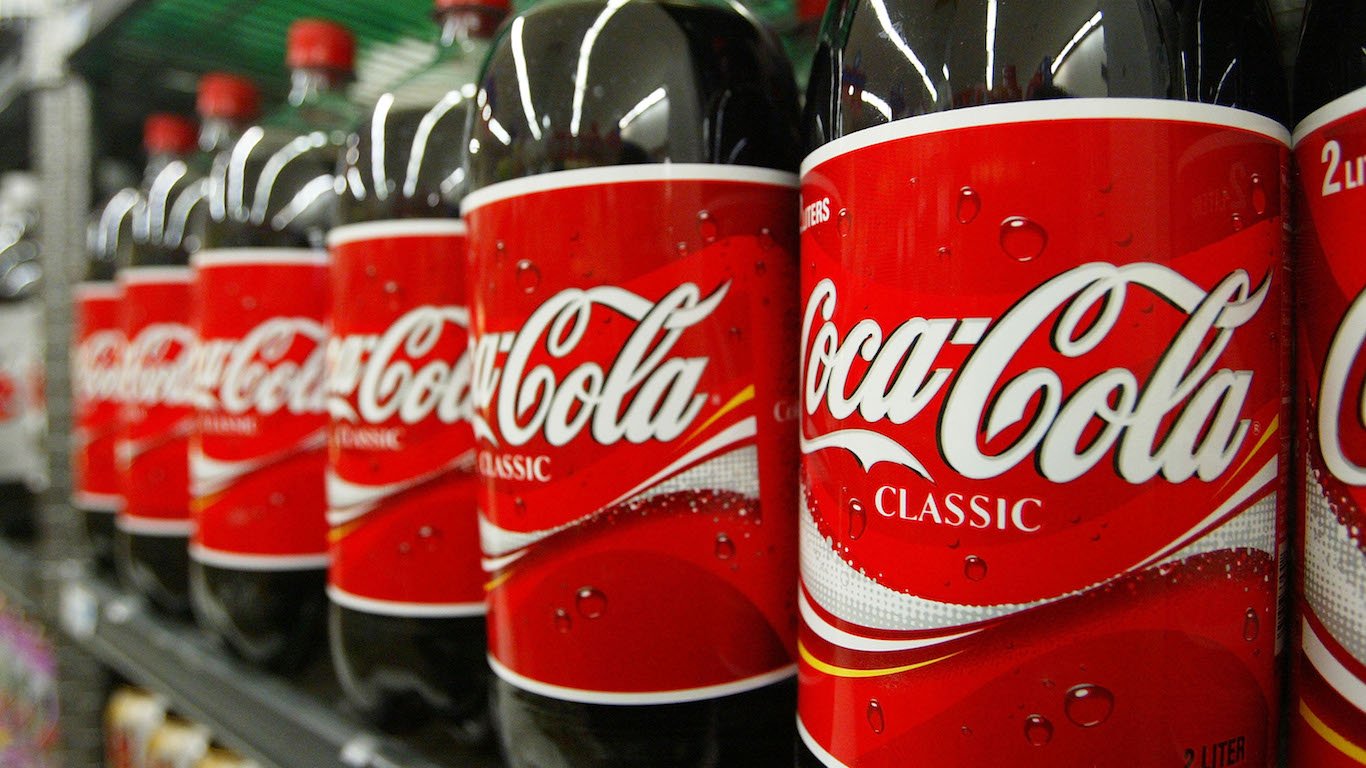
Coca-Cola yields 2.19% at $96.23 per share and pays 53 cents quarterly. The company announced its 64th consecutive annual dividend increase, raising the quarterly payout from 51 cents to 53 cents per share. Annual raises have continued through recent years: 46 cents in 2023, 48.5 cents in 2024, 51 cents in 2025 and 53 cents in 2026.
Coverage is solid on both earnings and cash. A full year of dividends at the current rate equals about 63% of trailing EPS of $3.39. Paying 53 cents per quarter on roughly 4.3 billion shares costs about $9.12 billion a year. Management expects free cash flow of at least $13.0 billion[5], up from its earlier forecast of $12.4 billion. The balance sheet can easily carry that load. Net debt is 2.49 times EBITDA and interest coverage is 8.32x, both comfortable for a franchise model where bottling partners handle most of the capital spending.
Bull case: Coca-Cola is selling more drinks, and charging more for them, at the same time. Third-quarter revenue rose 7.4%[5] to $13.38 billion, ahead of the $12.93 billion estimate. Adjusted EPS of 91[5] cents beat the 88-cent forecast. Global unit case volume grew 5%[5], Coca-Cola Zero Sugar grew 16% and comparable operating margin rose to 32.9% from 31.9%. The company’s CEO, Henrique Braun, said the “results this quarter demonstrate our system’s sustained momentum.”[5] Management now expects comparable EPS growth of at least 11%, which leaves plenty of earnings growth to fund the next dividend raise.
Risk: The stock is expensive. Shares are up 40.33% year to date and trade at 29x trailing earnings, and Barron’s recently said Coca-Cola’s valuation is the highest in a quarter century. If the multiple shrinks, the share price could go nowhere for a while even as the dividend keeps rising. New buyers also lock in a lower starting yield.
3 Dividend Kings Built to Pay for Life
These three companies each pay their dividend from a different source: household brands at P&G, a AAA balance sheet and drug pipeline at J&J and a cash-rich bottling franchise at Coca-Cola. Yields range from 1.98% to 2.56%. Payout coverage, free cash flow and raise runs measured in decades matter more to a retiree than the starting yield. If you want more names in this bucket, we ranked ten Dividend Kings by valuation in a free report here. Together, these three companies offer a dividend stream that should keep growing with inflation without the need to chase riskier yields.
Contact [email protected] for any questions or corrections.
Joel South covers large-cap stocks, dividend investing, and major market trends, with a focus on earnings analysis, valuation, and turning complex data into actionable insights for investors.
He brings more than 15 years of experience as an investor and financial journalist, including 12 years at The Motley Fool, where he served as an investment analyst, Bureau Chief, and later led the Fool.com investing news desk. He has also co-hosted an investing podcast and appeared across TV and radio discussing market trends.