How to Collect Over $1,700 in Easy Passive Income From 3 High-Yield Leaders

This post may contain links from our sponsors and affiliates, and Flywheel Publishing may receive compensation for actions taken through them.

Retirees usually worry about two things: running out of money and having to sell shares in a down market to pay the bills. Selling stock to cover living expenses means accepting whatever price the market offers on that day. Dividend income helps address that problem. The shares stay put, and cash shows up in the brokerage account on a regular schedule.
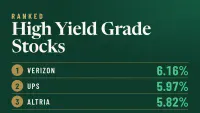
Here is what a $10,000 stake in these three high-yield names would generate in annual income. That is $30,000 invested in total, producing roughly $1,738.53 a year, which meets a $1,700 passive income target. The yields below are forward yields at current share prices, and the stocks are listed from lowest yield to highest.
Realty Income
- Stock #3: Realty Income (NYSE:O)
- Yield: 5.46%
- Shares for $10,000: 166.20
- Annual Passive Income: ~$546.45
Realty Income owns single-tenant net-lease properties. Tenants cover most property costs, and the REIT collects long-term rent from retail, industrial, gaming, and data center properties. Occupancy was 98.8% in the third quarter. As a REIT, the company must distribute most of its taxable income, which keeps its yield structurally high.
The right measure of coverage here is AFFO. Third-quarter AFFO came in at $1.12 per share, up 3.7% YoY, and management raised its 2026 AFFO guidance to $4.45-$4.46 per share. The forward dividend works out to about 74% of the guidance midpoint. In September, the company announced its 116th consecutive quarterly dividend increase. The monthly payout has since grown to $0.274 from $0.2715. That payment goes ex-dividend on November 30, 2026, and is paid on December 15.
Altria
- Stock #2: Altria (NYSE:MO | MO Price Prediction)
- Yield: 5.95%
- Shares for $10,000: 133.96
- Annual Passive Income: ~$594.78
Altria sells Marlboro, Copenhagen, Skoal, On! and NJOY, and it holds a large equity stake in AB InBev. Its yield is high because domestic cigarette books are contracting by about 5% a year. The market values Altria as a mature cash source, and the company returns most of that cash to shareholders.
Earnings cover the payout. Management raised 2026 adjusted EPS guidance to $5.66 to $5.74[1], so the $4.44 annualized dividend comes to roughly 78% of the midpoint. The August increase was Altria’s 61st dividend increase in 57 years[1]. The board also added a $1B[1] expansion to the buyback program. Reuters reports that Altria is exploring a cash bid for Imperial Brands and a possible carve-up of that business (Reuters). A deal of that size would affect leverage, so it is worth tracking for anyone counting on this payout.
Verizon Communications
- Stock #1: Verizon Communications (NYSE:VZ)
- Yield: 5.97%
- Shares for $10,000: 211.06
- Annual Passive Income: ~$597.30
Verizon generates recurring subscription revenue from wireless, broadband, and a growing fiber network. Telecom is a slow-growth business that requires heavy spending, and Verizon runs $166.2B of debt. The market prices it as an income stock, and that keeps the yield elevated.
Coverage is the firmest of the three. Full-year adjusted EPS guidance rose to $5.04 to $5.06[2], which sets the $2.83 annualized dividend at about 56% of the midpoint. Third-quarter free cash flow reached $7.80B, up 13.88%[2]. The quarter also brought a net increase of 406,000 postpaid phones. Verizon had bought back $4.0B[2] of stock through the first nine months, out of a 2026 plan of up to $4.5B.
Combined Income From All Three Positions
| Name | Yield | Annual Dividend Income |
|---|---|---|
| Realty Income | 5.46% | $546.45 |
| Altria | 5.95% | $594.78 |
| Verizon | 5.97% | $597.30 |
| Total | 5.80% | $1,738.53 |
Combined, these 3 positions generate $1,738.53 in annual passive income on a $30,000 investment, a blended yield of 5.80%. Verizon contributes $597.30, Altria adds $594.78, and Realty Income rounds out the group with $546.45.
Reinvesting those payouts increases the share count with every distribution, and each new share produces its own dividend. When all three companies raise their payouts, the income from a fixed starting stake grows twice: from the larger share count and from the higher dividend per share. Over a long retirement, that compounding can turn a $1,700 income stream into a much larger one without adding any new money, which is the whole point of the dividend ladder described in a free guide to living off the checks without ever selling a share.
Contact [email protected] for any questions or corrections.
Lee Jackson has covered Wall Street analysts' equity and debt research and equity strategy daily for 24/7 Wall St. since 2012. His broad, diverse career, including a stint as creative services director at an NBC affiliate in Austin, Texas, gives him unique insight into the financial industry.
Lee Jackson's journey in the financial industry spans more than 30 years, including nearly two decades as an institutional equity salesperson at Bear Stearns, Lehman Brothers, and Morgan Stanley. His career spanned pivotal sell-side Wall Street events, from the dot-com rise and bubble to the Long-Term Capital Management debacle, 9/11, and the Great Recession of 2008. This reflects his resilience and adaptability amid market volatility.
Lee Jackson’s practical financial industry experience, gained through a career at some of the biggest banks and brokerage firms, is complemented by a lifetime of writing across various platforms. This unique combination allows him to shed light on the intricacies of Wall Street in a way only someone with deep insider experience and knowledge can. Moreover, his extensive network across Wall Street continues to provide direct access for him and 24/7 Wall St., a privilege few firms enjoy.
Since 2012, Jackson’s work for 24/7 Wall St. has been featured in Barron’s, Yahoo Finance, MarketWatch, Business Insider, TradingView, Real Money, The Street, Seeking Alpha, Benzinga, and other media outlets. He attended the prestigious Cranbrook Schools in Bloomfield Hills, Michigan, and has a degree in broadcasting from the Specs Howard School of Media Arts.