Tesla Stock Price Prediction: Is a 30% Rally Possible in 2027?

This post may contain links from our sponsors and affiliates, and Flywheel Publishing may receive compensation for actions taken through them.

Tesla (NASDAQ:TSLA | TSLA Price Prediction) is changing what it tells investors. On the October 21[1] earnings call, Elon Musk said the business is moving from “many years of a sort of grind and things being fairly flat” toward “a lot of fun and significant growth.”
So far the stock has not followed. Tesla trades at $363.95, down 19.07% year-to-date. Underneath, software is taking a bigger role. Active FSD subscriptions reached 1.74 million[2], up from 1.04 million a year earlier. Let’s look at what Tesla needs to do to hit $475 per share in 2027.

Wall Street Sees Upside, but Conviction Is Split
The average analyst price target is $419.05, which means about 15% upside. Opinions are divided: 20 analysts rate the stock a buy or strong buy, 22 rate it a hold and 2 rate it a sell. Even so, analysts expect 2027 EPS of $2.1592, up from $1.7242 in 2026. That works out to roughly 25% earnings growth on about 13% revenue growth.

Estimates have drifted lower over the past $2.2520 90 days. Still, 14 analysts revised up in the past week. Tesla has exceeded EPS estimates in three of its last four quarters, including a 6.41%[2] beat in Q3. Revenue has beaten consensus in all four.
Here’s What It Takes for Tesla to Reach $475
Reaching $475 means a 30.5% gain. Today Tesla trades at about 169x 2027 earnings. At $475, that multiple would rise to roughly 220x, against a forward multiple in the low 20s for the S&P 500.
Investors value Tesla on autonomy and robotics more than on its car business. If earnings reach the top Street estimate of $4.13, the multiple at $475 falls to about 115x.

What could push Tesla to $475?
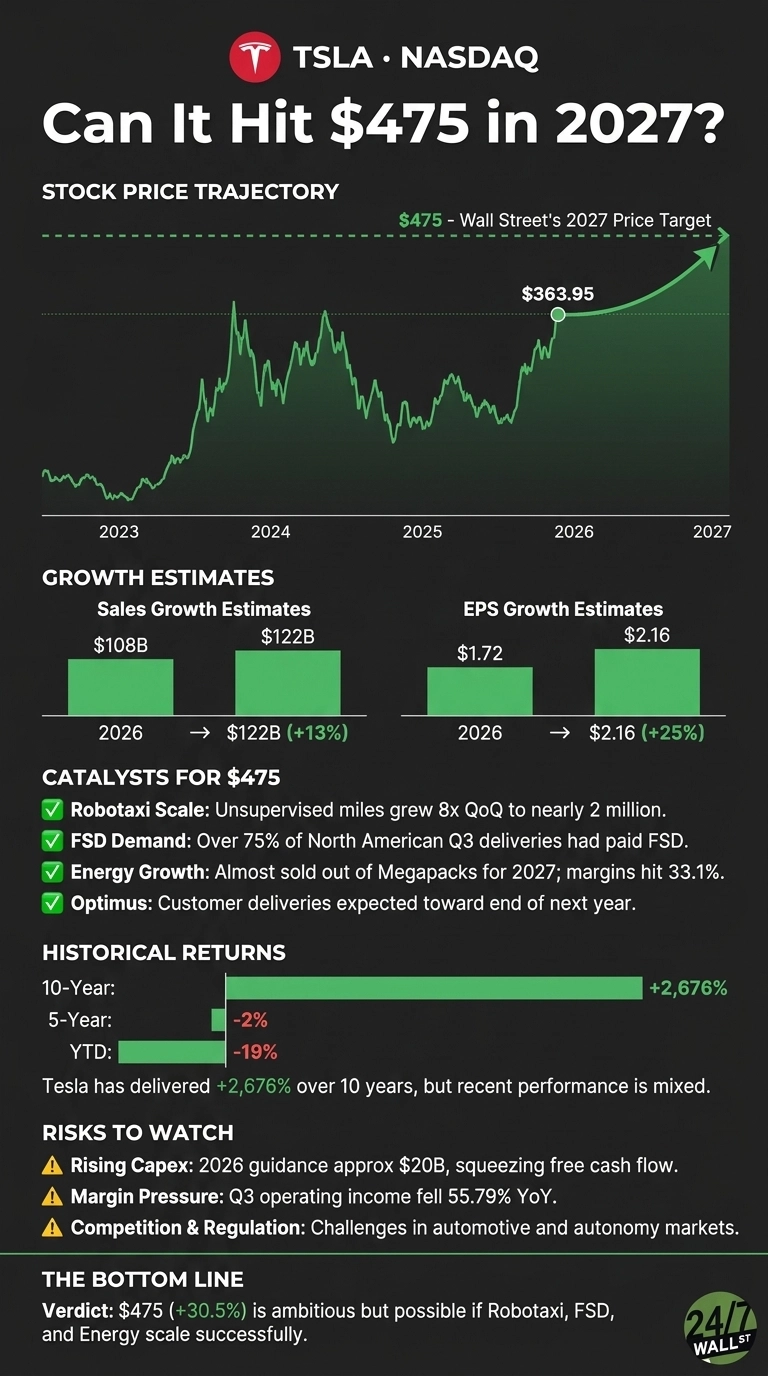
- Robotaxi scale: Musk said Robotaxi will become “noticeable probably in Q2 and then probably a big deal by Q3 or Q4 of next year.”[1] Unsupervised miles grew 8x[2] quarter over quarter.
- FSD demand: More than 75%[1] of North American Q3 deliveries came with a paid FSD sign-up. Management hopes for EU-wide approval by Q1.
- Energy: Tesla is “almost sold out of all Megapacks for 2027,”[1] and energy gross margin rose to 33.1%.
- Optimus: Musk expects customer deliveries “toward the end of next year.”[1]
- Vehicle backlog: Tesla has its largest passenger vehicle backlog in four years[2], and battery supply is what limits deliveries.
- SpaceX: Barclays (NYSE:BCS) upgraded the stock to overweight and raised its target to $450, citing upside from an expected SpaceX merger.
Tesla Traded Above $475 Within the Past Year
The stock has already been there. Its 52-week high is $498.83, and shares started 2026 at $449.72. The 52-week low of $297.38 shows how far the stock can fall. Its beta is 1.743.
Over 10 years, shares have returned 2,676.13%. Over five years, they have returned -2.16%, which helps explain why investors want new growth drivers.
$475 Is a Stretch, but Tesla Has the Levers
Getting to $475 calls for a 30.5% rally, about twice the gain means by the Street’s target. Spending is the main hurdle. Q3 operating income fell 55.79%[2], and capex guidance for this year is about $20 billion[1].
On the other side, Tesla has $45.447 billion[2] in cash, demand is strong, and Robotaxi, FSD and Megapack are all growing. If those businesses start making visible profits, $475 is within reach. Returns at this level shouldn’t be expected every year, but we’ve outlined the case for how Tesla could see outsized returns in 2027.
Contact [email protected] for any questions or corrections.
Vandita Jadeja is a financial publisher with over a decade of experience writing about financial topics, including investment, savings, retirement, insurance and banking. Vandita is a Chartered Accountant who loves to debunk financial concepts for readers.
Her work has appeared on sites that include The Motley Fool, InvestorPlace, and Benzinga. She covers investing and focuses on stock picks and price prediction for 24/7 Wall St.
When not looking for the next stock investment opportunity, she can be found traveling, reading, chasing sunsets and enjoying her iced latte.