Bitcoin Outperforms Stocks and Gold in September: What Surpassed Bitcoin?
Bitcoin posted a solid September gain while stocks stumbled and gold sank, yet a handful of smaller coins left it completely in the dust. The forces behind that surprise rotation could either spark a lasting altcoin season or collapse the…

This post may contain links from our sponsors and affiliates, and Flywheel Publishing may receive compensation for actions taken through them.

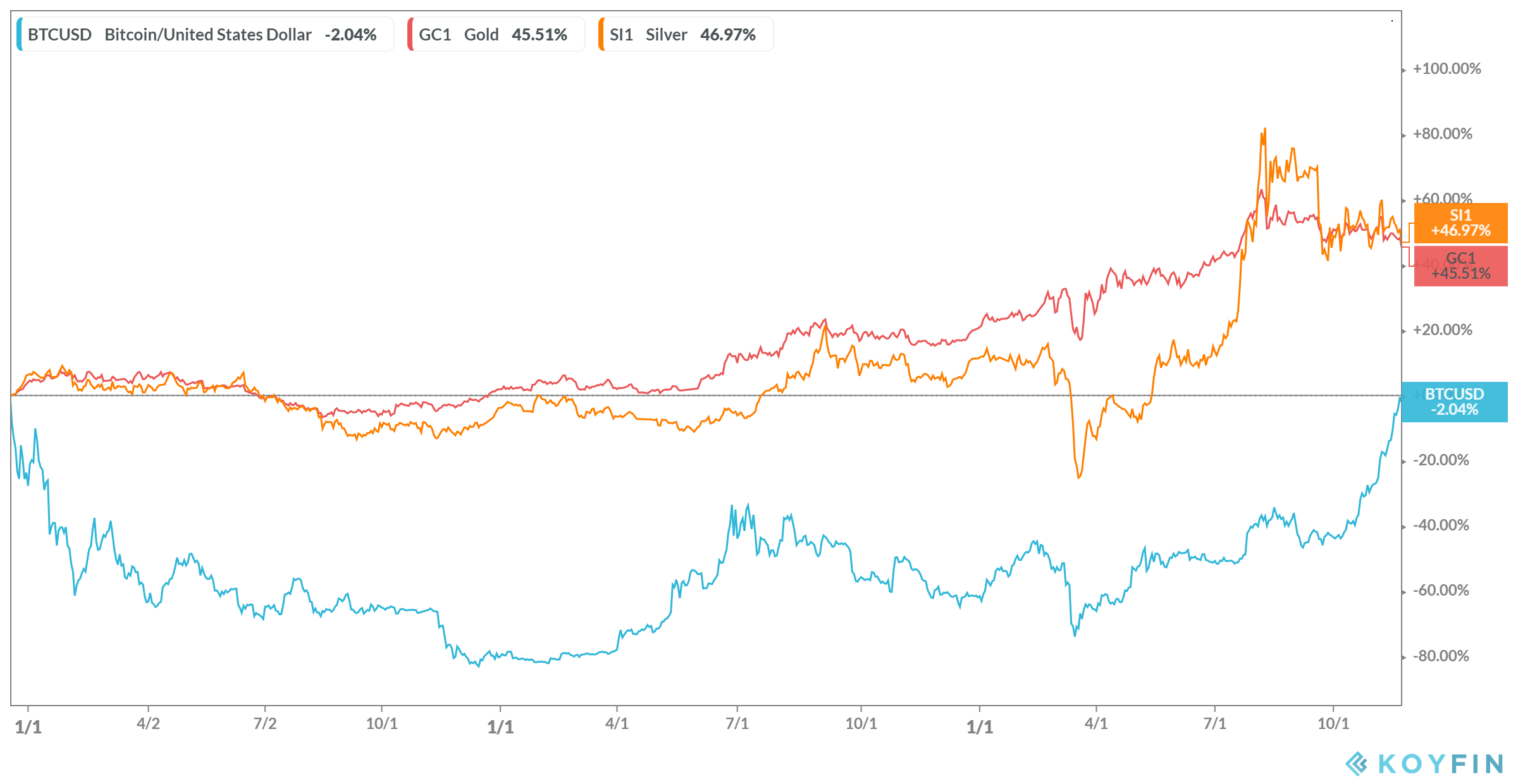
In September 2026, Bitcoin (CRYPTO:BTC) experienced a gain of about 7%. While the S&P 500 index barely changed and gold declined by more than 6%, many other major cryptocurrencies outperformed Bitcoin. Notably, NEAR (CRYPTO:NEAR) surged by 186.6%, and Arbitrum (CRYPTO:ARB) climbed 137.1%.
Bitcoin wrapped up the month at $83,995 on September 30. So, what led to renewed interest in crypto in September, and why did so much of that investment flow to smaller coins rather than Bitcoin?
Cooler August Inflation Sparked a Short Squeeze in Crypto

According to Santiment, the turnaround can be traced back to the August inflation report, which came in lower than anticipated. This unexpected news briefly pushed down Treasury yields, making cash and bonds offer lower returns. As a result, some investors redirected their funds toward cryptocurrency.
The crypto market reacted more dramatically than the stock market because many traders had taken short positions, expecting prices to fall. When prices began to rise instead, those traders had to buy back coins to limit their losses. Additionally, exchanges liquidated borrowed positions once traders’ collateral was depleted, leading to more buy orders and turning modest positive news into a powerful rally.
However, a rally fueled by short covering can lose momentum once those positions close. After that, price movement relies on genuine buyers, and Santiment data doesn’t clarify how much of Bitcoin’s September gain came from forced buying.
Bitcoin’s September Gain Came From ETF and Corporate Buyers

Bitcoin’s recent rally saw many buyers eager to own the asset. During a five-day period from September 21 to September 25, US spot Bitcoin ETFs attracted around $2.4 billion, though daily inflows decreased from $999 million to $134 million.
Additionally, Strategy (NASDAQ:MSTR | MSTR Price Prediction), known for holding Bitcoin as its primary treasury asset, bought 1,665 BTC for $143 million in late September, bringing its total holdings to 847,666 BTC, valued at about $71.2 billion by month-end. These institutional and corporate buyers provided a more stable base for Bitcoin’s rise compared to the forced buying that characterized smaller coins.
NEAR and Arbitrum Led Smaller Coins Past Bitcoin in September

As market fears subsided, investors began reallocating capital into smaller coins, causing Bitcoin’s share of the total crypto market to drop to 58.4% of the $2.88 trillion market cap. Other significant cryptocurrencies also outpaced Bitcoin during this period, with Ethereum (CRYPTO:ETH) up 9.8%, XRP (CRYPTO: XRP) up 9.9%, and Solana (CRYPTO: SOL) up 16.2%, per CoinGecko’s 30-day data, which put Bitcoin’s return at just 7.7%.
| Coin | 30-Day Return |
|---|---|
| NEAR | +186.6% |
| Arbitrum | +137.1% |
| Zcash (CRYPTO: ZEC) | +74.6% |
| Uniswap (CRYPTO:UNI) | +74.5% |
| Sui (CRYPTO: SUI) | +61.8% |
| Avalanche (CRYPTO: AVAX) | +52.2% |
| Hedera (CRYPTO: HBAR) | +46.7% |
| Litecoin (CRYPTO: LTC) | +38.1% |
| Stellar (CRYPTO: XLM) | +27.1% |
| Chainlink (CRYPTO: LINK) | +26.7% |
| Cardano (CRYPTO: ADA) | +26.2% |
| Bitcoin Cash (CRYPTO: BCH) | +25.0% |
| Solana | +16.2% |
| Dogecoin (CRYPTO: DOGE) | +15.3% |
| BNB (CRYPTO: BNB) | +11.8% |
| XRP | +9.9% |
| Ethereum | +9.8% |
| Bitcoin | +7.7% |
While triple-digit gains for smaller coins reflect volatility rather than underlying project strength, coins like NEAR, Arbitrum, and Zcash can swing wildly in both directions. Thus, a significant short-term return does not guarantee long-term potential.
Overall, Bitcoin is still down year-to-date, down 4.5% for 2026 and 26.7% over the past 12 months. September’s performance appears to be a temporary bounce within a larger downward trend.
Can the Altcoin Rally Survive the Fed’s October Meeting?
The surge in smaller coins may be the weakest part of September’s recovery. Their significant gains largely came from a market heavily filled with short positions, and once those short trades close, forced buying should stop. In contrast, Bitcoin has stronger backing from institutional and corporate investors.
However, the relief from tightening interest rates may not last. Following the Fed’s rate hike on September 16, futures traders currently foresee a 64% probability of another increase at the next meeting on October 27-28.
If Bitcoin’s market share rises above 58.4% while NEAR and Arbitrum surrender their gains, it might signal an end to this rotation. Conversely, if Bitcoin continues to attract large inflows into spot ETFs while its market share decreases, we’ll have to see if the smaller coins that outperformed Bitcoin in September 2026 can maintain their lead into October.
Contact [email protected] for any questions or corrections.
Sam Daodu is a crypto analyst who's spent nearly a decade making blockchain understandable—no easy task when most whitepapers read like fever dreams. He writes for 24/7 Wall St., covering Bitcoin, altcoins, and crypto market analysis for investors. Before crypto, he was a tech writer (back when explaining "the cloud" was peak innovation). Since 2018, he's written for CoinTelegraph, Yahoo Finance, The Block, Cryptonews, Zypto, Rain, and more—basically anywhere people want crypto news without the headache. Sam runs MacLabs Marketing, a content agency for crypto brands tired of sounding like AI wrote their website. He also publishes free crypto education on his site for Web3 enthusiasts who think "gas fees" is a typo. When he's not writing or staring at charts, Sam's either: - Watching anime (currently convinced One Piece has better tokenomics than most altcoins) - At the gym sculpting himself into a Greek god - Listening to the music your mum warned you only bad boys listen to Connect: LinkedIn | Email | MacLabs Marketing