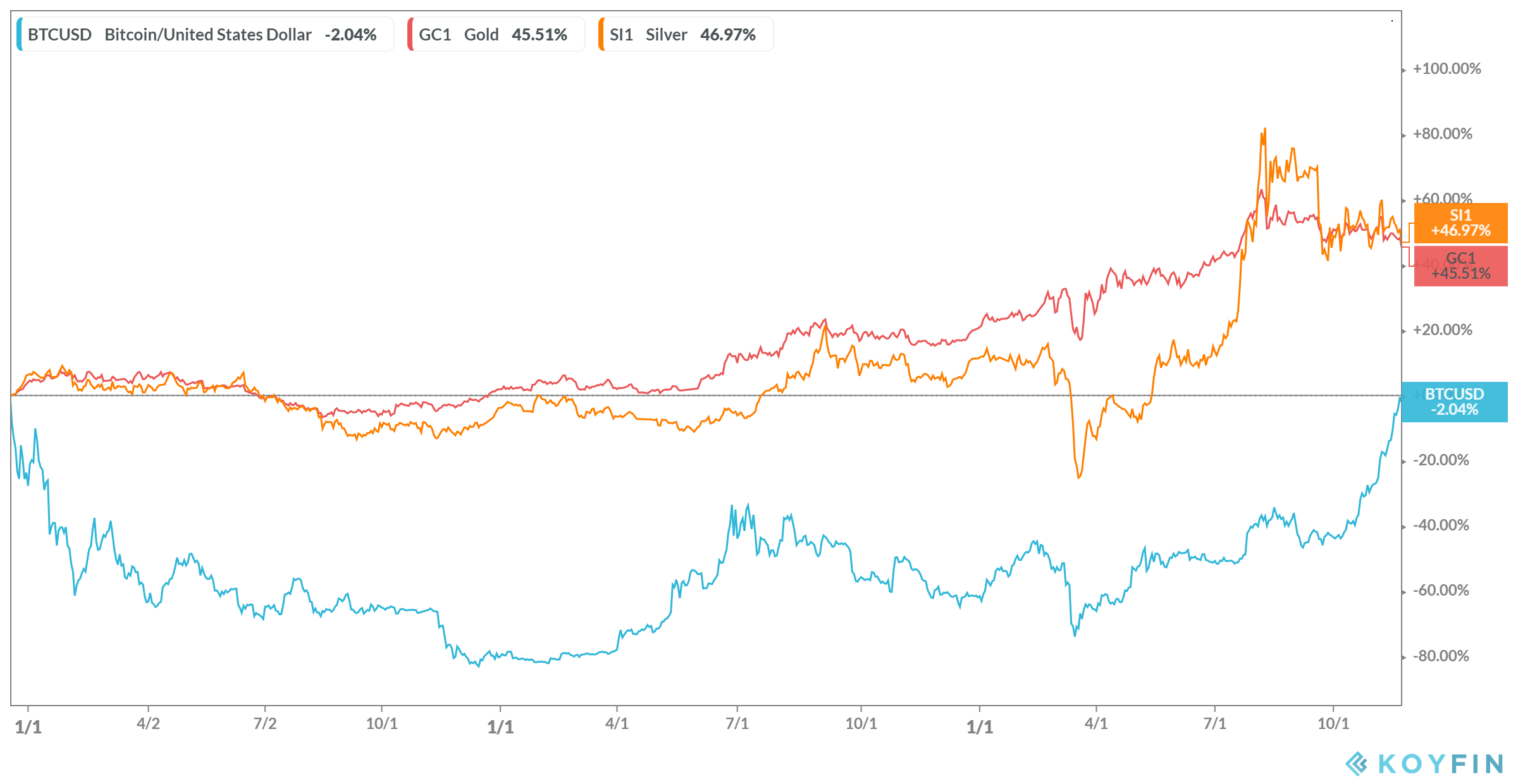
Mike McGlone and Peter Schiff Still See Bitcoin at $10,000. It Is $86,093. What Would Have to Happen for Them to Be Right?
Mike McGlone of Bloomberg Intelligence and gold advocate Peter Schiff both forecast that Bitcoin (CRYPTO:BTC) could fall to $10,000, a price it last reached in 2020. McGlone has reiterated his Bitcoin $10,000 prediction multiple times throughout 2026. Schiff suggests that…

This post may contain links from our sponsors and affiliates, and Flywheel Publishing may receive compensation for actions taken through them.

Mike McGlone of Bloomberg Intelligence and gold advocate Peter Schiff both forecast that Bitcoin (CRYPTO:BTC) could fall to $10,000, a price it last reached in 2020. McGlone has reiterated his Bitcoin $10,000 prediction multiple times throughout 2026. Schiff suggests that falling prices could trigger a cycle of forced selling, calling the current price increase temporary.
As of October 6, 2026, Bitcoin is trading at $85,896, up 2.3% over the past week. To reach $10,000, Bitcoin would need to drop by 88%. McGlone has also indicated price levels that could prove him wrong, giving readers a way to assess his prediction against market trends. So, what would need to occur for both McGlone and Schiff to be correct in their forecasts?
Why McGlone and Schiff See Bitcoin Falling to $10,000

Both analysts base their $10,000 targets on Bitcoin’s decline from its recent highs. McGlone takes a reversion approach, expecting Bitcoin, which has remained well above its long-term value, to drift back towards it. He highlights $10,000 as the most frequently traded price level for Bitcoin since CME launched Bitcoin futures in 2017. This level was also a point of stability before massive liquidity injections from governments and central banks in 2020 and 2021.
Earlier this year, McGlone suggested that Bitcoin staying above $75,000 could invalidate his prediction. He revisited this idea in August when Bitcoin dropped below $69,000, interpreting that comfort beneath this level as a potential sign of further declines towards $10,000. Given that Bitcoin peaked around $69,000 in 2021, trading below that mark suggests Bitcoin is giving back gains from that cycle.
Schiff views the market differently. He believes that falling prices could compel borrowers and leveraged traders to sell, leading to further price drops and triggering additional selling—a concept he refers to as a ‘death spiral.’ Earlier in the year, Schiff noted that Bitcoin might find initial support near $10,000, although he doubted this level would hold.
What Would It Take for Bitcoin to Fall to $10,000?

Currently, Bitcoin is trading 31.9% below its all-time high of $126,080, set in October 2025, which has left many investors from that cycle holding coins worth less than what they paid. These investors often sell during price increases to recoup their losses, limiting the potential for any significant upward movement.
If Bitcoin fell to $10,000, it would need to lose 88% of its current value. With about 20.1 million coins in circulation and a maximum supply of 21 million, this drop would reduce Bitcoin’s market value from $1.73 trillion to around $201 billion. In comparison, Tether’s USDT, a stablecoin tied to the dollar, is valued at $184 billion, suggesting Bitcoin could become only slightly more valuable than Tether. McGlone has even argued that Tether could eventually surpass Bitcoin in market value.
For Bitcoin to reach $10,000, three main factors would need to unfold, roughly in this sequence.
- Heavy redemptions from spot Bitcoin ETFs. These funds hold Bitcoin for their shareholders. If investors start cashing out of spot Bitcoin ETFs, the funds would need to sell Bitcoin to fulfill these redemptions.
- Selling by corporate treasuries. Public companies that hold Bitcoin, such as Strategy, may feel pressured to sell if Bitcoin’s price continues to decline, especially if they face challenges refinancing their debts. Some companies already sold Bitcoin earlier in 2026.
- A shock to stocks, credit and crypto markets. A simultaneous downturn in these markets might deter typical buyers from stepping in to buy during price dips.
Each event could trigger the next, creating the kind of cycle Schiff has warned about.
Bitcoin Fell Below $69,000 in 2026 and Recovered Instead of Spiraling

So far in 2026, Bitcoin has spent significant time trading below McGlone’s $69,000 threshold. It dropped as low as $60,000 in February and closed June near the same level. However, buyers have consistently stepped in, helping Bitcoin recover above $85,000 by October rather than spiraling down towards $10,000.
Currently, Bitcoin stands 14.5% above McGlone’s $75,000 line and 24.5% above his $69,000 line, indicating that, by his own criteria, his prediction is not holding up. Even with a modest 2.3% increase over the last week, the focus will remain on ETF flows and corporate holdings data to determine if a selling cycle is beginning.
Is the Bitcoin $10,000 Prediction Still Live?
With Bitcoin’s current trajectory, it is increasingly unlikely that McGlone and Schiff will see their $10,000 predictions materialize. McGlone’s April benchmark already weighs against him, especially since Bitcoin rebounded after dropping below $69,000 earlier in the year—the kind of drop Schiff’s expected downturn required. While holders still face risks, as ETF redemptions and selling from corporate treasuries could start before any significant price drop, Schiff’s argument is harder to validate because he hasn’t set a clear price point that could disprove his theory.
In the ever-evolving cryptocurrency landscape, it’s crucial to stay informed and watch for changes that could affect future predictions.
Contact [email protected] for any questions or corrections.
Sam Daodu is a crypto analyst and the editor of 24/7 Wall St.'s Crypto Desk, where he covers Bitcoin, XRP, Ethereum, Solana and the altcoins investors search for most. His work focuses on price levels, spot ETF flows, on-chain data and the regulatory decisions that move crypto markets, written so a first-time buyer and a seasoned trader can both use it.
Sam has written about crypto professionally since 2019 and has published more than 2,000 articles. Before joining 24/7 Wall St., he wrote for crypto media outlets and Web3 companies and ghostwrote for crypto founders and token launches. His analysis is syndicated on Yahoo Finance, MSN and AOL and has been cited by other crypto news sites. He also founded MacLabs Marketing, a content and personal branding agency for crypto founders and executives.
When he isn't reading charts, Sam is usually at the gym or watching One Piece, a series he maintains has better tokenomics than most altcoins.