A Holder Who Put $100 a Month Into Bitcoin Since 2015 Has Paid In $14,000. Here Is What the Stack Is Worth Now.
Putting $100 into Bitcoin every month for over a decade sounds simple, but the gap between what that stack was worth at its peak versus today raises a harder question about whether consistency alone is enough to protect against volatility.

This post may contain links from our sponsors and affiliates, and Flywheel Publishing may receive compensation for actions taken through them.

If you invested $100 in Bitcoin (CRYPTO: BTC) at each month’s close starting in March 2015, you would have spent $14,000 over 140 months. This approach would have accumulated 7.049 Bitcoins, which are now worth $586,702 at a Bitcoin price of $83,232. So, your $100 monthly investment in Bitcoin would have grown about 42 times your original investment.
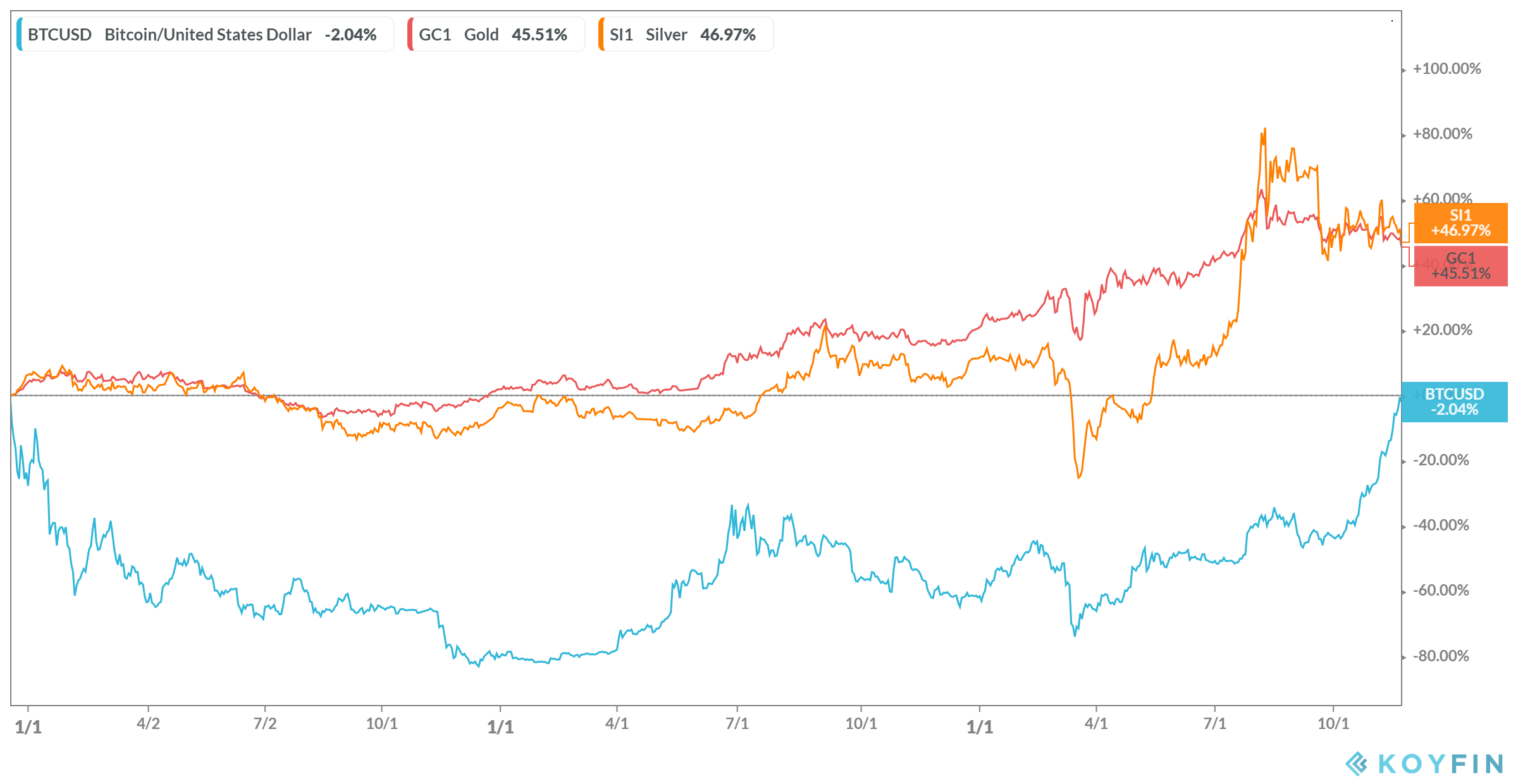
As of October 14, 2026, Bitcoin is priced at $82,972, up 6.7% over the past month and 32.3% over the last 60 days. However, this price is still 26.3% lower than it was on October 14, 2025.
At its peak, Bitcoin reached $126,080. At that price, your 7.049 Bitcoins would have been valued at $888,737. So, which value should you trust? And what does the difference between these two amounts mean for the strategy of buying Bitcoin consistently over time?
How Dollar-Cost Averaging Turned $100 a Month Into 7.049 Bitcoin
 These numbers derive from a calculation based on Bitcoin’s historical monthly closing prices. This model represents a hypothetical scenario, not an individual investor’s experience. Every month, at the closing price, the model consistently invests $100. It continues this for 140 months, regardless of market fluctuations, never timing the market or shifting strategy based on news trends.
This method, known as dollar-cost averaging, means you invest the same amount regularly, regardless of Bitcoin’s price. This approach means you buy more Bitcoin when prices are low and less when prices are high. As a result, months with lower prices contribute more to your total Bitcoin holdings, lowering your average cost per coin.
Why the $100-a-Month Bitcoin Plan Spent Only Four Months Underwater

An investment is considered “underwater” when its current value is less than the amount invested so far. Over 140 months, this investment dropped below the amount invested so far in only four months, all at the beginning.
Early purchases are few, so even a small price decrease can make the investment appear underwater. However, as more low-price months accumulate, those cheaper coins help cushion the overall value. For a later price drop to push the stack underwater again, Bitcoin would have to return to levels seen during those early purchases.
Bitcoin has experienced significant price drops during the market cycles of 2020, 2021, and 2022 to 2023. Each time, those early investments kept the overall value above the total amount invested.
Fees, Taxes, and Timing the $100-a-Month Bitcoin Model Leaves Out
This model does not include trading fees, spreads, or taxes. A spread is the difference between what a buyer pays and what a seller receives on an exchange. Each of these factors could reduce your total amount, meaning a real-world account following this plan would potentially acquire fewer coins or yield less profit after taxes.
The model also relies on a March 2015 starting point. If someone started at a different time, especially near a market peak, they might get a very different outcome and could stay underwater much longer. Additionally, the market may not resemble the past eleven years.
This investment’s value changes daily, directly reflecting Bitcoin’s price. While the coin count remains at 7.049, its value has fallen from a peak of $888,737 to $586,702. The 26.3% drop over the past year highlights Bitcoin’s volatility.
While monthly investments can reduce the risk of entering the market at a high point, they also expose the investor to Bitcoin’s price swings. If Bitcoin’s price falls and stays low for an extended period, this fixed monthly strategy could keep buying into a decline without guaranteeing a recovery.
Contact [email protected] for any questions or corrections.
Sam Daodu is a crypto analyst who's spent nearly a decade making blockchain understandable—no easy task when most whitepapers read like fever dreams. He writes for 24/7 Wall St., covering Bitcoin, altcoins, and crypto market analysis for investors. Before crypto, he was a tech writer (back when explaining "the cloud" was peak innovation). Since 2018, he's written for CoinTelegraph, Yahoo Finance, The Block, Cryptonews, Zypto, Rain, and more—basically anywhere people want crypto news without the headache. Sam runs MacLabs Marketing, a content agency for crypto brands tired of sounding like AI wrote their website. He also publishes free crypto education on his site for Web3 enthusiasts who think "gas fees" is a typo. When he's not writing or staring at charts, Sam's either: - Watching anime (currently convinced One Piece has better tokenomics than most altcoins) - At the gym sculpting himself into a Greek god - Listening to the music your mum warned you only bad boys listen to Connect: LinkedIn | Email | MacLabs Marketing