How Much Bitcoin Would You Need to Be a Millionaire if It Gets Back to Its Record High?
Bitcoin sits nearly 40% below its record high, and the path back carries real math that most holders have never run. Knowing exactly how many coins stand between you and seven figures changes how you think about the wait.

This post may contain links from our sponsors and affiliates, and Flywheel Publishing may receive compensation for actions taken through them.

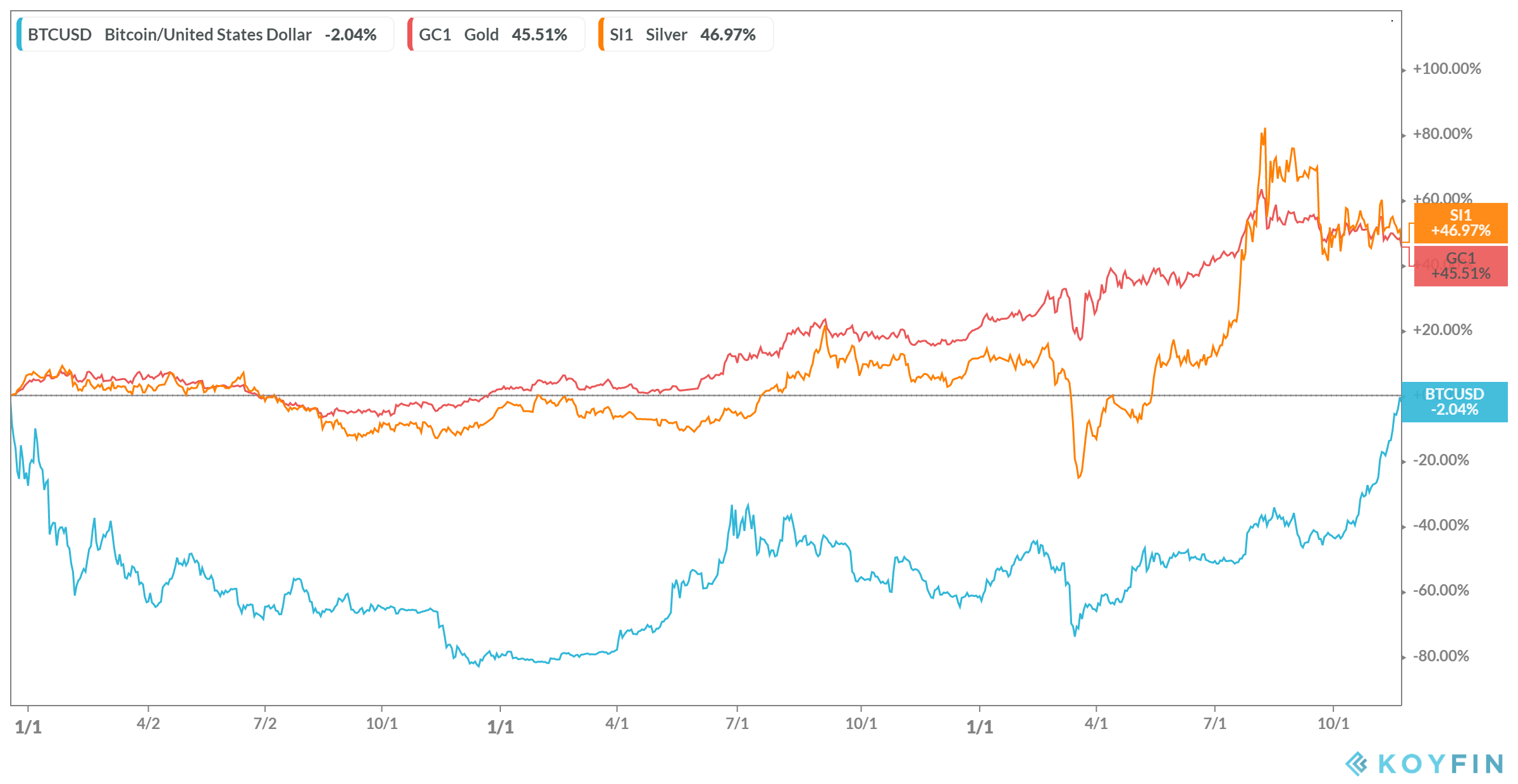
Bitcoin (CRYPTO: BTC) holders would need about 7.9 BTC to claim a million dollars if the price returns to its record high of $126,080, reached on October 6, 2025. As of October 30, 2026, Bitcoin is trading at $76,636, reflecting a 4.5% drop in the last 24 hours and sitting 39.2% below its record high – the lowest level since mid-September. The cryptocurrency peaked at $86,490 on October 4 over the past 30 days.
That record high continues to attract investor attention. Our analysis of when ChatGPT predicts BTC could return to $126,000 indicates the ongoing interest in this milestone. So how much Bitcoin is needed to reach millionaire status at that previous high, and how likely is it to return?
How Much Bitcoin Do You Need to Be a Millionaire at Different Prices?

At the record price of $126,080, about 7.93 BTC equals $1 million. With Bitcoin currently priced at $76,636, acquiring this amount of Bitcoin would cost around $608,000. Therefore, a full recovery to that record price would add about $392,000 to your investment.
| BTC Price | BTC Needed for $1 Million | Approximate Cost at $76,636 |
|---|---|---|
| $100,000 | 10 BTC | $766,000 |
| $126,080 (record) | 7.93 BTC | $608,000 |
| $150,000 | 6.67 BTC | $511,000 |
| $200,000 | 5 BTC | $383,000 |
For Bitcoin to regain its record, it will need significantly more investment overall. Market cap, calculated by multiplying the price of a single coin by its total supply, was about $2.49 trillion at the close on October 6, 2025, compared to about $1.54 trillion. As miners continue to produce new coins, returning to the previous high will require more capital each year.
Keep in mind that taxes can reduce your returns on any seven-figure sale. A capital gain occurs when Bitcoin sells for more than what the owner originally paid. Under federal law, gains are long-term if the asset was held for over a year (26 U.S.C. § 1222(3)), which generally attracts lower tax rates than short-term gains on assets held for a year or less.
For a similar analysis, check out our piece on how much XRP would make you a millionaire.
Bitcoin ETF Assets Total $104 Billion, Down From Their October Peak

Spot Bitcoin ETFs (exchange-traded funds) hold actual Bitcoin, allowing investors to gain exposure through regular brokerage accounts. By October 29, U.S. funds had taken in $57.6 billion in cumulative net inflows and held $104.3 billion in assets.
However, October flows fluctuated significantly. The funds gained $528 million on October 21, but lost $636 million in a subsequent session. Assets peaked at $110.8 billion on October 5, and while inflows were consistent for four consecutive sessions through October 29, the last session brought in only $17 million.
Past Bitcoin Records Took 28 to 35 Months, and the Price Is Under Its 50-Day Average

Looking at history provides insight into how long it typically takes for Bitcoin to recover to its record highs. The December 2017 peak near $19,796 held until November 2020, when it reached $19,864—a wait of 35 months. Similarly, the November 2021 peak near $68,991 held until March 2024, when Bitcoin rose to $73,813, taking 28 months.
With the current record dated to October 2025, the recovery clock started only about a year ago.
A moving average calculates the average price over a specific number of days, helping traders identify trends. Bitcoin is currently below its 20-day average of $81,618 and its 50-day average of $81,887, but it remains above its 200-day average of $73,107. Notably, the coin has increased by 23.3% over the past 90 days.
Can Bitcoin Return to Its Record High Before 2027?
Currently, the chance of Bitcoin recovering to $126,080 by December 31 feels low. Traders on U.S. exchanges estimate about a 14% chance the price will surpass $100,000 by year-end, and about 4% that it will exceed $120,000.
For a recovery to occur, Bitcoin needs to close above the 50-day average near $81,887, then surpass the 90-day high of $86,597 from September 21, and ETF assets need to rise above $110.8 billion.
If ETF outflows persist and Bitcoin falls below its 200-day average, the price could slide toward its June 30 low of $58,566.
This scenario would make each coin cheaper, but the wait for recovery could be longer. Based on past cycles, recovery times point to a potential new high arriving in 2027 or 2028, with daily closes above $86,597 and ETF assets crossing back over $110.8 billion serving as initial signs of a quicker recovery.
Contact [email protected] for any questions or corrections.
Sam Daodu is a crypto analyst and the editor of 24/7 Wall St.'s Crypto Desk, where he covers Bitcoin, XRP, Ethereum, Solana and the altcoins investors search for most. His work focuses on price levels, spot ETF flows, on-chain data and the regulatory decisions that move crypto markets, written so a first-time buyer and a seasoned trader can both use it.
Sam has written about crypto professionally since 2019 and has published more than 2,000 articles. Before joining 24/7 Wall St., he wrote for crypto media outlets and Web3 companies and ghostwrote for crypto founders and token launches. His analysis is syndicated on Yahoo Finance, MSN and AOL and has been cited by other crypto news sites. He also founded MacLabs Marketing, a content and personal branding agency for crypto founders and executives.
When he isn't reading charts, Sam is usually at the gym or watching One Piece, a series he maintains has better tokenomics than most altcoins.