The Next 30% Crash Will Happen. These 3 ETFs Mean You Won’t Panic-Sell at the Bottom
History says it is coming. A 30% drawdown is part of the contract you signed when you bought stocks. What matters is whether you will still be holding the bag when prices recover. Three ETFs are built for that stress…

This post may contain links from our sponsors and affiliates, and Flywheel Publishing may receive compensation for actions taken through them.
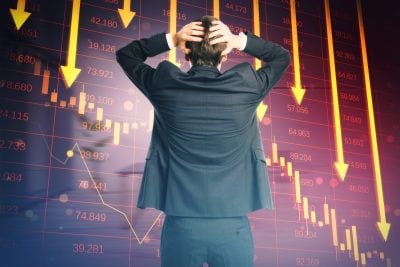
History says it is coming. A 30% drawdown is part of the contract you signed when you bought stocks. What matters is whether you will still be holding the bag when prices recover. Three ETFs are built for that stress test: Schwab U.S. Dividend Equity ETF (NYSEARCA:SCHD) pays you to wait, iShares MSCI USA Min Vol Factor ETF (NYSEARCA:USMV) softens the ride, and SPDR Gold Shares (NYSEARCA:GLD) tends to climb when stocks crater. Together they give you the cash flow and emotional ballast to ignore the headlines at the bottom, which is where most portfolios die.
And the warning lights are blinking. The University of Michigan Consumer Sentiment index sits at 44.8, approaching recessionary levels. The 10Y-2Y Treasury spread compressed from 0.74% in February to 0.31%. The VIX already spiked to 31.05 in late March. The next leg lower may already be loading.
SCHD: income that keeps showing up
SCHD tracks the Dow Jones U.S. Dividend 100 Index, screening for companies with 10+ years of payments and quality balance sheets. The 0.06% expense ratio means you keep $994 of every $1,000 working for you. Net assets sit at $71.6 billion, anchored by names like Bristol-Myers Squibb at 4.26%, Merck at 4.14%, ConocoPhillips at 4.10%, and Lockheed Martin at 4.07%. Pharma, energy, telecom, and staples keep cutting checks through recessions.
Performance backs the thesis: +18.32% year to date, +25.42% over one year, and +222.83% over ten years. Quarterly distributions hit your account four times a year whether the index is up or down. That cash flow is the psychological anchor that keeps your finger off the sell button.
USMV: less swing, more stay
USMV owns 195 U.S. equity positions screened and weighted for lower volatility than the broad market, with $22.86 billion in net assets. The top holdings tell you everything: Cisco at 1.80%, Exxon at 1.60%, Microsoft at 1.56%, Duke Energy at 1.55%. Utilities, healthcare, and staples dominate. Boring is the feature.
Returns reflect the design: +2.91% YTD, +5.02% over one year, and +148.98% over ten years. USMV will lag in strong rallies by design. The payoff is preventing the 35% gut punch that turns disciplined investors into panic sellers at the exact wrong moment.
GLD: the asset that zigs when stocks zag
GLD is a physically backed gold bullion trust. 0.40% expense ratio. No dividend. Gold’s role is non-correlation. Over the past year, GLD returned +22.36% while stocks chopped sideways, and it is up +122.53% over five years and +187.03% over ten. When the VIX spiked into the 30s this past spring, gold did exactly what it is supposed to do: hold value while equities buckled. A 5% to 10% sleeve in GLD gives you something to sell high and rotate into stocks low, which is the opposite of panic.
The catch
None of these come free. SCHD leans heavy on old-economy sectors, so when AI and growth lead, it lags. USMV trades upside for smoother rides; in a roaring bull market you will envy your friend in Invesco QQQ Trust (NASDAQ:QQQ). GLD pays nothing, can stagnate for years, and just dropped -11.64% in the past month alone. Those are real trade-offs.
But if your true risk is selling at the bottom out of fear, accepting slightly lower peak returns is the better deal. Owning all three means something in your portfolio is always working, even when something else is not. That is what keeps you in your seat through the next 30% drawdown. And it is the only edge most investors actually need.
Contact [email protected] for any questions or corrections.
I am a long time investor and student of business, and believe finding good companies that can become great investments is the best game on earth. After 20 years of writing and researching the public markets it is clear that individuals have never had more tools and information to take control of their financial lives. From ETFs and $0 commissions to cryptos and prediction markets there has never been a greater democratization of access to investing.
I write to help people understand the investments available to them so they can make the best choice for their portfolio, whether they're starting out or looking for income in retirement.