We Checked 14 Dividend ETFs Against SCHD in 2026. Not One Beat It
We put 14 dividend ETFs through a head-to-head test against SCHD in 2026, covering total return, dividend growth, and portfolio quality, and every single one came up short. The reasons why reveal something important about where most income investors go…

This post may contain links from our sponsors and affiliates, and Flywheel Publishing may receive compensation for actions taken through them.

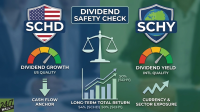
If you own the Schwab U.S. Dividend Equity ETF (NYSEARCA:SCHD), you already know the pitch: roughly 100 U.S. companies filtered for a decade of consecutive dividends, healthy cash flow to debt, strong return on equity, and a track record of raising the payout. That formula has made SCHD one of the most widely held dividend ETFs on the market, with $111.98 billion in net assets as of September 15, 2026. We lined up 14 rival dividend ETFs against SCHD this year, from higher-yielding covered-call funds to aristocrat-style peers, and none of them delivered a better combined package of total return, dividend growth, and portfolio quality. Our recommendation: stay put—and here is why.
What SCHD Actually Delivered in 2026
SCHD is up 27.21% year-to-date through September 15, 2026, and up 29.49% over the trailing year. Over five years it has returned 60.88%, and over ten years 243.94%, all on a total-return basis. That is a compounding story, driven by which companies the index owns and which it screens out.
Cash distributions continue to flow as well. SCHD’s trailing 12-month distribution totals $1.048 per share, with an annualized forward distribution of $1.01. Individual quarterly distributions vary, but the underlying dividends from the holdings continue to rise.
Why the 14 Rivals Fell Short
Most competing dividend ETFs fall into two camps. High-yield funds reach for 5% to 7% headline yields by loading up on telecoms, REITs, and legacy energy names, then give back those gains through weaker price appreciation or eroded payouts. Covered-call dividend funds cap upside precisely when quality dividend stocks are rallying. Neither group beat SCHD on total return in 2026 according to our screen.
Inside SCHD’s Dividend Growers
SCHD’s edge is what sits inside the portfolio.
- PepsiCo (NASDAQ:PEP | PEP Price Prediction): quarterly dividend up from $1.4225 to $1.48, current yield 4.22%.
- Chevron (NYSE:CVX): raised to $1.78 per quarter from $1.71, with the stock up 46.44% year to date.
- Coca-Cola (NYSE:KO): quarterly payout up to $0.53 from $0.51.
- Automatic Data Processing (NASDAQ:ADP): quarterly dividend stepped up from $1.54 to $1.70, with management guiding fiscal 2027 adjusted EPS growth of 9% to 11%.
- Amgen (NASDAQ:AMGN): quarterly dividend of $2.52, a 6% increase compared with Q2 2025.
Rival ETFs that skip this quality screen end up with slower-growing income and, in 2026, weaker price performance to match. Several of the classic dividend growers anchoring SCHD also headline our free Dividend Kings report, which ranks ten 50-year raisers by valuation right now.
Real Tradeoffs You Should Understand With Your Eyes Open
SCHD is U.S.-only. It has no international exposure, and sector caps push weight into energy, staples, healthcare, and financials. When mega-cap tech leads, SCHD lags. Income also fluctuates: the latest quarterly distribution was $0.2525, below the prior quarter’s $0.2569 and the $0.2782 paid in December 2025. And with the 10-year Treasury yielding 4.96% as of September 11, 2026, cash-like alternatives now clear a much higher bar for investors with pure income needs.
How to Think About Your Position Now
If you own SCHD for a growing, tax-friendly U.S. equity income stream, the 2026 evidence says keep it. Pair it with an international or broad-market fund to fill the geographic and growth gaps, rather than replacing SCHD to chase a higher headline yield. Selling shares in a taxable account after a 27.21% year-to-date advance would also lock in capital gains. What would change this view: a sustained market regime in which the highest-yielding, lowest-growth names lead, or a structural change to SCHD’s fee or index methodology. Neither is on the table today.
Verdict for the Holder
The best swap for SCHD in 2026 is no swap at all. Evaluate it against your own income needs, tax picture, and international exposure. If the answer to why you bought SCHD is still “quality U.S. dividend growth at very low cost,” the fund is still doing exactly that job.
Contact [email protected] for any questions or corrections.
Ryne Mauck is an investment writer covering exchange-traded funds, retirement planning, and portfolio strategy. Through his work at 24/7 Wall St. and other investment platforms, including Seeking Alpha, he aims to provide clear, research-driven insights that help investors make more informed decisions while maintaining a long-term approach to investing.
Ryne holds a B.Sc. in Finance and an M.A. in Political Science. He is a formerly registered Municipal Advisor Representative and has passed the Series 50, Series 63, and Series 65 exams. His articles are not intended to be, nor should they be interpreted as, financial advice.