You’re 60 With $300K in the Bank Earning Nothing. These 3 ETFs Put It to Work Before Inflation Wins
You’re approaching retirement and have $300,000 parked in a savings account or a checking account earning close to nothing, while your bank’s own website advertises a 1.65% average on a 12-month CD. Meanwhile, the Consumer Price Index just hit 334.0…

This post may contain links from our sponsors and affiliates, and Flywheel Publishing may receive compensation for actions taken through them.

You’re approaching retirement and have $300,000 parked in a savings account or a checking account earning close to nothing, while your bank’s own website advertises a 1.65% average on a 12-month CD. Meanwhile, the Consumer Price Index just hit 334.0 in May, sitting in the 90th percentile of its historical range. Every month you sit in cash, your grocery bill gets bigger and your buying power gets smaller. Three exchange-traded funds can fix this without dragging you into anything reckless: Vanguard S&P 500 ETF (NYSEARCA:VOO), Schwab U.S. Dividend Equity ETF (NYSEARCA:SCHD), and iShares 0-3 Month Treasury Bond ETF (NYSE:SGOV). Together they cover growth, income, and safety in one clean split.
The real problem: cash is the slow leak
The bank average pays 1.65% on a 1-year CD. Inflation over the last twelve months added 11.81 points to CPI. Your balance holds steady on paper while your purchasing power shrinks every single month. At 60, you probably have 25 to 30 more years of spending ahead of you. Doing nothing is the risky move.
VOO: the growth engine you still need
Retirement still calls for stock exposure. Vanguard’s S&P 500 ETF owns a slice of the 500 largest U.S. companies and charges a 0.03% expense ratio. On $100,000, that is roughly $30 a year in fees. The rest works for you. Over the last decade the fund returned 317.19% on a price basis, and it is up 21.48% over the past year and 10.8% year to date. That kind of long-run compounding is what keeps a 30-year retirement funded. A reasonable slice here, roughly a third of the $300,000, gives inflation something real to chase.
SCHD: pay yourself while you wait
The Schwab U.S. Dividend Equity ETF tracks the Dow Jones U.S. Dividend 100 Index and screens for companies with strong cash flow and consistent payouts. Its expense ratio is 0.06%, so on every $10,000 you invest, you pay about $6 a year in fees. Assets under management sit at $71.6 billion, so liquidity is not an issue. The top holdings read like a retiree’s shopping list: Bristol-Myers Squibb at 4.26%, Merck at 4.14%, ConocoPhillips at 4.10%, Lockheed Martin at 4.07%, Chevron at 4.04%, Verizon at 4.03%, AbbVie at 3.99%, Cisco at 3.99%, Coca-Cola at 3.97%, and Altria at 3.97%. Healthcare, energy, defense, telecom, and staples: sectors that tend to keep raising prices when inflation climbs. The fund is up 22.17% over the past year and 19.45% year to date, and it pays a quarterly dividend that lands in your account whether the market has a good week or not.
SGOV: the cash you actually need, but with a real yield
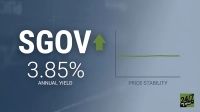
You still need money you can touch without flinching. SGOV holds only U.S. Treasury bills with 0-3 month maturities, charges a 0.09% expense ratio, and moves almost not at all. Look at the chart: up 0.07% for the week, 1.83% year to date, and 3.89% over the past year. With the Fed funds target upper bound at 3.75% and the 10-year Treasury at 4.49%, short bills are throwing off yields your savings account cannot touch. SGOV is where the emergency fund and the next two years of living expenses belong.
The trade-off
Each of these funds carries real risk. VOO can drop 20% or more in a bad year and test your nerves right when you least want it. SCHD is concentrated in older, slower-growing sectors, so it tends to lag when technology leads. SGOV’s yield tracks the Fed: if rate cuts continue past the current 3.75%, your income from it will shrink. A rough split (one third VOO, one third SCHD, one third SGOV) gives you growth to beat inflation, dividends to fund your life, and cash you can spend tomorrow. That is a portfolio doing three jobs at once, which is more than $300,000 in a checking account has ever done for you.
Contact [email protected] for any questions or corrections.
I am a long time investor and student of business, and believe finding good companies that can become great investments is the best game on earth. After 20 years of writing and researching the public markets it is clear that individuals have never had more tools and information to take control of their financial lives. From ETFs and $0 commissions to cryptos and prediction markets there has never been a greater democratization of access to investing.
I write to help people understand the investments available to them so they can make the best choice for their portfolio, whether they're starting out or looking for income in retirement.