Oil Pipeline Boom Transforms AMLP Into Income Machine With Quarterly Raises Ahead
AMLP has surged to decade-best performance while its top holdings race to outdo each other on distribution raises, but a 26% crude price drop and a hidden tax structure are quietly working against every dollar of that yield.

The Alerian MLP ETF (NYSEARCA:AMLP) is having one of its best years in a decade. AMLP trades near $53, up roughly 17% year to date and roughly 17% over the past year, while the quarterly distribution stepped up to $1.03 from $1.01. With a $4.12 forward annualized payout, AMLP yields roughly 7.8%. The question for income investors: is the uptrend a signal the distribution is safer than it has been in years, or a warning that midstream is running hot?
How AMLP Generates Income
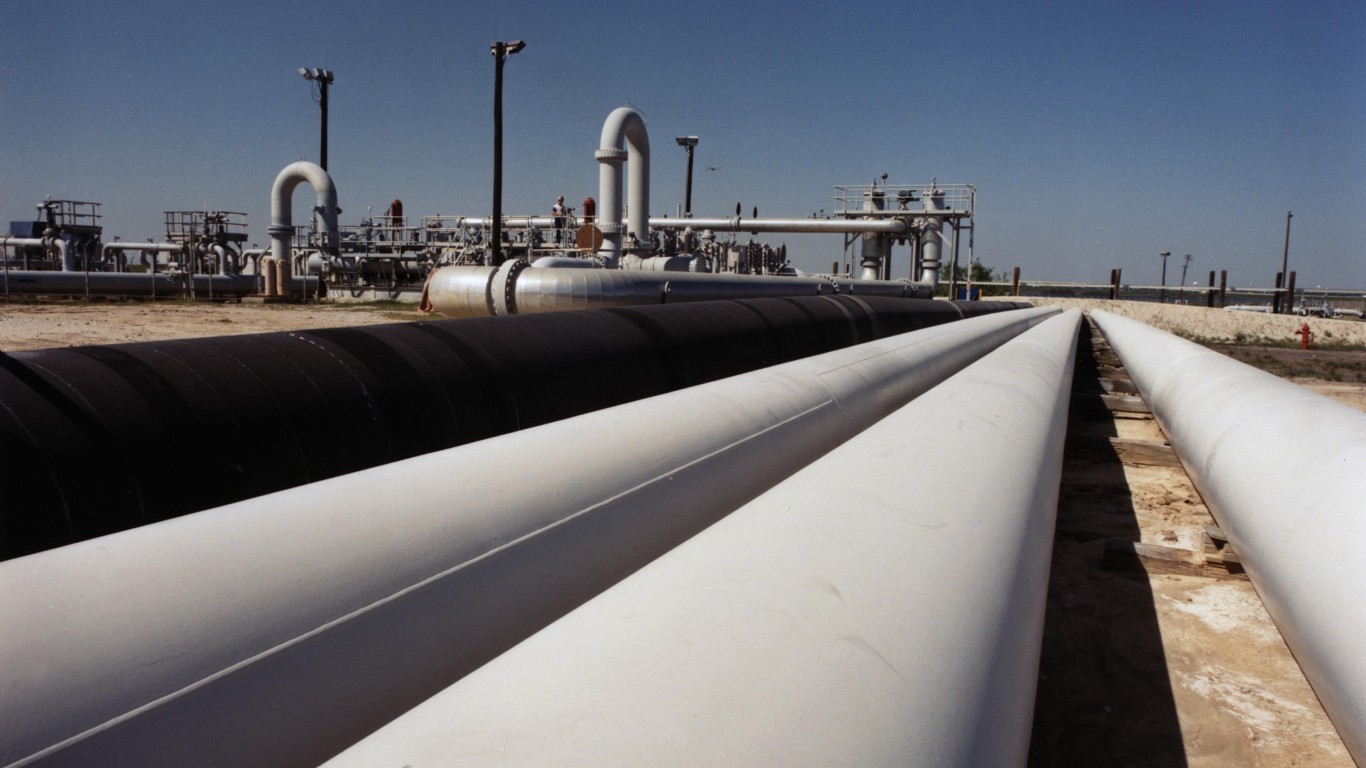
AMLP owns a concentrated basket of large-cap midstream master limited partnerships that toll oil, gas, and NGL molecules across pipelines, processing plants, and export terminals. The fund passes their cash distributions through to holders, minus a 0.84% expense ratio and corporate-level taxes since AMLP is structured as a C-corp rather than a pass-through.
The top four holdings account for roughly 73% of assets: MPLX (NYSE:MPLX | MPLX Price Prediction) at roughly 13%, Western Midstream Partners (NYSE:WES) at 12%, Enterprise Products Partners (NYSE:EPD) at 12%, and Energy Transfer (NYSE:ET) at roughly 11%. If those four raise distributions, AMLP’s payout does too.
The Four Names That Decide the Payout
Enterprise is the anchor of the safety case. It declared a 3% increase to $0.55 per unit, extending a 27-year streak of distribution growth. Q1 distributable cash flow of $2.7 billion covered the payout with $1.5 billion retained for reinvestment, the coverage cushion income investors want to see.
MPLX is the most aggressive grower. Management lifted the distribution 13% to $1.08 and reaffirmed the same annual pace through 2027. Leverage climbed to 3.7x after the Northwind, BANGL, and Whiptail deals, with interest expense rising to $291 million from $229 million. Still inside the target, but the margin of safety narrowed.
Energy Transfer raised its distribution more than 3% to $0.3375 and lifted 2026 EBITDA guidance by $750 million to $18.2 to $18.6 billion. A $68.3 billion long-term debt load and interest expense of $947 million in Q1 offset gains. DCF of $2.7 billion covers the payout comfortably, with roughly 40% of EBITDA coming from fee-based gas assets, including a new Oracle data-center supply deal ramping to ~900 MMcf/d.
Western Midstream sits at the highest yield near 8.2% after raising to $0.93. Q1 adjusted EBITDA hit a record $683 million, and management is tracking the high end of the $2.50 to $2.70 billion full-year guide following the Aris and Brazos Delaware II acquisitions.
The Risks Underneath the Yield
WTI has slid from a $115 April peak to about $70, a 26% one-month drop. Most AMLP holdings run fee-based, volume-linked contracts, but sustained sub-$60 crude would eventually pressure producer activity and throughput. The C-corp wrapper imposes a persistent tax drag: AMLP’s five-year total return of 117% trails what the underlying MLPs delivered directly, with MPLX up 198% and WES up 216% over the same span. Income holders trade that alpha for a 1099 instead of a K-1.
The Verdict
The AMLP distribution is safe on current cash flow. Every top holding raised its payout in the first half of 2026, EPD’s coverage is aristocrat-grade, and ET’s guidance raise plus MPLX’s multi-year commitment give visibility through 2027. Genuine risks are leverage creep at MPLX and ET, a further crude decline, and the tax structure eroding total return. Investors wanting cleaner compounding can look at C-corp-only midstream funds, which hold non-MLP midstream names and avoid the entity-level tax bite in exchange for a lower headline yield. For an income-first holder who understands the tax mechanics, AMLP’s payout looks durable heading into 2027.
Contact [email protected] for any questions or corrections.
After 15 years on Wall Street with 7 of them as Director of Corporate and Municipal Bond Trading for a NYSE member firm, I started my own project and corporate finance consultancy. Much of the work involves writing business plans, presentations, white papers and marketing materials for companies seeking budgetary allocations for spinoffs and new initiatives or for raising capital for expansion or startup companies and entrepreneurs. On financial topics, I have been published under my own byline at The Motley Fool, 247wallst.com, DealFlow Events’ Healthcare Services Investment Newsletter and The Microcap Newsletter, among others. Additionally, I have done freelance ghostwriting writing and editing for several financial websites, such as Seeking Alpha and Shmoop Financial. I have also written and been published on a variety of other topics from music, audiophile sound and film to musical instrument history, martial arts, and current events. Publications include Copper Magazine, Fidelity (Germany), Blasting News, Inside Kung-Fu, and other periodicals.