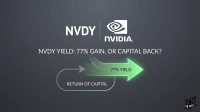
The $1,000 Hidden Tax on Every $10,000 Invested in This NVIDIA ETF
NVDY promises NVIDIA gains plus a fat monthly paycheck, but the fund's structure quietly works against you in ways the factsheet never mentions. Before your next contribution, find out exactly where that income is coming from and what you are…

This post may contain links from our sponsors and affiliates, and Flywheel Publishing may receive compensation for actions taken through them.
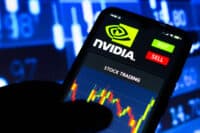
If you bought YieldMax NVDA Option Income Strategy ETF (NYSEARCA:NVDY) to ride NVIDIA‘s (NASDAQ:NVDA | NVDA Price Prediction) rocket while collecting a fat monthly check, the fund is quietly clipping both sides of your ticket. It charges you more than nine times what a plain index ETF costs, and it hands the underlying stock’s biggest up-moves to the option buyers on the other side of its trades.
What You’re Actually Paying
NVDY’s fact sheet lists a gross and net expense ratio of 1.09%. On a $10,000 stake, that is roughly $109 a year flowing out of your NAV before a single option premium hits the account. Compound that against a mainstream, cheap alternative like the Invesco QQQ Trust or the iShares Semiconductor ETF, and the drag stops looking like a rounding error. Over 10 years, a 1.09% annual fee on $10,000 quietly removes more than $1,000 of ending value versus a low-cost peer, before you even discuss the options overlay.
The comparison gets sharper against just owning the underlying. NVIDIA stock is up 28.72% over the past year and 13.25% year to date through July 10, 2026. NVDY, by comparison, returned 27.94% over the past year and 11.38% year to date. Those gaps are the covered call cap showing up in the price chart, on top of the fee.
The Part the Factsheet Doesn’t Highlight
Look inside the fund and the marketing story frays. As of May 19, 2026, only 11.5% of net assets sit in NVIDIA common stock. 20.6% is parked in U.S. Treasury securities. The N-PORT snapshot from April 30, 2026 shows an even more extreme cash tilt, with Treasury bills making up roughly 94.9% of net assets and NVIDIA exposure delivered through offsetting long and short options rather than shares.
That structure has two costs the factsheet does not spell out. First, the short calls cap your upside. On every big NVIDIA rip, someone else exercises against the fund and takes the gain above the strike, which is why NVDA can post 28.72% in a year while NVDY trails. Second, the fund’s income is a blend of option premiums and Treasury coupons, not pure NVIDIA dividends. NVIDIA itself pays only $0.25 a quarter after its June 2026 hike. The rest of NVDY’s high distribution is manufactured, and manufactured income has historically included return-of-capital and short-term gains that get taxed as ordinary income in a taxable account.
There is also transaction drag. Rolling multiple short and long NVIDIA calls week after week, visible in the July 17, 2026 expiration with 997,144 call contracts of open interest, generates bid-ask friction that never appears in the 1.09% headline.
The Cheaper Mirror
If the goal is NVIDIA exposure, holding NVDA directly costs nothing in fund fees and preserves the full upside. If the goal is diversified AI exposure with a lower expense ratio, broad tech and semiconductor ETFs run at a fraction of NVDY’s 1.09%. The trade-off is clear: you give up the loud monthly distribution and accept price appreciation as your return. NVDY sells the reverse trade, and NVDY holders paid for it in the one-year gap between the fund and its underlying.
What This Means for You
NVDY is a specific bet: swap a chunk of NVIDIA’s upside for a smoother, front-loaded income stream, and pay 1.09% a year for someone to run the options desk. The question worth asking before your next contribution is whether that monthly check, after fees, taxes, and the capped upside on a stock still compounding at 955.75% over five years, is actually paying you, or paying the structure.
Contact [email protected] for any questions or corrections.
I am a long time investor and student of business, and believe finding good companies that can become great investments is the best game on earth. After 20 years of writing and researching the public markets it is clear that individuals have never had more tools and information to take control of their financial lives. From ETFs and $0 commissions to cryptos and prediction markets there has never been a greater democratization of access to investing.
I write to help people understand the investments available to them so they can make the best choice for their portfolio, whether they're starting out or looking for income in retirement.