CSD and VEGN Both Beat the S&P 500 but One Thrives When Markets Punish Tech
Two rules-based ETFs have both outrun the S&P 500, yet they are built on completely opposite bets, and the same market conditions that reward one will likely punish the other.


Two rules-based ETFs, both beating the S&P 500, have almost nothing else in common. Invesco S&P Spin-Off ETF (NYSEARCA:CSD) versus US Vegan Climate ETF (NASDAQ:VEGN): one is a concentrated basket of corporate castoffs; the other is a tech-heavy large-cap fund filtered through animal-welfare and climate screens. Both have outrun the index, but their underlying engines differ fundamentally, and that difference dictates when each fund wins.
What Each Fund Is Actually Betting On
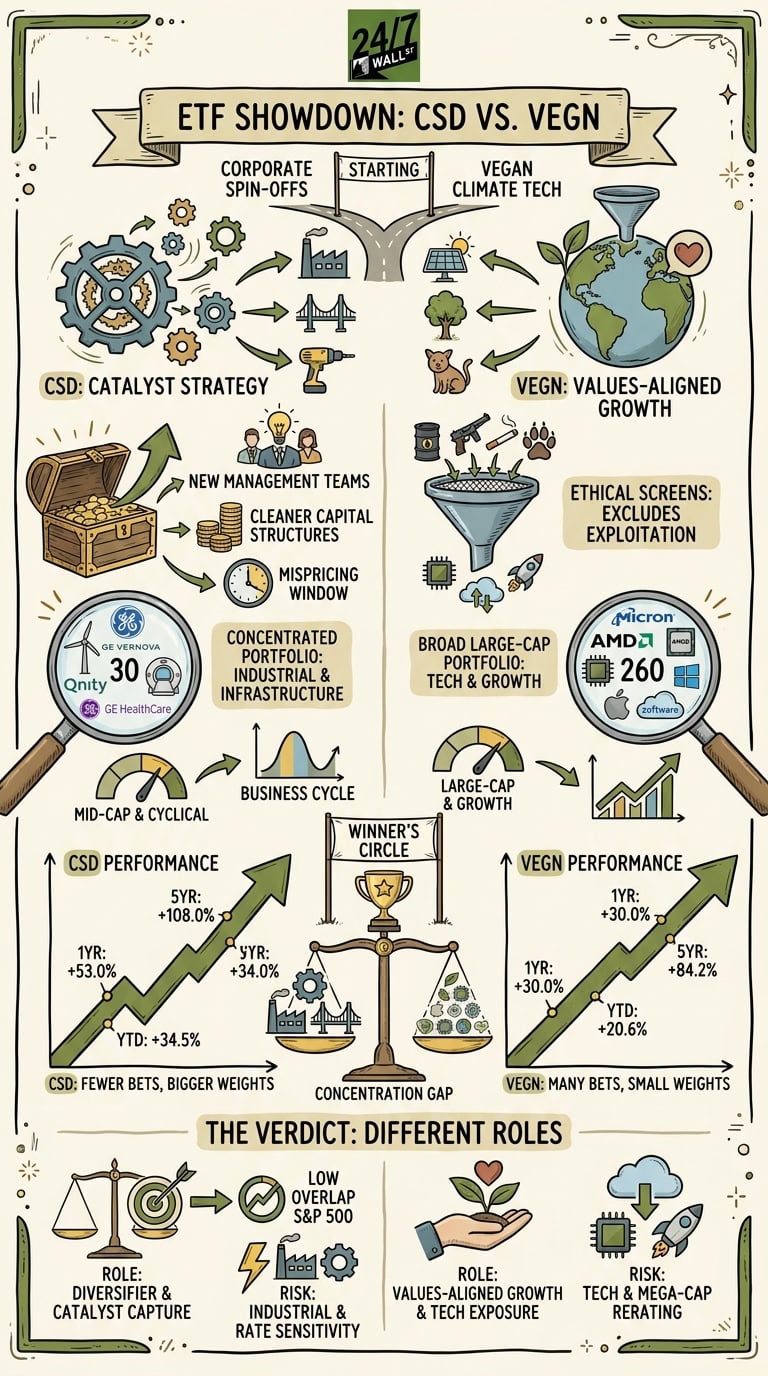
CSD holds recently separated U.S. companies, typically within roughly four years of a spin-off, tracking the S&P U.S. Spin-Off Index. It is a catalyst strategy betting that newly independent management teams, cleaner capital structures, and forced institutional selling around separation create a mispricing window. The portfolio is tiny by ETF standards, holding about 30 positions with heavy weights in industrial and infrastructure spin-offs like GE Vernova at 9.3%, Qnity at 8.0%, and GE HealthCare at 6.9%. SanDisk, at 9.5%, is the largest single equity. This is a mid-cap, cyclical, industrial-tilted basket with essentially zero overlap with the S&P 500’s mega-cap leadership.
VEGN runs the opposite trade. Its Beyond Investing US Vegan Climate Index starts with the U.S. large-cap universe and excludes companies tied to animal exploitation, fossil fuel extraction, defense, tobacco, and human rights abuses. What survives resembles the Nasdaq-100 with financials added. Top holdings are Micron at 5.9%, AMD at 4.6%, Applied Materials at 3.9%, and Apple at 3.8%. Semiconductors and software dominate. The implicit bet is that ethical screens push toward asset-light, high-margin businesses that win in growth regimes.
Where the Difference Shows Up
The past year makes the contrast clear. CSD returned 53.0% over the trailing 12 months and is up 34.5% year to date. VEGN returned 30.0% over one year and 20.6% year to date. SPY is up 16.3% over one year and 8.6% YTD. QQQ trailed VEGN slightly at 18.9% over the year.
Over five years, CSD’s edge widens: 108.0% for CSD versus 84.2% for VEGN and 68.8% for SPY. VEGN’s tech tilt punished it during the 2022 rate shock while CSD’s cyclical, mid-cap industrial book held up materially better. When the market punishes duration, VEGN is a duration trade dressed as an ethics screen.
The Practical Comparison
| Metric | CSD | VEGN |
|---|---|---|
| Net assets (April 30, 2026) | $223.4M | $191.0M |
| Positions | 29 | 260 |
| Largest equity weight | SanDisk, 9.5% | Micron, 5.9% |
| YTD 2026 return | 34.5% | 20.6% |
| 5-year return | 108.0% | 84.2% |
Note the concentration gap. CSD is concentrated into fewer than three dozen names. VEGN spreads capital across roughly 260 positions, most of them tiny. CSD behaves like a concentrated event-driven strategy in ETF wrapping; VEGN behaves like a large-cap growth index with an ESG filter.
The Verdict
These funds serve different roles. CSD suits investors holding a broad-market core who want targeted exposure to mid-cap corporate catalysts with low S&P 500 overlap. It is a diversifier that also generates return. VEGN suits investors wanting large-cap U.S. equity exposure aligned with values, accepting concentrated semiconductor and mega-cap tech risk. For investors who already own QQQ or a tech-heavy fund, VEGN adds mostly correlated risk. A sustained rate shock or industrial recession would pressure CSD’s cyclical book harder than VEGN’s balance sheets. A broad rerating of mega-cap semis would erase VEGN’s edge over the S&P 500 in a single quarter.
Contact [email protected] for any questions or corrections.
Trey has been an editor and author at 24/7 Wall St. for more than a decade, where he has published thousands of articles analyzing corporate earnings, dividend stocks, short interest, insider buying, private equity, and market trends. His comprehensive coverage spans the full spectrum of financial markets, from blue-chip stalwarts to emerging growth companies.
Beyond 24/7 Wall St., Trey has created and edited financial content for Benzinga and AOL's BloggingStocks, contributing additional hundreds of articles to the investment community.
Trey's editorial expertise extends across multiple publishing environments. He served as production editor at Dearborn Financial Publishing and development editor at Kaplan, where he helped shape financial education materials. Earlier in his career, he worked as a writer-producer at SVE. His freelance editing portfolio includes work for prestigious clients such as Sage Publications, Rand McNally, the Institute for Supply Management, the American Library Association, Eggplant Literary Productions, and Spiegel.
Outside of financial journalism, Trey writes fiction and has been an active member of the writing community for years, moderating workshop sessions at regional conventions.