3 Value ETFs That Pay Solid Dividends and Keep Beating the Market This Year
Large-cap value has quietly outrun the S&P 500 in 2026, and three dividend-paying ETFs are leading the charge, but each defines value so differently that picking the wrong one could cost you more than you gain.

This post may contain links from our sponsors and affiliates, and Flywheel Publishing may receive compensation for actions taken through them.

Large-cap value has quietly outrun the broader market in 2026, and three exchange-traded funds capture that shift while paying meaningful dividends: the Vanguard Value ETF (NYSEARCA:VTV), the Pacer US Cash Cows 100 ETF (CBOE:COWZ), and the WisdomTree U.S. High Dividend Fund (NYSEARCA:DHS). Each is beating the S&P 500 year to date, but each defines “value” differently, which matters more than the shared headline.
The market context helps explain the rotation. Franklin Templeton’s 2026 outlook argues that falling short-term interest rates should push investors out of cash and into risk assets, with financials benefiting from a steeper yield curve and improving net interest margin. That combination — cheaper valuations outside mega-cap tech and a friendlier rate backdrop for cyclicals — is exactly what these three funds are built to harvest. For reference, the SPDR S&P 500 ETF Trust (NYSEARCA:SPY) is up about 12% year to date, and all three ETFs below have posted notably better numbers.
VTV: The Low-Cost Value Anchor
[stock_chart symbol=”VTV”]
Vanguard’s flagship value fund tracks the CRSP US Large Cap Value Index and carries a gross expense ratio of just 0.03%, which is effectively free by ETF standards. That fee advantage compounds materially over decades, and it is the single strongest reason VTV belongs at the center of most value allocations rather than as a side bet.
The mechanism connecting VTV to the 2026 rally is straightforward. The index leans into financials, healthcare, industrials, and energy, exactly the sectors that Franklin Templeton flagged as beneficiaries of rate cuts, a steeper curve, and improving profitability outside the mega-cap tech complex. Investors get broad, cap-weighted exposure to the parts of the market that have re-rated as capital rotated away from crowded growth names, without stacking a factor bet on top of a factor bet.
Performance backs it up. VTV is up about 20% year to date, versus roughly 12% for SPY, and 27% over the trailing year. The fund pays quarterly distributions, and the most recent payment of $1.0818 was the largest in the trailing-year series, with a trailing 12-month total of $4.0905. Yield sits in the low-2% neighborhood at the current $226.79 share price.
The tradeoff: because VTV is cap-weighted, its largest holdings look a lot like the value tilt inside any S&P 500 fund. Investors seeking a sharper, more differentiated value exposure might find it too diluted.
COWZ: Value Defined by Cash, Not Book Value
[stock_chart symbol=”COWZ”]
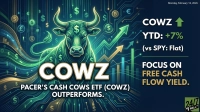
Pacer’s Cash Cows 100 ETF is the strategic pick on this list and the sharpest tool for the current environment. COWZ ranks Russell 1000 constituents by trailing free cash flow yield and holds the top 100, weighted by free cash flow with a cap, sidestepping the price-to-book screen that has repeatedly misfired against asset-light business models. The result is value with a built-in quality overlay, since companies that gush cash tend to sustain dividends and buybacks through cycles.
The portfolio looks nothing like a traditional value index. Top holdings as of the April NPORT filing include QUALCOMM at 2.67%, Altria at 2.20%, ConocoPhillips at 2.17%, CVS Health at 2.16%, and Bristol-Myers Squibb at 2.03%. Energy exposure runs deep, with ConocoPhillips, Diamondback Energy, Marathon Petroleum, Valero, and SLB all in the top ranks. Technology names that throw off enormous cash, like Adobe, Salesforce, and Intuit, sit alongside them.
Assets stand at roughly $18.2 billion, giving the fund real institutional scale. Year to date, COWZ has returned about 20%, and 11% in the past month alone, the strongest of this trio. Distributions are quarterly and variable, tied to underlying free cash flow generation. The trailing 12-month payout was $1.238, though the quarterly amounts have been lumpy.
Two things to understand before buying. First, COWZ is more concentrated than VTV, and heavy energy and healthcare weightings mean commodity swings and regulatory news can move it. Second, the expense ratio sits around 0.49%, well above VTV, so investors are paying a real premium for the methodology.
DHS: Dividend-Weighted Income for Yield-First Investors
[stock_chart symbol=”DHS”]
The WisdomTree U.S. High Dividend Fund takes the third approach. It screens for the top 30% highest-yielding U.S. large-cap dividend payers and weights them by cash dividends paid rather than market cap. That fundamental weighting mechanism is unusual and consequential: a company that raises its dividend gets a bigger slot at the next rebalance, while a stock that rallies without raising its payout gets trimmed. It is a rules-based buy-low, sell-high on income.
DHS is the income standout of the group. It distributes monthly, with a trailing 12-month total of $3.72 and an annualized forward amount of $3.66, which at the current $119.58 share price implies a yield in the 3% range, well above VTV. The expense ratio is 0.38%, sitting between VTV and COWZ.
The fund’s tilt toward energy, staples, healthcare, and utilities is exactly the mix that has led value’s 2026 run. DHS is up about 20% year to date and 23% over the past year. It has lagged COWZ but still trounced the S&P 500.
The risk with any high-yield screen is a value trap, buying stocks whose yields are elevated because the underlying business is impaired. WisdomTree’s dividend-weighting mitigates but does not eliminate that risk, particularly in sectors like tobacco and legacy telecom where secular pressures are real.
Which Value ETF Fits Which Investor
The three funds are not interchangeable, and the choice comes down to what an investor actually wants from a value allocation.
Pick VTV if the goal is a low-cost, tax-efficient core holding that will not deviate far from broad large-cap value. The 0.03% fee makes it the default choice for anyone building a long-term portfolio who does not want to think about factor timing.
Pick COWZ if free cash flow is the value signal that matters most. It has been the top performer this year, and its methodology filters out the balance-sheet weakness that has historically plagued cheap-on-book stocks. Investors pay for that with a higher fee and more concentration.
Choose DHS if current income is the primary objective. The monthly distribution schedule, higher yield, and dividend-weighted rebalancing make it the cleanest expression of an income-first value strategy, particularly for retirees drawing from the portfolio.
The three ETFs serve different roles. Investors comfortable owning more than one can pair VTV as the anchor with either COWZ or DHS as a satellite tilt toward cash-flow quality or income, depending on which lever matters more.
Contact [email protected] for any questions or corrections.
Ryne Mauck is an investment writer covering exchange-traded funds, retirement planning, and portfolio strategy. Through his work at 24/7 Wall St. and other investment platforms, including Seeking Alpha, he aims to provide clear, research-driven insights that help investors make more informed decisions while maintaining a long-term approach to investing.
Ryne holds a B.Sc. in Finance and an M.A. in Political Science. He is a formerly registered Municipal Advisor Representative and has passed the Series 50, Series 63, and Series 65 exams. His articles are not intended to be, nor should they be interpreted as, financial advice.