SPYI’s 12% Payout Creates a Tax Bill That Could Die With You
SPYI's 12% monthly payout has made it one of the fastest-growing ETFs in the country, but the tax math buried in its distribution notices reveals a very specific type of investor who benefits and everyone else who quietly loses ground.

This post may contain links from our sponsors and affiliates, and Flywheel Publishing may receive compensation for actions taken through them.

NEOS S&P 500 High Income ETF (BATS:SPYI) offers a 12% distribution rate payout that looks like a retiree’s dream, with monthly distributions as part of the schedule. What matters far more than the headline yield is what those payments are actually for, tax-wise.
According to SPYI’s August 19a-1 notice, roughly 97% of the latest distribution and 96% of fiscal-year distributions were estimated as return of capital. A review of the prior year reached a similar conclusion, reporting that 94% of SPYI’s 2025 distributions were classified as return of capital. That reshapes the entire question of who should own this fund, because return of capital is not really income at all. It is a slow refund of the money you put in, and it creates a deferred tax problem that has one very specific escape hatch.
Return of Capital and Cost Basis
When an ETF distributes more cash than it earns in dividends and realized gains, the excess gets labeled return of capital. The IRS treats those dollars as a partial refund of your investment rather than as income, so nothing is taxed in the year you receive them.
The catch is that every return-of-capital dollar reduces your cost basis in the fund. Basis is what you paid, adjusted over time, and it determines how much gain the IRS eventually recognizes when you sell. Lower basis today means a larger taxable gain later. Once basis hits zero, additional return-of-capital payments generally become taxable capital gains in the year received, so the deferral runs out for long-term holders who never sell shares.
The 19a-1 estimates are not final. Fund sponsors reclassify these figures after year-end based on actual results, and the ordinary-income share can rise or fall. Investors only learn the true character on the 1099-DIV that arrives the following winter.
How Basis Erodes Over Time
Consider a hypothetical $100,000 stake earning an unchanged 12% distribution rate. That position throws off $12,040 in monthly distributions in the first year, and if the tax character stays roughly the same, about $11,558 of it comes off the basis rather than showing up as taxable income. Repeat that year after year and the basis line marches down while the market value can hold steady or even climb. SPYI has done the latter recently, with the share price at $53.78 and a one-year total return of about 18%.
Real outcomes will differ as classifications shift and distributions change month to month. The fund itself has grown to roughly $10.4 billion in net assets as of June 30, 2026, so the strategy clearly has an audience. Most are buying the yield without thinking carefully about what happens when basis approaches zero.
Step-Up in Basis Changes Everything
Under Internal Revenue Code Section 1014, when a taxpayer dies, qualifying assets held in a taxable account generally receive a new basis equal to their fair market value on the date of death. Heirs inherit shares at the stepped-up cost basis rather than the decedent’s cost basis.
For a SPYI holder who spent years watching basis grind toward zero, that reset is meaningful. The embedded gain evaporates, and heirs can sell the next day with little to no capital gains tax on the accumulated appreciation. Two important limits apply: gifts made during life do not receive a step-up, and retirement accounts gain nothing here because IRA and 401(k) shares have no basis to reset.
Who SPYI Actually Suits
SPYI fits a narrow profile well. An older investor holding it in a taxable brokerage account, drawing monthly distributions to fund living expenses, and planning to leave remaining shares to heirs can plausibly convert most of the payout stream into a deferred obligation that never comes due. That only works if the surrounding estate paperwork is in order, which is the whole subject of a free checklist we put together on beneficiary forms, titling, and trusts.
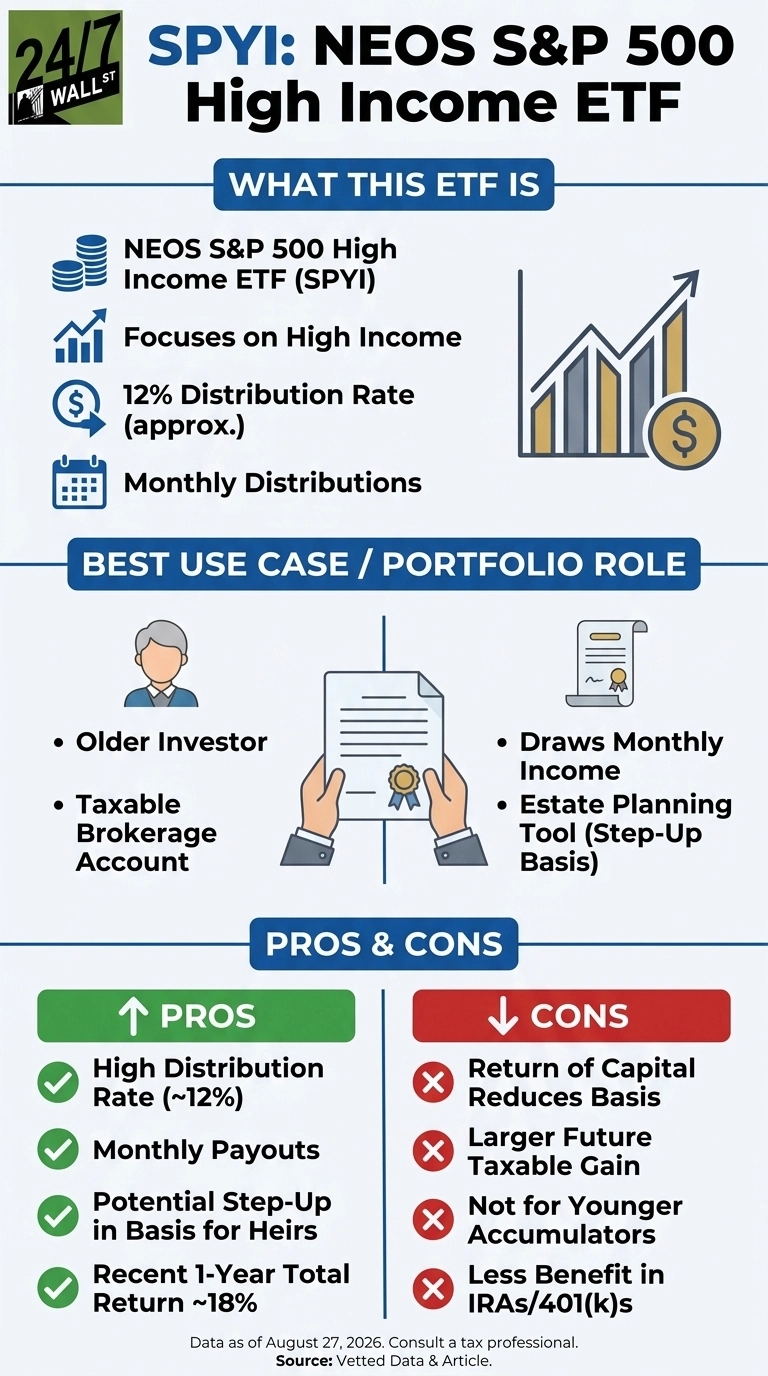
Younger accumulators get the worst of the arrangement. They spend down basis for decades, then either sell and pay the deferred bill or watch distributions convert to taxable gains once basis reaches zero. A cheaper total-return index fund in a taxable account, or SPYI inside a Roth, sidesteps both problems. Confirm your situation with a tax professional before treating SPYI as an estate-planning instrument.
Contact [email protected] for any questions or corrections.
Omor Ibne Ehsan is a writer at 24/7 Wall St. He is a self-taught investor with a focus on growth, cyclical, and dividend equities that have strong fundamentals, value, and long-term potential. He also has an interest in high-risk, high-reward investments such as penny stocks.