Own an Index Fund, a Growth Fund, and a Tech Fund? You Likely Own the Same Companies Three Times. These 3 ETFs Remove the Overlap
Most investors assume owning multiple funds means owning different things, but a quick look at the actual holdings reveals a much more uncomfortable truth about where all that money is really concentrated.

This post may contain links from our sponsors and affiliates, and Flywheel Publishing may receive compensation for actions taken through them.
You bought an S&P 500 index fund. A few years later, you added a large-cap growth fund. Then came a technology fund. Three funds, three different reasons. It feels diversified. Open the holdings pages side by side, though, and you’ll find the same handful of giant companies sitting near the top of all three.
A trio of funds with barely overlapping holdings solves the problem: iShares Core S&P Total U.S. Stock Market ETF (NYSEARCA:ITOT), Vanguard Total Bond Market ETF (NASDAQ:BND), and iShares Core MSCI Total International Stock ETF (NASDAQ:IXUS). One covers U.S. stocks, one covers bonds, and one covers companies listed everywhere else.
Why Your Three Funds Keep Buying the Same Stocks
Most index funds weight companies by market value. A broad U.S. index fund puts its biggest weights in the largest companies. A large-cap growth fund screens for fast-growing big companies, and when the largest companies are also the fastest growers, those same names rise to the top again. A technology fund adds a third layer, because many of those giants are tech companies.
The result is a statement showing several funds and a portfolio whose fortunes ride on a small group of stocks. When those companies rally, everything you own rallies. When they fall, everything falls together. Your portfolio acts like one position while looking like three.
That concentration can be fine. The trouble starts when it’s invisible. You can’t manage a risk you don’t know you hold.
ITOT Puts the Entire U.S. Market in One Holding
ITOT tracks the whole U.S. stock market, reaching past the large caps into mid-size and smaller companies your growth and tech funds likely skip. You still own the giants, but at their market weight instead of being counted three times.
The cost is minimal: a net expense ratio of 0.03%, according to the fund’s July 31, 2026 prospectus. Net assets stood at about $94.1 billion as of June 30, 2026. It pays quarterly, totaling about $1.69 per share over the trailing 12 months. The adjusted price is up 13.35% year-to-date and 16.45% over the past year.
BND Adds an Asset Class Your Stock Funds Never Touch
Every fund you own today is a stock fund. BND holds broad U.S. investment-grade bonds and tracks the Bloomberg U.S. Aggregate Float Adjusted Index, so its overlap with your equity funds is zero. Bond prices respond mainly to interest rates and credit conditions, drivers that differ from the ones moving tech stocks.
The expense ratio is 0.04%, per Vanguard’s June 2026 fact sheet. BND pays monthly, with trailing 12-month distributions of about $2.93 per share. Bonds carry their own risk, though. Rising rates push prices down, and BND’s adjusted price is down 2.85% year-to-date and 2.77% over the past month. Its job is to steady the portfolio.
IXUS Fills the Biggest Gap in Portfolios Like Yours
A portfolio built from U.S. index, growth, and tech funds usually holds almost nothing listed outside the U.S. IXUS covers developed and emerging markets outside the U.S. through the MSCI ACWI ex USA IMI benchmark, so it sits beside your U.S. funds without duplicating them.
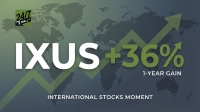
Its July 31, 2026 holdings filing lists names such as Royal Bank of Canada, Toronto-Dominion Bank, Shopify, Volvo, Teva Pharmaceutical, and Sea Limited, spanning banks, energy, miners, industrials, and software. Net assets reached about $58.4 billion. Distributions arrive semi-annually, adding up to about $2.80 per share over the trailing 12 months. The adjusted price is up 13.94% year-to-date and 19.42% over the past year.
Trade-Offs to Weigh Before You Reshuffle
This lineup spreads risk more truly. ITOT’s adjusted price rose 295.59% over the last ten years, while IXUS gained 141.8% and BND gained 11.57%. Real diversification means some pieces will lag for long periods.
Taxes matter too. Selling existing funds in a taxable account can create a tax bill, so transition deliberately over time rather than in a single session.
Why This Trio Belongs in Your Portfolio
If you believed you were diversified because you owned several funds, these three turn fund count into actual breadth: the full U.S. market, a bond market your stock funds never reach, and thousands of companies abroad. Each one holds what the other two leave out, and you finally know exactly what you own.
Contact [email protected] for any questions or corrections.
Ryne Mauck is an investment writer covering exchange-traded funds, retirement planning, and portfolio strategy. Through his work at 24/7 Wall St. and other investment platforms, including Seeking Alpha, he aims to provide clear, research-driven insights that help investors make more informed decisions while maintaining a long-term approach to investing.
Ryne holds a B.Sc. in Finance and an M.A. in Political Science. He is a formerly registered Municipal Advisor Representative and has passed the Series 50, Series 63, and Series 65 exams. His articles are not intended to be, nor should they be interpreted as, financial advice.