Your Adviser’s Model Portfolio Is Four Index Funds and a 1% Fee. These 4 ETFs Are the Same Portfolio for Under 0.10%
Your quarterly statement reveals four basic index funds inside a model portfolio charging 1% annually, and that gap between what you pay and what you actually own raises a question most investors never think to ask.

This post may contain links from our sponsors and affiliates, and Flywheel Publishing may receive compensation for actions taken through them.

You opened your quarterly statement, scrolled past the performance chart, and found the actual holdings: a US stock index fund, an international stock index fund, a bond index fund, and a short-term Treasury position. You pay 1% of your assets every year for that model portfolio. You want to know what that fee covers.
On the holdings side, four ETFs fill the same four slots: iShares Core S&P 500 ETF (NYSEARCA:IVV), iShares Core MSCI Total International Stock ETF (NASDAQ:IXUS), Vanguard Total Bond Market ETF (NASDAQ:BND), and iShares 0-3 Month Treasury Bond ETF (NYSEARCA:SGOV). Every expense ratio comes in under 0.10%.
What Your Adviser Does That a Fund Lineup Can’t
To be fair to your advisor, a good one handles tax-aware withdrawal sequencing, keeps rebalancing on schedule, and coordinates beneficiaries and estate documents. Most valuable of all, a good advisor talks you out of selling at the bottom of a market drop. So the real question is whether the fee buys enough to justify what it costs, and the answer depends on who you are.
IVV Fills Your US Large-Cap Core
IVV tracks the S&P 500, the same 500 large US companies sitting at the center of most model portfolios. Its expense ratio is 0.03%, among the lowest you’ll find for this exposure. IVV has gained about 17.35% over the past year and roughly 324.93% over the past decade on an adjusted basis. Its size and liquidity keep the spread between buy and sell prices tight.
IXUS Covers Everything Outside the US
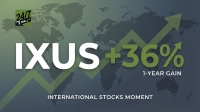
IXUS tracks the MSCI ACWI ex USA IMI Index, which spans developed and emerging markets and includes small caps that narrower international funds leave out. It held about $58.4 billion in net assets as of July 31, 2026. Recent filings show holdings ranging from Canadian banks and energy producers to companies in Japan, Sweden, Israel, and Singapore. IXUS has returned about 17.02% over the past year but roughly 142.48% over ten years, well behind IVV. That gap is the cost of diversifying abroad, and it’s worth knowing before you count on international stocks to keep pace. The fund maintains an expense ratio of 0.07%.
BND Anchors the Bond Allocation
BND mirrors the Bloomberg US Aggregate Float Adjusted Index, holding Treasuries, agency mortgage-backed securities, and investment-grade corporate bonds in one fund. Vanguard’s fact sheet lists its expense ratio at 0.04%. Distributions come monthly, most recently $0.248502 per share on October 5, with $2.938625 paid over the trailing 12 months. Bonds still carry rate risk. BND is down about 1.99% over the past year, a period in which the Fed raised its target rate’s upper bound to 4.00% from 3.75%.
SGOV Handles the Cash Sleeve
SGOV holds Treasury bills maturing in three months or less, so it carries minimal interest-rate and credit risk. At 0.09%, it is the most expensive fund in this group. Costs vary across the four funds, and your cash holding costs the most. Its income tracks short-term rates, and the 13-week T-bill yielded about 4.19% as of October 13. SGOV pays monthly, most recently $0.300547 per share, down from $0.346643 in October 2025. If short-term rates fall, that payout shrinks.
You Inherit the Job Along With the Savings
Buying the four funds is the easy half. Once the advisor steps away, the work becomes yours. You rebalance on a schedule when stocks run ahead of bonds. You decide which account holds each fund, since taxable brokerage accounts and IRAs treat bond income and stock gains differently.
You choose what to sell when you need cash, and in what order. The fee you save is real. So is the job you take on, and readers who plan for both are the ones who make this work.
Who Should Keep Paying the Fee
If you’ve sold in a panic before, or you know a rebalancing reminder will sit unopened in your inbox, your advisor may be earning that 1%. A calm voice during a crash can keep you from locking in losses, which matters most in the early years of retirement when a bad drawdown does permanent damage (we walked through that defense in a free guide here: The First Five Years).
Contact [email protected] for any questions or corrections.
Ryne Mauck is an investment writer covering exchange-traded funds, retirement planning, and portfolio strategy. Through his work at 24/7 Wall St. and other investment platforms, including Seeking Alpha, he aims to provide clear, research-driven insights that help investors make more informed decisions while maintaining a long-term approach to investing.
Ryne holds a B.Sc. in Finance and an M.A. in Political Science. He is a formerly registered Municipal Advisor Representative and has passed the Series 50, Series 63, and Series 65 exams. His articles are not intended to be, nor should they be interpreted as, financial advice.