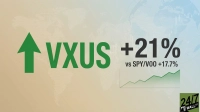
Forget VXUS: VOO Returned 320.81% Over Ten Years Against VXUS’s 139.56%
VOO and VXUS both offer broad market exposure, but their ten-year return gap tells a story that challenges the standard case for international diversification and forces a real decision about what belongs in your portfolio.

This post may contain links from our sponsors and affiliates, and Flywheel Publishing may receive compensation for actions taken through them.
Vanguard Total International Stock ETF (NASDAQ:VXUS) is the standard way investors add non-US stocks to a portfolio, and the logic holds up. VXUS spreads money across companies outside the United States, so your wealth does not depend on one economy. In terms of performance, though, VXUS has not kept pace. In the ten years through the Friday, October 16, 2026 close, VXUS returned 139.56%, while Vanguard S&P 500 ETF (NYSEARCA:VOO) returned 320.81%. That leaves VOO ahead by 181.25 percentage points. Both windows start on October 18, 2016, and both figures assume distributions were reinvested.
One Fund Owns Large US Companies, the Other Owns the Rest of the World
These two funds own different parts of the world. VXUS’s February 27, 2026 summary prospectus calls it the ETF share class of Vanguard Total International Stock Index Fund. The fund tracks stocks of companies “located in developed and emerging markets, excluding the United States.” VOO’s April 28, 2026 prospectus calls it the ETF share class of the Vanguard 500 Index Fund. Its benchmark is “dominated by the stocks of large U.S. companies.”
So moving money from VXUS into VOO changes where in the world your money sits. Make that call on purpose. Chasing a better return chart alone is a poor reason.
VOO Led in Every Window We Measured
Here is how the two funds compare over each period, measured through the October 16, 2026 close:
| Period | VOO | VXUS | VOO’s Lead |
|---|---|---|---|
| Ten years | 320.81% | 139.56% | 181.25 points |
| Five years | 83.56% | 49.16% | 34.4 points |
| One year | 16.85% | 15.26% | 1.59 points |
| Year to date | 12.86% | 11.4% | 1.46 points |
The five-year window began on October 15, 2021. Over the past month, VOO gained 1.47% while VXUS fell 2.14%. No window in this comparison shows VXUS ahead.
The size of VOO’s lead changes a lot by window. Over five and ten years, the gap is large. Over the past year and year-to-date, VOO leads by less than two points. A VXUS holder looking only at recent results would see two funds running close together, while the longer windows show a much wider gap.
What a Decade of Data Can and Cannot Prove
This record covers one decade that ends on one date, so it tells you what happened and stops there.
Investors own international stocks because those stocks do not always move with US stocks. That is the whole reason they diversify a portfolio. A fund that behaves differently will trail whenever US stocks lead, and the past ten years have been such a period.
Nobody knows which region will lead next, and this article makes no forecast either way. If you drop VXUS because of a decade of lagging returns, you give up the one feature that justifies having it, which is exposure to markets that move independently of the US.
Currency Adds a Second Layer to VXUS Returns
VXUS’s companies trade in their own currencies, and the fund reports its value in dollars. Its return therefore reflects two things: how the underlying companies perform and how their currencies move against the dollar. A stronger foreign currency adds to a US investor’s return, and a weaker one subtracts from it. VOO’s large US companies trade in dollars, so it has no currency layer. This is a built-in feature of international funds, and it can add to or subtract from returns in any given year.
Switching Without a Surprise Tax Bill
Inside an IRA or 401(k), you can sell VXUS and buy VOO with no tax consequences. In a taxable account, selling VXUS at a gain triggers capital gains tax, which reduces the money you have left to reinvest. An easier path is to keep your existing VXUS shares and direct new contributions to VOO, which gradually shifts your allocation over time without selling anything. With VOO at $701.63 and VXUS at $83.43 as of Friday’s close, check whether your broker supports fractional shares so cash does not sit uninvested.
Matching Your VXUS Weighting to Your Portfolio Goals
If VXUS is a large part of your portfolio and growth is the goal, its weighting deserves a closer review. Over the past decade, it has not justified a large weighting based on performance alone. If you hold international stocks so your whole portfolio does not rise and fall with the US market, a smaller VXUS position can still serve that purpose. That diversification only helps if you still own it when international markets start to lead.
Contact [email protected] for any questions or corrections.
Ryne Mauck is an investment writer covering exchange-traded funds, retirement planning, and portfolio strategy. Through his work at 24/7 Wall St. and other investment platforms, including Seeking Alpha, he aims to provide clear, research-driven insights that help investors make more informed decisions while maintaining a long-term approach to investing.
Ryne holds a B.Sc. in Finance and an M.A. in Political Science. He is a formerly registered Municipal Advisor Representative and has passed the Series 50, Series 63, and Series 65 exams. His articles are not intended to be, nor should they be interpreted as, financial advice.