$10,000 in Vanguard’s Health Care ETF in 2004 Grew to $93,915, and It Still Charges 0.09%
A single health care ETF launched two decades ago at rock-bottom cost has quietly compounded into a sum that surprises most investors, but whether its three closest rivals can match it depends entirely on what kind of risk you are…

This post may contain links from our sponsors and affiliates, and Flywheel Publishing may receive compensation for actions taken through them.
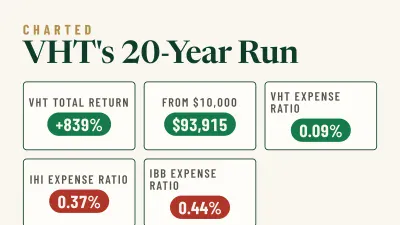
A $10,000 investment in Vanguard Health Care ETF (NYSEARCA:VHT) made on January 30, 2004 and held through October 29, 2026, with every distribution reinvested, grew to $93,915.
That is a total return of 839%. The fund’s prospectus filed with the SEC, dated June 30, 2026, lists a net expense ratio of 0.09%.
That pairing of low cost and broad reach makes VHT a strong core health care option for long-term investors, and it sets the bar for three alternatives. The Health Care Select Sector SPDR Fund (NYSEARCA:XLV) is the large-cap-only version of the sector. The iShares U.S. Medical Devices ETF (NYSEARCA:IHI) focuses on equipment makers, and the iShares Biotechnology ETF (NASDAQ:IBB) concentrates on drug developers. Each narrows the exposure or costs more, so each needs a specific reason to own it.
What VHT Owns: Drugmakers, Device Makers, Insurers and Small Caps
VHT tracks the MSCI US Investable Market Index Health Care 25/50, which covers large, mid-size, and small U.S. companies across the entire sector, according to its summary prospectus. That includes pharmaceuticals, biotechnology, medical equipment and supplies, health insurers and providers, drug distributors, plus technology services tied to medicine.
The fund weights holdings by market cap, so the largest companies drive results. Every cap-weighted health care fund leans on the same giants. For example, in XLV’s latest SEC holdings report, Eli Lilly (NYSE:LLY | LLY Price Prediction) alone made up about 17% of assets. VHT owns those same leaders at the top, then adds the mid-size and small companies that S&P 500 funds leave out. The 25/50 rule in its index caps any single issuer at 25% and limits the combined weight of all issuers above 5% to 50%, so no single drugmaker can command the portfolio.
VHT’s portfolio turnover was just 4% in the most recent fiscal year. Rarely selling positions generates fewer trading costs and fewer taxable capital gains, which matters for anyone holding the fund in a brokerage account.
Demand for what these companies sell tends to hold steady. People fill prescriptions, schedule surgeries, and pay insurance premiums in recessions and expansions alike. An aging population adds a structural layer, since older adults use more medical care. Steady demand supports revenue, though it guarantees nothing about stock prices.
How $10,000 Turned Into $93,915
The long-run result came in uneven pieces. Over the past ten years, VHT returned 219% with distributions reinvested. Over the past year alone, it returned 28%. Yet over five years, the fund’s adjusted price rose only about 42%, a slow stretch showing how long the sector can stall. A single strong year says little about the next one.
Dividends did part of the work. VHT pays quarterly, and its most recent distribution was $0.97 per share in September 2026. Reinvesting every one of those payments over two decades is built into the $93,915 figure.
That figure assumes one lump sum, every distribution reinvested, no taxes, and no selling. Real investors who add money gradually, pay tax on distributions, or sell during a slump will land somewhere else. The number is backward-looking as well, and the next two decades may look nothing like the last two.
Why a 0.09% Fee Matters Over Decades
An expense ratio is the yearly percentage of your investment a fund keeps to pay for management and operations. It comes out of fund assets automatically, so you never see a bill. VHT’s breaks down to a 0.08% management fee plus 0.01% in other expenses.
Future returns, dividends, and valuations are unknowable. The fee is one of the few costs an investor knows in advance, and it applies every single year the money stays invested. For comparison, IHI charges 0.37%, and IBB charges 0.44%, according to their prospectuses dated July 31, 2026. Simply put, narrower exposure costs more.
Single-Sector Risks You Accept With VHT
VHT is a sector fund that carries concentrated risk and works best alongside a diversified portfolio. Four risks deserve attention:
- Sector lag. Results depend on one industry, and sector funds can trail the broad market for years. The modest five-year gain shows how patient a holder must be.
- Drug pricing and regulation. Medicare price negotiation, government reimbursement rates, and FDA decisions can reset profits for an entire class of companies at once, and no diversification within health care fully offsets that.
- Patent expirations. When a blockbuster drug loses patent protection, generic competition can erase a large share of its sales quickly, hitting the biggest pharmaceutical holdings hardest.
- Concentration. With Eli Lilly near 17% of XLV, a single company’s trial results or pricing setbacks can move a cap-weighted health care fund. VHT’s small-cap tail cushions this but does not remove it.
Three Alternatives and the Investors They Suit
XLV for Large-Cap Purists
XLV holds only S&P 500 health care stocks and carries about $41 billion in net assets, which brings deep trading liquidity. The tradeoff is greater reliance on mega-caps and zero exposure to the smaller companies that VHT includes.
IHI for Medical Device Exposure
IHI takes a different angle on the sector. Device makers sell surgical robots, implants, and diagnostic equipment to hospitals, so their revenue follows procedure volumes driven by an aging population. They face less direct exposure to drug-price negotiation and patent cliffs than pharmaceutical companies. The trade-offs include a higher fee, a narrow portfolio dominated by a handful of large device makers, and sensitivity to hospital budgets.
IBB for Biotech Innovation
IBB ties returns to clinical trial outcomes, FDA approvals, and acquisitions, which makes it far more volatile than a broad fund. It appeals to those seeking drug-discovery exposure who can bear that volatility. Equal-weighted biotech funds and actively managed genomics funds were left off this list because they add more speculative, small-cap risk without a cleaner link to steady health care demand.
Matching the Fund to the Investor
VHT fits buy-and-hold investors seeking the whole health care sector at minimal cost, typically held alongside a total-market fund. XLV suits those who prefer only the largest names, IHI fits investors seeking sector exposure with less drug-pricing risk, and IBB suits those comfortable with sharp swings. Before choosing, compare how much health care you already own through broad index funds.
Contact [email protected] for any questions or corrections.
Ryne Mauck is an investment writer covering exchange-traded funds, retirement planning, and portfolio strategy. Through his work at 24/7 Wall St. and other investment platforms, including Seeking Alpha, he aims to provide clear, research-driven insights that help investors make more informed decisions while maintaining a long-term approach to investing.
Ryne holds a B.Sc. in Finance and an M.A. in Political Science. He is a formerly registered Municipal Advisor Representative and has passed the Series 50, Series 63, and Series 65 exams. His articles are not intended to be, nor should they be interpreted as, financial advice.