Her Husband Needs a Nursing Home, and Medicaid Says They Have $237,000 Too Much. She’ll Turn It Into an Annuity Paying Her $4,470 a Month. If She Dies Early, the State Will Collect What’s Left

This post may contain links from our sponsors and affiliates, and Flywheel Publishing may receive compensation for actions taken through them.
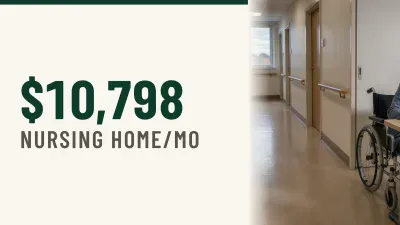
Picture a wife in her 70s whose husband can no longer live at home after a series of strokes. The nursing home quotes a private room near the national median of $10,798 a month. Medicaid will cover that bill, but only after the couple’s countable savings come down, and right now they sit $237,000[1] over the line.
Elder law attorneys reach for a standard fix in this situation: a Medicaid-compliant annuity. Under the Deficit Reduction Act of 2005, the spouse who stays home can turn excess cash into an irrevocable stream of monthly income. Medicaid counts that stream as her income, so it no longer shows up as a countable asset. In this example, $237,000 becomes roughly $4,470 a month[2]. The catch is that the state must be named in the required remainder-beneficiary position, and if she dies before the payments run out, Medicaid can collect from what remains up to the amount it paid for her husband’s care.
Medicare Stops at 100 Days, and Medicaid Takes Over
Families mix up the two programs all the time. Medicare is the federal health insurance for people 65 and older. It pays for skilled nursing care after a hospital stay, but only up to 100 days[3] per benefit period. Days 21 through 100 cost $217 a day[3] in 2026, and that rises to $222[4] in 2027. Once the need becomes long-term custodial care, Medicare’s coverage ends.
The joint federal-state program for people with limited means, Medicaid pays for long nursing home stays. When one spouse applies, it adds up the couple’s countable assets together, whoever’s name is on the account.
$162,660 Caps What She Keeps in 2026
Medicaid’s spousal impoverishment rules protect the at-home spouse through the Community Spouse Resource Allowance, or CSRA. For 2026, the federal minimum CSRA is $32,532 and the maximum is $162,660.
Where the couple lives makes a big difference here. In states using the 100% method, the at-home spouse can keep countable assets up to the maximum CSRA. In states using the 50% method, she generally keeps half of the couple’s countable assets, subject to the federal floor and ceiling. Two couples with the same savings can end up with very different excess amounts depending on their state.
In this example, assume $237,000 remains above what the couple can keep under their state’s rules, so that excess has to come down before her husband qualifies. Spent on care at $10,798 a month, it would be gone in about 22 months.
How a Medicaid-Compliant Annuity Turns $237,000 Into $4,470 a Month
Medicaid-compliant annuities are commonly structured around several protections:
- Irrevocable and non-assignable: once she buys it, she can’t cancel it, change it or sell it.
- Actuarially sound: the payout period can’t run past her life expectancy.
- Equal payments: regular checks of the same size, with no deferrals and no balloon payments.
- State as beneficiary: the state Medicaid agency is named as remainder beneficiary.
Miss any one of these and Medicaid can treat the purchase as a gift, which triggers a penalty period.
At an illustrative 5% annual rate, $237,000 paid over 60 months produces checks of about $4,472 a month, or roughly $268,350 over five years. For comparison, the average retired worker’s Social Security check will be $2,170[2] after the 2027 cost-of-living adjustment (COLA).
Current rates help her. The Fed raised the upper bound of its target range from 3.75% to 4.00%[5] in September, its first rate hike since 2023. The 10-year Treasury yield stood at 4.92% on November 20, 2026. Insurers set annuity payouts based on longer-term yields, so higher yields mean a bigger monthly check for the same premium. The national average 12-month CD pays just 1.81% APY[1].
The income belongs to her. Under federal spousal rules, the community spouse keeps all of his or her own income. That means the checks don’t count against her husband’s eligibility.
If She Dies in Year 3, the State Collects What’s Left
Federal rules apply here. They require the state to be named first remainder beneficiary for at least the amount of Medicaid benefits paid, or second after a community spouse, minor child or disabled child. She’s the annuitant, so she can’t be her own remainder beneficiary. With no minor or disabled child in the family, the state takes first position.
Say she dies after 30 payments while her husband is still in the nursing home. The remaining payments go to Medicaid until the state gets back what it has spent on his care. Anything left after that goes to her backup beneficiaries, usually the children.
That’s why planners often keep the term short. A five-year payout leaves the state less time to collect, and every check she cashes in the meantime stays with the family. Some states write their own versions of the beneficiary rule, too. Michigan, for example, requires the state to be named in the first position, or as the second remainder beneficiary after the community spouse.
She also takes inflation risk. The payment stays fixed for five years, so rising prices can erode what each $4,470 check buys.
Timing matters too. Families buy the annuity before filing the Medicaid application and disclose it on the paperwork. A contract with one wrong clause can cost the husband months of coverage while the nursing home keeps charging $10,798 a month.
Contact [email protected] for any questions or corrections.
Gerelyn Terzo is the author of dividend investing handbook "Dividend Investing Strategies: How to Have Your Cake & Eat It Too." A veteran financial journalist, she covers agri-finance for outlets like Global AgInvesting and the broader stock market and personal finance for 24/7 Wall Street. She began at CNBC and later helped launch Fox Business in New York. Gerelyn currently resides in Woodland Park, Colorado and dabbles in nature photography as a hobby.