QUAL Is Splitting Its Shares. Here’s What a Fund Split Changes and What It Doesn’t
QUAL is about to multiply its share count in a 4-for-1 split, and your brokerage statement will look different afterward. Before you mistake a sudden price drop for a loss, here is exactly what changes on November 5 and what…

This post may contain links from our sponsors and affiliates, and Flywheel Publishing may receive compensation for actions taken through them.
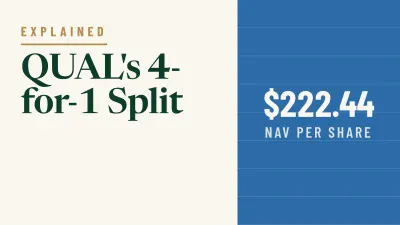
Shareholders in the iShares MSCI USA Quality Factor ETF (CBOE:QUAL) are about to own more shares. The fund is set to complete a 4-for-1 forward stock split. Shares are scheduled to begin trading on a split-adjusted basis on November 5, 2026.
A forward stock split divides each existing share into several new ones. At 4-for-1, every QUAL share you own becomes four shares, and the price of each share adjusts down in the same proportion. Your position is worth the same amount after the split as it was before.
Key Dates on the iShares Split Calendar
A notice on the QUAL fund page says iShares filed to issue the forward split on October 5, 2026. The record date is November 3, 2026.
The record date is the cutoff the fund uses to decide which shareholders get the additional shares, and if you’re a shareholder of record on that day, you’re included.
The split is scheduled to take effect after the close of trading on November 4, 2026. When the market opens on November 5, 2026, QUAL is set to trade at its new split-adjusted price.
Your Brokerage Statement Is About to Look Different
After the split, you’ll own more shares, each with a proportionally lower price, and several per-share figures you may track will be adjusted as a result.
Start with net asset value, or NAV. That’s the fund’s total assets divided by its number of shares. QUAL’s NAV was at $222.4352 per share as of October 30, 2026, according to iShares.
iShares also listed 216,000,000 shares outstanding as of that same date. After November 5, the NAV per share will be lower, and the number of shares will be higher, both in line with the split ratio. The fund’s total value stays the same.
Distributions work the same way. QUAL’s most recent quarterly distribution was $0.472671 per share on September 18, 2026, with an ex-date and record date of September 15, 2026. Going forward, per-share distribution amounts will look smaller because each payment is spread across a larger number of shares. Your total payout depends on the fund’s income, and the split itself doesn’t change that.
Put an October statement next to one from mid-November, and you’ll see a sudden drop in the per-share price. The split is behind that drop. It is a bookkeeping change, and you haven’t lost money. Most charting tools adjust older prices to account for splits, but saved screenshots and printed statements won’t be updated.
Holdings, Index and Fees Stay the Same
Splits change the number of shares and leave everything inside the fund alone. QUAL holds the same stocks in the same weights and continues to track the MSCI USA Sector Neutral Quality Index, which focuses on U.S. companies with strong quality characteristics. Its strategy stays the same.
BlackRock iShares lists the fund’s expense ratio at 0.15% in the prospectus, and the split leaves that fee unchanged. The fee is charged as a percentage of the assets you hold, so the cost of owning the fund stays the same. It also has no effect on the fund’s returns. On November 5, you’ll own the same piece of the fund’s assets that you owned on November 4.
Why Fund Sponsors Split Their Shares
Splits usually come down to the sticker price. A high per-share price can be awkward for investors who buy only whole shares, especially those adding modest amounts each month or rebalancing a retirement account. A lower price lets them invest in smaller steps and match their target allocations more closely.
Another common reason is options trading. A standard listed options contract covers 100 shares, so a lower share price reduces the dollar value of each contract. Options on the fund can become easier to use for investors who write covered calls or buy protective puts.
Many brokers now sell fractional shares, which undermines the first argument, but not every platform or retirement plan offers them. These are typical reasons for splits in general. iShares hasn’t said which of them, if any, applies to QUAL.
What You Need to Do Before November 5
For most shareholders, nothing. Your broker handles the adjustment automatically. Extra shares should show up in your account. If you hold QUAL on the November 3, 2026 record date, from November 5 your statement will show more shares at a lower price each.
Shareholders with open limit orders or stop orders on QUAL should ask their broker how they’ll be treated around the split. Some firms cancel those orders, and others adjust them. Also make a note of the split date in your own records so the price drop doesn’t throw you off when you check your account later.
The split changes only the number of shares and the per-share price. QUAL’s holdings, index, fee, and the total value of your position will be the same on November 5 as they were the day before. Only the number of shares and the price of each one will change.
Contact [email protected] for any questions or corrections.
Ryne Mauck is an investment writer covering exchange-traded funds, retirement planning, and portfolio strategy. Through his work at 24/7 Wall St. and other investment platforms, including Seeking Alpha, he aims to provide clear, research-driven insights that help investors make more informed decisions while maintaining a long-term approach to investing.
Ryne holds a B.Sc. in Finance and an M.A. in Political Science. He is a formerly registered Municipal Advisor Representative and has passed the Series 50, Series 63, and Series 65 exams. His articles are not intended to be, nor should they be interpreted as, financial advice.