MBB Trailed Treasuries by $9,630 on $300,000 in 2020 as Refinancing Homeowners Capped Its Gains
When mortgage bonds and Treasuries both hold government backing and both catch a falling rate environment, the gap in their returns can quietly cost a $300,000 investor thousands of dollars, and the reason has nothing to do with fees or…

This post may contain links from our sponsors and affiliates, and Flywheel Publishing may receive compensation for actions taken through them.
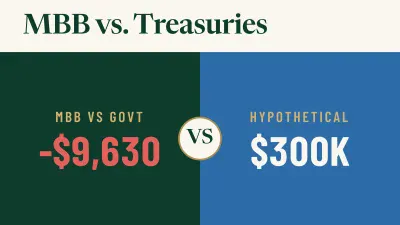
Say you held a hypothetical $300,000 in the iShares MBS ETF (NASDAQ:MBB) through 2020. You would have finished the year $9,630 behind an investor who put the same money in plain Treasuries through the iShares U.S. Treasury Bond ETF (NYSEARCA:GOVT). Both funds hold government-linked bonds, and rates fell sharply that year. The Treasury fund rode the rally. The mortgage fund saw homeowners refinance its gains away.
A Tiny Fee Hid a Much Bigger 2020 Bill
MBB charges a net expense ratio of 0.04%, according to its June 29, 2026 prospectus. That works out to $4 per year per $10,000 invested, or $120 a year on $300,000. The fee is minimal. The real cost sits in how mortgage bonds behave when rates fall.
From December 31, 2019 to December 31, 2020, with dividends reinvested, MBB returned 4.08%. GOVT returned 7.29%. On a hypothetical $300,000, that gap was $9,630.
GOVT holds some longer-term bonds, and those bonds gain more when rates fall, prepayments or not. So check MBB against the shorter-maturity iShares 3-7 Year Treasury Bond ETF (NASDAQ: IEI). Reducing the maturity gap isolates more of the prepayment effect. IEI returned 6.95% in 2020. MBB still trailed it by $8,610 on the same $300,000. Differences in maturity and holdings explain part of that gap. Prepayments are a major reason for the rest.
How Refinancing Quietly Caps Your Gains
Picture a homeowner who locked in a mortgage when rates were higher. Rates drop. She refinances, pays off the old loan in full, and takes a new one at a lower rate. Inside MBB, the bond backed by her old mortgage gets repaid at face value. That happens right when the bond should be climbing in price, because higher-coupon bonds become more valuable as rates fall. The fund takes in the cash and must reinvest it at the new, lower rates.
Treasuries carry no such escape route. The government cannot pay them off early, so they keep their coupons and keep rising. Bond managers call this negative convexity (upside capped, downside intact).
The fund’s income tells the story. MBB’s monthly distribution fell from $0.255997 per share in February 2020 to $0.191048 by November 2020, then dropped to $0.018858 in October 2021. The records don’t break out how much of that decline came from prepayments. The pattern does match what happens when returned principal gets reinvested at lower yields.
The “government-backed” label also covers less than many holders assume. Agency support protects you if a homeowner defaults. It offers nothing when a homeowner pays off early.
Rising Rates Flip the Same Risk Against You
When rates climb, refinancing dries up. Homeowners keep their cheap loans longer, so mortgage bonds stretch out in length just as their prices fall. Analysts call this extension risk. The bonds get shorter when you want them long and longer when you want them short. The 10-year Treasury yield stood at 4.98% on October 29, 2026. If rates move down from here, the 2020 problem could come back.
A Cheaper Mirror Comes With the Same Flaw
The Vanguard Mortgage-Backed Securities ETF (NASDAQ:VMBS) charges 0.03%, or $3 per $10,000. On an adjusted basis through October 30, 2026, it gained 12.79% over ten years, against 12.2% for MBB. Over five years, the figures are 2.02% and 1.26%. VMBS holds the same kind of agency mortgage bonds, though, and returned just 3.76% in 2020. Switching to VMBS cuts the fee. It leaves the refinancing drag in place. Treasury funds like GOVT or IEI avoid prepayment risk entirely, though you give up the extra yield mortgage bonds usually pay for taking it on.
What Retirement Investors Should Ask Now
If MBB sits in your portfolio as a “safe” Treasury stand-in, ask what job you need it to do. If your bonds are there to rally when rates fall and cushion a stock selloff, 2020 offers a dated, dollar-specific answer. MBB behaves like a mortgage fund, and the gap tends to show up in the years when bond investors expect their bonds to do best.
Contact [email protected] for any questions or corrections.
Ryne Mauck is an investment writer covering exchange-traded funds, retirement planning, and portfolio strategy. Through his work at 24/7 Wall St. and other investment platforms, including Seeking Alpha, he aims to provide clear, research-driven insights that help investors make more informed decisions while maintaining a long-term approach to investing.
Ryne holds a B.Sc. in Finance and an M.A. in Political Science. He is a formerly registered Municipal Advisor Representative and has passed the Series 50, Series 63, and Series 65 exams. His articles are not intended to be, nor should they be interpreted as, financial advice.