Can a Crowded ETF Market Still Find Room for Mid-Sized Sponsors Like Global X?
Three firms already control more than half of all global ETF assets, and thousands of funds are fighting for what's left. Here's what Global X's biggest advertising push ever reveals about where the ETF industry is heading and what investors…

This post may contain links from our sponsors and affiliates, and Flywheel Publishing may receive compensation for actions taken through them.
Global X launched what it calls the largest integrated advertising campaign in its history in October 2026 — with ads running on streaming television, podcasts, social media, digital billboards, and in print and digital newspapers and magazines.
Fund companies have long sold mainly to financial advisors, so seeing ETF ads next to streaming shows tells you how hard it has become for a mid-sized fund company to get noticed. If you’re an investor nearing retirement, expect to see more fund pitches showing up on your own screens.
A New Brand, a Rebuilt Website and Ads Everywhere
As reported by citybiz, Global X combined the campaign with a redesigned website and an updated brand identity. Global X Management Company LLC said it had $93 billion in assets under management and 120 ETFs as of September 30, 2026.
The firm was founded in 2008 and first made its name with thematic funds. Those are ETFs that bundle companies linked to a single trend or idea. It has since expanded into income, commodity, international, and core funds.
Global X Management Company LLC said it spent nine months developing the brand and site. The firm said it drew on research involving more than 700 financial advisors and retail investors, more than 30 internal employees, and nearly a dozen clients.
“The brand defines our story, and the website brings it to life,” said Christopher Adams, Global X’s chief marketing officer. “Now we’re sharing them with the world by launching the most expansive integrated media campaign in our history.”
The website now has redesigned fund pages, one search bar covering both fund data and research, more detailed fund screening, and a tool for comparing funds side by side.
Three Giants Are Collecting Nearly Half of New ETF Money
Fund companies are turning to consumer-style advertising because the ETF market is packed.
ETFGI counted a record 1,397 new ETF products listed worldwide through the end of May 2026. By the end of September, ETFGI said the global industry included 17,989 ETFs from 1,076 providers.
Meanwhile, the money keeps piling up at the top. ETFGI said iShares, Vanguard and State Street SPDR together managed $13.93 trillion at the end of September 2026, or 58.3% of global ETF assets.
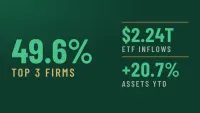
ETFGI also reported that those three gained $1.11 trillion in net new assets this year through September, which was 49.6% of total global ETF inflows.
When nearly half of new money goes to three firms and thousands of funds fight over the rest, smaller sponsors have every reason to go straight to investors instead of waiting for an advisor to bring them up. Global X itself said the goal is to strengthen its digital presence and increase awareness of its investment platform.
Four Questions to Ask Before an ETF Ad Moves Your Money
An ad can tell you a fund exists. It can’t tell you whether that fund belongs in your portfolio, and that matters most when you’re close to retirement and protecting savings you can’t easily rebuild.
- What does it hold? Read the top holdings. A catchy theme can turn out to be a handful of large stocks you may already own.
- What does it cost? Check the expense ratio, the annual fee taken out of fund assets. Specialized funds often charge more than broad index funds.
- How big and liquid is it? Small, lightly traded funds can have wider gaps between buying and selling prices, and they’re more likely to shut down.
- Does it duplicate what you own? Compare it with the funds you already have. Two ETFs with different names can hold many of the same companies.
Each of those answers is on the fund’s fact sheet and in its prospectus, the legal document that spells out a fund’s strategy, costs, and risks. None of it fits in a 30-second spot.
Contact [email protected] for any questions or corrections.
Ryne Mauck is an investment writer covering exchange-traded funds, retirement planning, and portfolio strategy. Through his work at 24/7 Wall St. and other investment platforms, including Seeking Alpha, he aims to provide clear, research-driven insights that help investors make more informed decisions while maintaining a long-term approach to investing.
Ryne holds a B.Sc. in Finance and an M.A. in Political Science. He is a formerly registered Municipal Advisor Representative and has passed the Series 50, Series 63, and Series 65 exams. His articles are not intended to be, nor should they be interpreted as, financial advice.