DraftKings Plunges After Cutting Its Outlook. Here’s Which ETFs Feel It Most
A brutal earnings miss sent DraftKings spiraling, but most retirement portfolios will barely notice. One narrow thematic fund could take a far deeper hit, and a bet on prediction markets explains why the damage may not be over.

This post may contain links from our sponsors and affiliates, and Flywheel Publishing may receive compensation for actions taken through them.
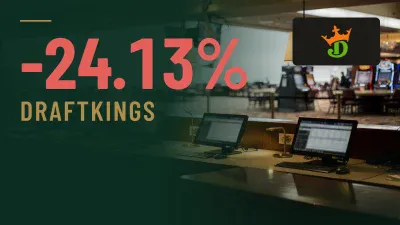
DraftKings (NASDAQ:DKNG | DKNG Price Prediction) shares fell 24.13% in today’s regular session and traded at $17.85 as of 1:08 PM ET. The company missed estimates on both earnings and revenue and cut its full-year outlook. The Wall Street Journal reported that DraftKings is pouring more money into prediction markets. Rivals Flutter Entertainment (NYSE:FLUT) and Penn Entertainment (NASDAQ:PENN) also fell. For ETF investors, the real question is the extent to which this damage reaches their funds.

Double Miss and a Sharply Lower Profit Outlook
Third-quarter adjusted EPS came in at -$0.53, against a consensus estimate of -$0.19. Revenue of $1.33 billion missed the $1.40 billion estimate, though it still grew 16.2% year over year. The adjusted EBITDA loss widened to $316.9 million from $126.5 million, as sales and marketing expense rose to $605.7 million from $360.4 million.
Full-year 2026 revenue guidance fell to $6.35 billion to $6.55 billion from $6.50 billion to $6.90 billion. Adjusted EBITDA guidance dropped to $175 million to $275 million from $700 million to $900 million.
The driver is DraftKings Predictions, a federally regulated event-contract trading product under CFTC oversight. Customers buy contracts linked to yes-or-no outcomes of sports and other events. DraftKings spends heavily up front to acquire these customers, and new-customer promotions are expected to offset most gross revenue, leaving Predictions revenue immaterial in 2026. The costs land now, and the return comes later. Predictions investment for 2026 is now $650 million to $700 million. CEO Jason Robins said, “We expect our 2026 cohort to pay back in approximately 20 months, well below our two-year payback target.”
Management also introduced 2027 targets of $7.35 billion to $7.75 billion in revenue and $800 million to $1.0 billion in adjusted EBITDA.
Today’s drop added to a long slide. DraftKings traded at $24.69 after its first-quarter report and $21.43 after the second, and the stock is now down 48.2% year to date.

Which ETFs Hold Enough DraftKings to Matter
| Fund | DraftKings Weight | Holdings As Of |
|---|---|---|
| Roundhill Sports Betting & iGaming ETF | 6.60% | June 30, 2026 |
The Roundhill Sports Betting & iGaming ETF (CBOE:BETZ) is where this move hits hardest. DraftKings made up about 6.6% of net assets as of June 30, behind Flutter at 7.54%. Penn added another 4.28%. Together, those three U.S.-listed operators accounted for about 18.4% of the fund on that date.
The fund was down 4.89% as of 1:14 PM ET. A rough estimate, based on the June 30 weight, puts DraftKings’ direct contribution at about 1.6 percentage points. The actual figure is likely somewhat smaller, since the stock has fallen since that holdings date. The rest of the decline suggests that selling spread across the fund’s peer holdings. The fund was already down 22.07% year to date.

Broad index holders barely feel this. With a market cap of about $8.90 billion, DraftKings is a tiny fraction of any total-market or large-cap index fund that spreads assets across hundreds or thousands of companies. Even a 24% drop barely shows up at the portfolio level for a typical retirement index fund.
Concentration Risk Hits Narrow Thematic Funds Hardest
A niche fund holds the same small group of companies that tend to react to the same news. When the sector’s largest player reports bad numbers and its peers fall in sympathy, the losses stack up inside a fund like the Roundhill Sports Betting & iGaming ETF instead of canceling each other out. A broad index has hundreds of unrelated holdings to absorb the hit. A thematic fund does not.
Overlap matters too. Investors who own DraftKings shares directly and also hold a gaming ETF carry more exposure to this single name than either position suggests on its own. A careful review of fund holdings, with attention to each report date, gives a cleaner picture of true concentration.
What Comes Next for DraftKings Holders
Management guided fourth-quarter Predictions investment to $175 million to $225 million. Regulation is the bigger variable. Robins said the company’s “Base Case Forecast is a mid-year 2028 Supreme Court ruling,” and added that “if there’s an early negative signal, we might actually pull back on some of that investment.” Thematic fund holders should watch for any regulatory update, since it would likely move the fund’s largest holdings together.
Contact [email protected] for any questions or corrections.
Ryne Mauck is an investment writer covering exchange-traded funds, retirement planning, and portfolio strategy. Through his work at 24/7 Wall St. and other investment platforms, including Seeking Alpha, he aims to provide clear, research-driven insights that help investors make more informed decisions while maintaining a long-term approach to investing.
Ryne holds a B.Sc. in Finance and an M.A. in Political Science. He is a formerly registered Municipal Advisor Representative and has passed the Series 50, Series 63, and Series 65 exams. His articles are not intended to be, nor should they be interpreted as, financial advice.