Why Schwab’s SCHD Tops These 3 Dividend ETFs for Retirees Right Now
Three dividend ETFs swap stock picking for a written rulebook, and each one defines a good payer differently. One screens for strength, one for raise streaks, one for raw yield. Which rulebook protects a retirement paycheck, and which quietly invites…

This post may contain links from our sponsors and affiliates, and Flywheel Publishing may receive compensation for actions taken through them.
Building a dividend portfolio one stock at a time means reading balance sheets, tracking payout ratios, and deciding when a high yield signals trouble. For investors at or near retirement, three ETFs hand that work to a written rulebook: Schwab US Dividend Equity ETF (NYSEARCA: SCHD), ProShares S&P 500 Dividend Aristocrats ETF (CBOE: NOBL) and State Street SPDR Portfolio S&P 500 High Dividend ETF (NYSEARCA: SPYD).
Each one answers a different question. SCHD asks which payers are financially strongest. NOBL asks which companies have raised dividends the longest. SPYD asks which S&P 500 stocks yield the most. A rules-based fund never gets attached to a favorite holding. When a company fails the screen, it leaves at the next review, which is the discipline most individual investors struggle to apply to their own picks. These three funds all pay quarterly.
Schwab’s Quality Filter Earns the Top Spot for Most Retirees
SCHD tracks the Dow Jones U.S. Dividend 100 Index. The rules require at least 10 consecutive years of dividend payments, then rank survivors on a blend of four measures: cash flow relative to debt, return on equity, dividend yield, and five-year dividend growth. In plain terms, a company must pay a solid dividend and show it can afford to keep paying. The index excludes REITs and is reconstituted once a year, with weights adjusted quarterly.
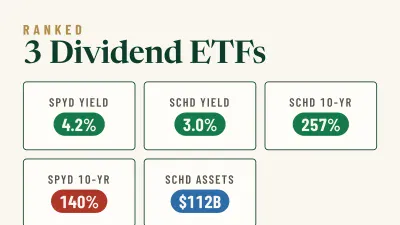
That combination makes SCHD the strongest all-around choice here. The fund yields roughly 3.0% on trailing payouts, and its fee sits among the lowest in the dividend ETF category. Scale helps too: net assets stand near $112 billion, so trading costs are minimal.
The payout is also edging higher. The most recent quarterly distribution was about 27 cents per share, up from roughly 26 cents in the same quarter a year earlier. Over 10 years, the adjusted return reached 257%, the best of the three.
The tradeoff is concentration. SCHD holds about 100 stocks, yet its 10 largest positions account for roughly 42% of assets. Merck, Amgen and Abbott Laboratories each sit near 5%, and Chevron and ConocoPhillips add a meaningful energy stake. A rough stretch for drugmakers or oil prices will show up quickly in the fund’s results.
NOBL Rewards Only Companies With 25-Year Raise Streaks
NOBL takes the slowest, most conservative approach. To qualify, a company must belong to the S&P 500 and have increased dividends for at least 25 consecutive years. Any company that cuts or freezes its payout drops out at the annual review. Each holding gets an equal weight, adjusted quarterly, so no single name dominates.
That equal weighting produces a distinct portfolio. Every position sits between roughly 1% and 2% of assets, with FactSet Research Systems the largest at about 1.8%. The roster leans toward industrial distributors such as W.W. Grainger and Fastenal, household brands like Clorox and Colgate-Palmolive, and materials names including Sherwin-Williams and Nucor. These are businesses that grow their payouts steadily over time.
The income profile is the catch. Trailing distributions work out to about 3.0%, but recent checks have declined. The September payment of about 28 cents per share compares with roughly 66 cents in an earlier quarter. Annualizing the latest payment implies a yield closer to 1.9%.
Retirees who budget around a predictable quarterly check should expect uneven deposits from this fund. Its 10-year adjusted return of 186% trails SCHD, which shows what a long raise streak alone can deliver.
SPYD Delivers the Biggest Check, With No Quality Gate
SPYD is the contrarian pick on this list, because its rules are the bluntest. The index takes the 80 highest-yielding securities in the S&P 500 and weights them equally, refreshing the list twice a year. It applies no balance-sheet test and no growth requirement.
The return is income. SPYD yields about 4.2% on trailing distributions, the highest of the three, and its fee is as low as SCHD’s. Its quarterly payments also run steadier than NOBL’s, ranging from roughly 42 cents to 55 cents across the four quarters of 2025.
The portfolio looks very different from the other two. Real estate and utilities carry heavy weight, with Simon Property Group, Host Hotels & Resorts, Edison International, and Duke Energy all in the mix. Iron Mountain was the largest holding at roughly 1.6%. Those sectors are sensitive to interest rates, so SPYD tends to lag when rates rise.
A key risk is that because the screen ignores financial health, a stock whose yield is high only because its price collapsed can still get in. Names such as Viatris and CVS Health appear in the portfolio for exactly that reason (we laid out the seven warning signs that a big yield is about to be cut here: Dividend Traps). SPYD’s 10-year adjusted return of 140% is the lowest here, which is the cost of taking more income up front.
Why Vanguard’s Dividend Fund Missed the Cut
The Vanguard High Dividend Yield ETF (NYSEARCA: VYM) is popular, but it weights hundreds of stocks by market value. Its largest companies dominate the fund, so it behaves much like a broad large-cap fund with a modest yield boost. The three funds above each apply a sharper rule and give investors a clearer choice.
Match the Rulebook to Your Income Goal
Start with what you need the money to do.
- Dependable income that grows, at a low fee: SCHD’s quality screen fits most retirees best. Its one-year adjusted return of 38% led the group, and it pays a mid-range yield. The key question is how much healthcare and energy exposure fits your portfolio.
- Steadiness and a long record of raises: NOBL suits investors who still have years before they draw down their savings and value staying power over current yield. It works best alongside other income sources, since its distributions swing from quarter to quarter.
- The largest check right away: SPYD gives retirees the most income per dollar invested. In exchange, they accept interest-rate risk and the chance that some holdings are high-yielding because they’re in trouble.
Some income investors combine approaches, pairing a quality screen with a higher-yield screen to balance growth and current income. Whichever rulebook you choose, check the fund’s sector weights after each annual review. Those changes show where the rules are taking your money next.
Contact [email protected] for any questions or corrections.
Lee Jackson has covered Wall Street analysts' equity and debt research and equity strategy daily for 24/7 Wall St. since 2012. His broad, diverse career, including a stint as creative services director at an NBC affiliate in Austin, Texas, gives him unique insight into the financial industry.
Lee Jackson's journey in the financial industry spans more than 30 years, including nearly two decades as an institutional equity salesperson at Bear Stearns, Lehman Brothers, and Morgan Stanley. His career spanned pivotal sell-side Wall Street events, from the dot-com rise and bubble to the Long-Term Capital Management debacle, 9/11, and the Great Recession of 2008. This reflects his resilience and adaptability amid market volatility.
Lee Jackson’s practical financial industry experience, gained through a career at some of the biggest banks and brokerage firms, is complemented by a lifetime of writing across various platforms. This unique combination allows him to shed light on the intricacies of Wall Street in a way only someone with deep insider experience and knowledge can. Moreover, his extensive network across Wall Street continues to provide direct access for him and 24/7 Wall St., a privilege few firms enjoy.
Since 2012, Jackson’s work for 24/7 Wall St. has been featured in Barron’s, Yahoo Finance, MarketWatch, Business Insider, TradingView, Real Money, The Street, Seeking Alpha, Benzinga, and other media outlets. He attended the prestigious Cranbrook Schools in Bloomfield Hills, Michigan, and has a degree in broadcasting from the Specs Howard School of Media Arts.