3 Dividend ETFs Retirees Can Buy Before the End of November for Hands-Off Income

This post may contain links from our sponsors and affiliates, and Flywheel Publishing may receive compensation for actions taken through them.

A retiree who put $100,000 into dividend ETFs over the past year could have collected very different amounts of income depending on which fund they chose. Trailing distributions work out to roughly $8,331 per $100,000 for the JPMorgan Equity Premium Income ETF (NYSEARCA:JEPI), about $3,070 for the Schwab U.S. Dividend Equity ETF (NYSEARCA:SCHD) and about $2,367 for the Vanguard High Dividend Yield ETF (NYSEARCA:VYM).
Retirees have to choose between bigger income now and income that grows later. SCHD is built to raise its payout over time. VYM spreads money across hundreds of large-cap U.S. stocks, and JEPI generates its yield by selling options. All three are hands-off, but each one comes with a different trade-off. Prices also slipped over the past week: SCHD fell 4% over the past week, VYM 6% and JEPI 6%.
SCHD: Income That Gets a Raise
SCHD tracks the Dow Jones U.S. Dividend 100 Index. That index screens for long payout records, cash flow relative to debt, return on equity and yield, and the screen is the reason the fund works for retirees. Companies that pass it usually have the balance sheets to keep raising their dividends, and those increases flow straight through to your quarterly check.
Annual distributions rose 194% from 2013 to 2023 and 31% from 2020 to 2023, both measured before the fund’s 2024 share split reset the per-share amounts. Inflation erodes a fixed payout over 20 years of retirement, so a growing one matters.
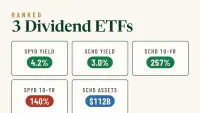
Today the fund pays $1.05 per share over the trailing 12 months on a price near $34, a yield of about 3.1%. The September payout of 27 cents came in above June’s 25 cents.
The portfolio holds about $112 billion[1] in net assets, and Merck (NYSE:MRK | MRK Price Prediction) is its biggest holding at roughly 5%[2]. Drugmakers, consumer staples and oil producers dominate the top of the list. The fund also delivered growth: an adjusted 32% return over the past year.
Trade-off: The sector tilts are heavy, so a bad year for energy or pharma hits SCHD harder than a broad fund. Dividend growth has also stalled lately. The first three 2026 payouts were roughly level with the same quarters of 2025.
VYM: The Overlooked Pick With Hidden Growth
Most retirees go straight to SCHD, so VYM gets less attention than it deserves. Its benchmark, the FTSE High Dividend Yield Index, ranks stocks by above-average estimated yield and excludes REITs. There’s no quality screen, so the fund owns any large company paying above-average dividends. That includes big banks and chipmakers that SCHD’s filters can leave out.
Broadcom (NASDAQ:AVGO) makes up about 7%[3] of the fund. That tech exposure helps explain VYM’s adjusted five-year return of 65%, ahead of SCHD’s 58%. Despite the “High Dividend” name, VYM’s trailing yield is only about 2.4%, below SCHD’s.
The payout still grows, just more slowly. Annual distributions rose 13% from 2021 to 2025, and the fund manages about $99 billion[4]. Quarterly amounts move around: September’s 89 cents was lower than June’s 98 cents.
Trade-off: VYM pays the least current income of the three. Its Broadcom weighting also means a semiconductor downturn would cut into the principal of a fund many retirees treat as a defensive holding.
JEPI: Monthly Checks Funded by Options Buyers
JEPI holds an actively managed, low-volatility portfolio of large-cap stocks. The fund adds equity-linked notes that copy a covered-call strategy on the S&P 500. Selling call options brings in premium, and that premium rises when markets get jumpy, and much of the payout comes from options buyers rather than corporate profits, and JEPI pays it out monthly.
The trailing distribution of $4.56 per share on a price near $55 works out to a yield of roughly 8.3%. The expense ratio is 0.35%[5], the highest of the three, which is the cost of active management.
The payout changes every month. Recent payments ran from 34 cents to 54 cents, so the best month paid 58% more than the weakest. November’s distribution was 35 cents, near the low end. If you’re paying fixed monthly bills from JEPI, budget around the smaller checks.
Trade-off: Selling calls caps your profits in a rally. JEPI returned an adjusted 5% over the past year, while SCHD returned 32%. Much of the options income is also taxed as ordinary income, so the fund works best in an IRA. JPMorgan’s Nasdaq-focused sibling pays even more, but it’s concentrated in tech and its premium swings more, so it isn’t a good fit for hands-off retirement income.
Which Fund Fits Your Retirement
For most retirees, SCHD offers the strongest balance of current income and payout growth, combining a mid-range yield with the longest record of payout growth. Your choice should depend on how long the money needs to last and how much income you need right now.
1. Early retirees with a 20-year or longer horizon: SCHD. A growing payout protects your purchasing power, and its quality screens tilt toward companies that can keep raising dividends through a recession.
2. Retirees who want one broad fund: VYM. You get lower income today in exchange for wider diversification and more tech and financial growth, which can help your principal keep pace with spending.
3. Older retirees who need cash now: JEPI, ideally inside an IRA. Its monthly checks are roughly $8,331 a year per $100,000, but you give up most of the upside in strong markets.
4. Retirees who want a mix: Combining JEPI for spending money with SCHD for growth balances both goals. You get cash flow now from the options income and a rising dividend for later.
Over the next few months, check SCHD’s December distribution to see whether its dividend growth picks up again. With JEPI, track how its monthly payout changes as market volatility rises or falls.
Contact [email protected] for any questions or corrections.
Joel South covers large-cap stocks, dividend investing, and major market trends, with a focus on earnings analysis, valuation, and turning complex data into actionable insights for investors.
He brings more than 15 years of experience as an investor and financial journalist, including 12 years at The Motley Fool, where he served as an investment analyst, Bureau Chief, and later led the Fool.com investing news desk. He has also co-hosted an investing podcast and appeared across TV and radio discussing market trends.