Vanguard Has an ETF That Chases Winning Stocks on Purpose. Most VOO Owners Have Never Heard of VFMO

This post may contain links from our sponsors and affiliates, and Flywheel Publishing may receive compensation for actions taken through them.
If you own the Vanguard S&P 500 ETF (NYSEARCA:VOO), you hold one of the best-known low-cost funds in the country. It charges a 0.03% expense ratio and owns the S&P 500 in proportion to each company’s size. Vanguard also runs a fund built on a very different idea. The Vanguard U.S. Momentum Factor ETF (CBOE:VFMO) buys the stocks that have been winning, and does it on purpose. In 2026, it has slightly outpaced VOO while holding a very different portfolio.
What Momentum Investing Means for Your Money
Momentum investing means buying stocks that have recently outperformed, on the theory that winners keep winning for a while. Trends often continue because investors and analysts adjust their views slowly. A momentum fund tries to ride those trends and moves on once a stock’s relative strength fades.
VFMO belongs to Vanguard’s range of actively managed ETFs. Its managers use a quantitative methodology to evaluate U.S. companies of all sizes, then apply a rules-based screen to keep the portfolio diversified and limit exposure to thinly traded stocks. Its benchmark is the Russell 3000, but it owns a much smaller slice of that universe.
How VFMO’s Portfolio Reaches Where VOO Can’t
VOO weights its holdings by market cap, so the largest companies get the biggest share of every dollar you invest. VFMO weights holdings by its own model, and it reaches well past the mega caps. In its August 31, 2026 portfolio filing, the larger positions included Fortinet (NASDAQ:FTNT | FTNT Price Prediction) at 0.88% of net assets and Advanced Micro Devices (NASDAQ:AMD) at 0.83%. Alongside them sat small companies such as AXT Inc (NASDAQ:AXTI) at 0.16%, plus a long list of small biotech and technology names.
No single stock dominates. The portfolio includes semiconductors, health care, biotechnology, financials, industrials, energy, transportation, consumer companies, and aerospace. Net assets reached $1.92 billion as of August 31, up from $1.84 billion at the end of May.
Performance Shows Bigger Swings in Both Directions
The two funds are compared on an adjusted-price basis through November 12, 2026:
| Period | VFMO | VOO |
|---|---|---|
| One week | 7.27% | 3.27% |
| One month | -5.43% | -2.68% |
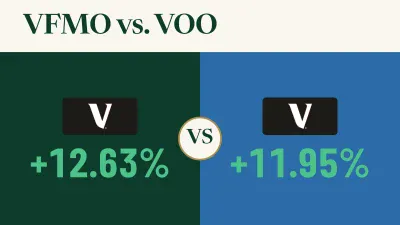
| Year to date | 12.63% | 11.95% |
| One year | 12.24% | 12.07% |
| Five years | 60.01% | 73.77% |
VFMO has inched ahead this year and over the past 12 months, while VOO holds a clear lead over five years. Since February 15, 2018, VFMO has gained 200.53%. VFMO’s one-week gain was more than double VOO’s, and its one-month loss was roughly twice as deep.
On cost, VOO charges just 0.03%, while VFMO’s fee is quite low for active management (0.13%).
Risks Retirees Should Weigh Before Adding Momentum
Momentum strategies can reverse sharply when market leadership changes. When last year’s winners suddenly fall out of favor, a momentum fund holds them at full weight until its model moves them out. Turnover is built into the design, since the portfolio must keep replacing fading leaders with new ones as market leadership shifts. The fund’s small-company exposure adds another layer of volatility.
Why Most Vanguard Investors Have Never Heard of VFMO
Vanguard built its reputation on indexing, and VFMO asks that same audience to trust active stock selection. Its own analysts acknowledge that, after decades of advocating the opposite, convincing investors that some managers can beat the market remains a challenge. The fund also has a shorter track record, with trading history going back to 2018, and it lists on Cboe instead of the exchanges where most of Vanguard’s main ETFs trade. At roughly $1.92 billion in net assets, it is tiny next to VOO.
Who VFMO Fits as a Complement to VOO
Some investors use VFMO as a small satellite position next to a core VOO holding. It suits investors with a long horizon for part of their portfolio who want exposure to mid and small caps that VOO leaves out, and who can sit through sharp monthly declines without selling. Chasing strength works best with safety rails, the ten rules we laid out in a free breakout guide on buying at new highs without one bad trade wrecking the account.
Its design may be a weaker match for retired people drawing regularly from their portfolio, anyone who needs predictable returns, and investors who want the lowest possible fee. For them, VOO’s simplicity remains hard to improve on.
Going forward, track VFMO’s next quarterly holdings filing to see where the model moves. Also watch whether its slim one-year lead over VOO holds if market leadership shifts away from today’s winners.
Contact [email protected] for any questions or corrections.
Ryne Mauck is an investment writer covering exchange-traded funds, retirement planning, and portfolio strategy. Through his work at 24/7 Wall St. and other investment platforms, including Seeking Alpha, he aims to provide clear, research-driven insights that help investors make more informed decisions while maintaining a long-term approach to investing.
Ryne holds a B.Sc. in Finance and an M.A. in Political Science. He is a formerly registered Municipal Advisor Representative and has passed the Series 50, Series 63, and Series 65 exams. His articles are not intended to be, nor should they be interpreted as, financial advice.