QQQ Paid a $300,000 Holder $1,524 in Dividends Over the Past Year While VYM Paid $7,164

This post may contain links from our sponsors and affiliates, and Flywheel Publishing may receive compensation for actions taken through them.
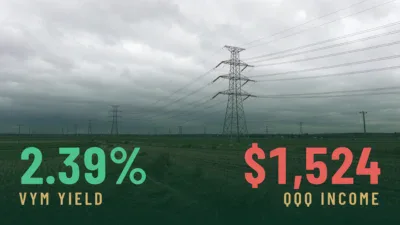
Consider a retiree with a hypothetical $300,000 in the Invesco QQQ Trust (NASDAQ:QQQ). Over the past year, that position paid $1,524 in dividends. The same money in the Vanguard High Dividend Yield ETF (NYSEARCA:VYM) paid $7,164. If you count on a portfolio to pay for groceries and utilities, that gap decides how the money reaches you. Either it shows up on its own, or you have to sell shares to get it.
How Much Cash Each Fund Actually Paid
QQQ made four quarterly payouts with ex-dates (the cutoff for getting a dividend) from December 22, 2025 through September 21, 2026. Together, they came to $3.0918 per share. At its $608.45 price as of November 20, 2026, that works out to a trailing yield of 0.51%, or $1,524 on a hypothetical $300,000.
VYM’s last four payouts, with ex-dates from December 19, 2025 through September 18, 2026, totaled $3.6755 per share. At its $153.92 price on November 20, 2026, that is a 2.39% trailing yield, or $7,164 on the same $300,000. These figures are the funds’ past payments. They do not promise future income, and both will change as share prices move and as companies raise or cut their dividends.
Why QQQ’s Index Ignores Dividends
QQQ aims to track the Nasdaq-100 Index. Invesco’s prospectus says the index holds 100 of the largest domestic and international non-financial companies listed on U.S. Nasdaq-affiliated listing exchanges based on market capitalization. Size decides which companies get in. Dividends play no part. The fund’s two largest positions on June 30, 2026[1] were NVIDIA (NASDAQ:NVDA | NVDA Price Prediction) and Apple (NASDAQ:AAPL).
Many technology companies put their earnings back into research, chip production, and data centers instead of paying them out. That leaves QQQ with little cash to hand to its holders. VYM takes the opposite approach. Vanguard says the fund tracks common stocks of U.S. companies that have paid above-average dividends for the previous 12 months, excluding REITs (real estate investment trusts). As of July 31, 2026[2], its holdings included banks, energy producers, healthcare companies, consumer staples, utilities and industrials.
Selling Shares to Fill the Gap
If you want QQQ to produce the same cash as VYM, your only option is to sell shares. That makes income a decision you face again and again. You pick when to sell and how many shares. In a taxable account, you also decide how much capital gain to take. Every sale leaves fewer shares to grow in the future, and some sales will happen while the market is falling.
This month showed how that plays out. QQQ fell 10.51% in the week ending November 20, 2026, and 16.1% over the past month. Anyone who needed cash that week would have sold at those lower prices. VYM fell too, losing 6.7% over the same week. Its holders, though, get their quarterly dividends without having to sell anything.
One Year of Total Return in Context
Total return (price change plus distributions) fills in the rest. From November 20, 2025 to November 20, 2026, QQQ returned 3.89%, and VYM returned 13.88%. Over that stretch, VYM came out ahead on both income and total return.
A single year is a short period, though. Growth funds have beaten dividend funds in other periods. QQQ’s focus on fast-growing companies can pay off for an investor who doesn’t need cash today. Which fund fits better comes down to one thing: do you need income now, or growth over decades?
A Cost Hiding in Plain Sight
QQQ charges no extra fee for its low income. Its yield is public, and Invesco reports every distribution. The cost falls on retirees who assume that a fund this popular, with more than $490 billion[1] in net assets as of June 30, 2026, must produce real income. A fund’s size and popularity tell you nothing about what it pays out. The same caution applies to VYM, whose income can drop when its companies cut dividends.
Questions to Ask Before Counting on QQQ for Income
Before you rely on any fund to cover living expenses, look up two numbers. One is its trailing yield. The other is the dollars it actually paid over the past year. The harder question comes next. Are you comfortable selling shares to make up the shortfall, even in a month like this one?
Contact [email protected] for any questions or corrections.
Ryne Mauck is an investment writer covering exchange-traded funds, retirement planning, and portfolio strategy. Through his work at 24/7 Wall St. and other investment platforms, including Seeking Alpha, he aims to provide clear, research-driven insights that help investors make more informed decisions while maintaining a long-term approach to investing.
Ryne holds a B.Sc. in Finance and an M.A. in Political Science. He is a formerly registered Municipal Advisor Representative and has passed the Series 50, Series 63, and Series 65 exams. His articles are not intended to be, nor should they be interpreted as, financial advice.