If You’ve Banked $1 Million By 45, Is It Possible to Retire?
It's safe to say that nearly everyone hopes to have a solid savings and retirement account by the time they turn 45. The dream is to retire early enough to truly enjoy the years ahead. If you can set aside…

This post may contain links from our sponsors and affiliates, and Flywheel Publishing may receive compensation for actions taken through them.

It’s safe to say that nearly everyone hopes to have a solid savings and retirement account by the time they turn 45. The dream is to retire early enough to truly enjoy the years ahead. If you can set aside $1 million by this age, the logical next question is whether you actually should and can step away from work for good.
For followers of the FIRE movement (financial independence, retire early), that question comes down to a few concrete factors: lifestyle expectations, cost of living, and how much you can realistically spend each year without depleting your nest egg too soon. The math is both clarifying and humbling once you run the numbers honestly.
How Much Can You Spend?
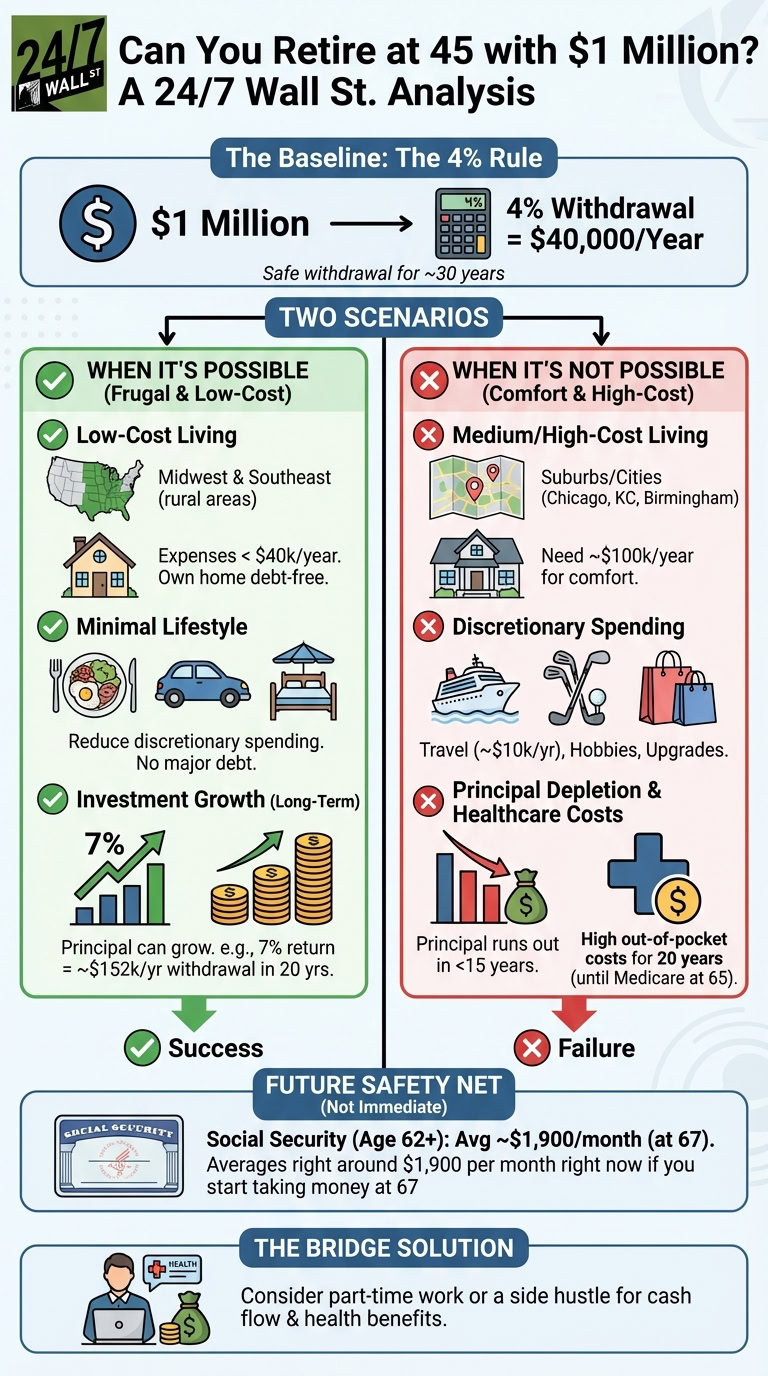
Most people pursuing early retirement use the 4% safe withdrawal rule as their starting benchmark. Applied to a $1 million portfolio, that works out to $40,000 per year. The original research was developed by financial planner Bill Bengen in 1994 and later validated by the Trinity Study. Both found that a 4% inflation-adjusted withdrawal survived every 30-year historical period tested. In his 2025 book A Richer Retirement, Bengen updated his analysis and concluded that 4.7% represents the historical “worst-case” floor (what he calls SAFEMAX) for a 30-year retirement, meaning a retiree with $1 million could spend up to $47,000 per year in most scenarios. For someone retiring at 45, though, the horizon stretches 45 to 50 years rather than 30, and many researchers now recommend a more conservative 3% to 3.5% to guard against that longer runway.
The other lifeline to keep in mind is Social Security. You can begin claiming as early as age 62, though waiting until full retirement age (67 for those born in 1960 or later) maximizes your monthly check. The average monthly retirement benefit for a retired worker reached approximately $2,088 as of August 2026, according to the Social Security Administration. That supplement changes the math considerably once it kicks in, but it still leaves a multi-decade gap to bridge on savings alone. A person who stops working at 45 will accumulate far fewer than the 35 years of earnings the SSA uses to calculate benefits, which can meaningfully reduce the eventual payout below that average.
Knowing that $40,000 is your annual ceiling ahead of Social Security forces some hard choices about where and how you live.
How It’s Possible To Retire
Retiring on $40,000 a year is achievable, but it requires choosing a low-cost state and a low-cost corner of that state. The Midwest and Southeast (South Florida excluded) have historically offered the most breathing room on this budget. In rural or small-city parts of Kansas, Iowa, and Illinois, total annual expenses can fall comfortably below that $40,000 ceiling.
Portfolio growth is the bright side of this picture. If your $1 million stays invested, it keeps compounding even as you draw it down. At a 7% annualized return, $1 million grows to just under $4 million over 20 years. That expansion means a larger principal base, more income-generating capacity, and a cushion against the unexpected. The key assumption is that your return exceeds your withdrawal rate, so the principal grows rather than shrinks over time.
Getting there demands genuine lifestyle discipline. Regular restaurant dinners, multiple annual vacations, and frequent car upgrades are likely off the table. Carrying debt, whether credit card balances, car loans, or a mortgage, makes this budget nearly impossible to sustain. Arriving at 45 with a paid-off home and a $1 million portfolio gives you the strongest possible foundation for making early retirement work.
When It’s Not Possible to Retire
The 4% rule’s $40,000 ceiling leaves almost no room to upgrade to a medium-cost location. Even the suburbs of mid-tier cities like Chicago, Kansas City, or Birmingham, Alabama push comfortable annual expenses well above that threshold. A realistic budget for those areas runs closer to $100,000 a year, which would exhaust a $1 million portfolio in 15 years or fewer, well before Social Security eligibility and long before Medicare begins at 65.
Healthcare is the largest hidden threat in any early retirement plan. For someone leaving the workforce at 45, there are 20 years of private insurance costs before Medicare coverage begins. An Urban Institute estimate puts average marketplace premiums for a 64-year-old at roughly $1,081 per month, and rates climb with age. The burden intensified sharply in 2026 after the enhanced premium tax credits introduced in 2021 expired at the end of 2025. According to the Kaiser Family Foundation, that expiration caused average net premium payments for subsidized marketplace enrollees to more than double, with average annual costs rising from roughly $888 to about $1,904. Starting coverage at 45 means those compounding costs accumulate for two full decades before Medicare eligibility arrives. Fidelity’s 2026 Retiree Health Care Cost Estimate found that a 65-year-old retiring this year may need $185,500 in after-tax savings just to cover healthcare costs from that point forward. That figure jumped 7.5% from the prior year’s estimate of $172,500, the steepest annual increase in recent years, and an early retiree faces substantial pre-Medicare expenses on top of it.
Discretionary spending compounds the problem. Travel alone can run $10,000 or more per year, consuming 25% of the $40,000 safe withdrawal before a single housing or grocery bill is paid. Add in hobbies, occasional larger purchases, or any lifestyle upgrades, and the math unravels quickly.
One practical middle ground is part-time work or a side business. Even modest earned income of $15,000 to $20,000 a year meaningfully reduces the pressure on the portfolio and, in many cases, can provide access to employer-sponsored health coverage. Closing even part of that coverage gap is the single most powerful lever for making early retirement sustainable between age 45 and Medicare eligibility.
Editor’s note: The Social Security average monthly benefit figure was updated to $2,088 (August 2026, per the SSA’s August Monthly Statistical Snapshot), the Urban Institute marketplace premium figure for a 64-year-old was clarified to $1,081 per month (the source’s actual figure), context was added on Bengen’s 4.7% as a worst-case SAFEMAX floor rather than a typical withdrawal target, and Fidelity’s 2026 healthcare cost figure of $185,500 was noted as the steepest annual increase (7.5%) in recent years.
Contact [email protected] for any questions or corrections.
David Beren has been a Flywheel Publishing contributor since 2022. Writing for 24/7 Wall St. since 2023, David loves to write about topics of all shapes and sizes. As a technology expert, David focuses heavily on consumer electronics brands, automobiles, and general technology. He has previously written for LifeWire, formerly About.com. As a part-time freelance writer, David’s “day job” has been working on and leading social media for multiple Fortune 100 brands. David loves the flexibility of this field and its ability to reach customers exactly where they like to spend their time. Additionally, David previously published his own blog, TmoNews.com, which reached 3 million readers in its first year. In addition to freelance and social media work, David loves to spend time with his family and children and relive the glory days of video game consoles by playing any retro game console he can get his hands on.